
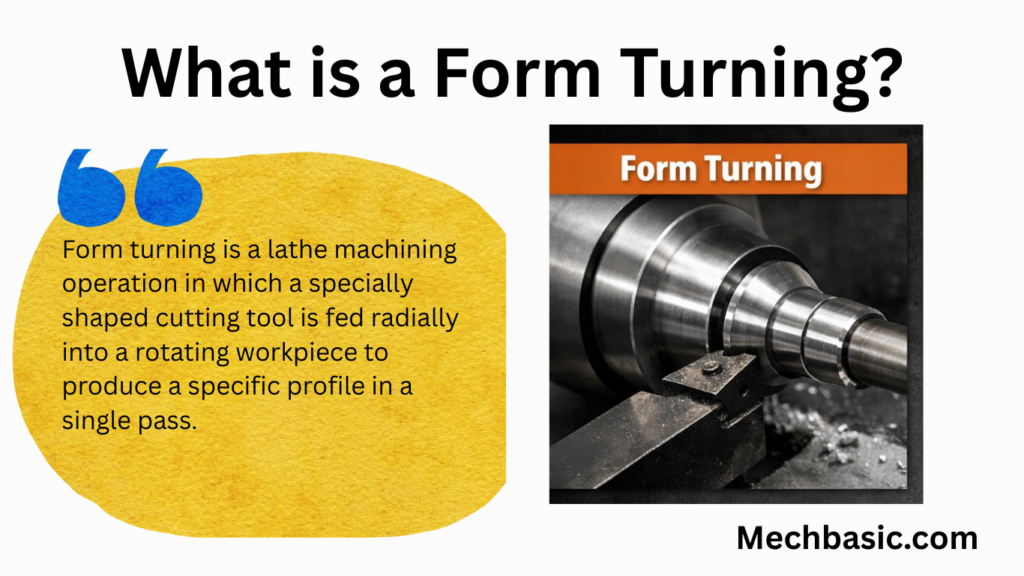
Form turning is a lathe machining operation in which a specially shaped cutting tool is fed radially into a rotating workpiece to produce a specific profile in a single pass.
The shape of the tool directly determines the shape formed on the workpiece, making this method ideal for creating contours, steps, grooves, and complex profiles quickly and accurately. Form turning is commonly used in mass production where consistent shape and reduced machining time are important.
In this article:
- Form Turning in Lathe Machining :
- 1. What is Form Turning?
- 2. Purpose of Form Turning
- 3. Principle of Form Turning
- 4. Form Tool
- 5. Setup for Form Turning
- 6. Steps in Form Turning (Manual Lathe)
- 7. Cutting Parameters
- 8. Advantages of Form Turning
- 9. Limitations of Form Turning
- 10. Applications
- 11. Defects & Remedies
- 12. Difference Between Form Turning and Profile Turning
- 13. CNC Form Turning
- Other courses:
Form Turning in Lathe Machining :
1. What is Form Turning?
Form turning is a lathe turning operation in which a specially shaped cutting tool (form tool) is fed radially into the rotating workpiece to produce a specific contour or profile in a single pass.
The shape produced on the workpiece is the mirror image of the cutting edge of the form tool.
2. Purpose of Form Turning
- To produce complex profiles quickly
- To achieve uniform shape and size
- To reduce machining time
- To enable mass production
- To maintain repeatability and accuracy
3. Principle of Form Turning
- The workpiece rotates about its axis.
- The form tool, which has the desired profile, is fed perpendicular to the workpiece axis.
- Material is removed simultaneously along the entire profile of the tool.
4. Form Tool
a) Definition
A form tool is a single-point cutting tool ground to the exact shape of the profile to be produced.
b) Types of Form Tools
- Flat Form Tool
- Used for shallow profiles
- Less cutting force
- Circular Form Tool
- Stronger cutting edge
- Used for deep or heavy profiles
c) Tool Materials
- High Speed Steel (HSS)
- Carbide tipped
- Indexable carbide inserts (CNC)
5. Setup for Form Turning
- Work holding: Chuck or collet
- Tool holding: Rigid tool post with minimum overhang
- Tool setting: Tool must be set exactly at center height
- Machine rigidity: Very important due to high cutting forces
6. Steps in Form Turning (Manual Lathe)
- Secure the workpiece in the chuck.
- Face and turn to approximate diameter.
- Mount the form tool in tool post.
- Set tool at center height.
- Select low spindle speed.
- Feed the tool radially inward slowly.
- Apply coolant to reduce heat.
- Retract tool after profile is formed.
7. Cutting Parameters
- Cutting speed: Lower than normal turning
- Feed: Slow feed (manual or power feed)
- Depth of cut: Entire profile depth in one or multiple passes
- Coolant: Essential for heat dissipation
8. Advantages of Form Turning
- High production rate
- Accurate and repeatable profiles
- Simple operation
- Ideal for batch and mass production
9. Limitations of Form Turning
- High cutting forces
- Tool design is expensive
- Not suitable for very deep profiles
- Limited flexibility (tool specific to profile)
10. Applications
- Grooves and contours
- Rounded shoulders
- Decorative profiles
- Knobs and handles
- Automotive and machine components
11. Defects & Remedies
| Defect | Cause | Remedy |
|---|---|---|
| Tool chatter | High cutting force | Reduce speed, increase rigidity |
| Poor surface finish | Blunt tool | Sharpen or replace tool |
| Tool breakage | Excess depth | Multiple passes |
| Inaccurate profile | Tool wear | Regrind or recalibrate tool |
12. Difference Between Form Turning and Profile Turning
| Form Turning | Profile Turning |
|---|---|
| Uses form tool | Uses single-point tool |
| One-pass operation | Multiple passes |
| High cutting force | Lower cutting force |
| Less flexible | Highly flexible |
13. CNC Form Turning
- Uses profiled inserts or programmed contour paths
- More accurate and flexible than manual form turning
- Suitable for complex geometries
14. Summary
Form turning is a lathe operation in which a specially shaped cutting tool is fed radially into a rotating workpiece to generate a contoured surface in one pass. It is widely used in mass production due to its accuracy and repeatability.
Other courses:





