
Ceramic molding is a precision casting process that uses a ceramic material to create the mold. The ceramic mold can withstand very high temperatures, allowing it to produce castings with excellent surface finish, fine detail, and tight dimensional accuracy.
It is commonly used for complex and high-temperature alloy components, especially in aerospace and industrial applications.
In this article:
Ceramic Moulding (Ceramic Mould Casting):
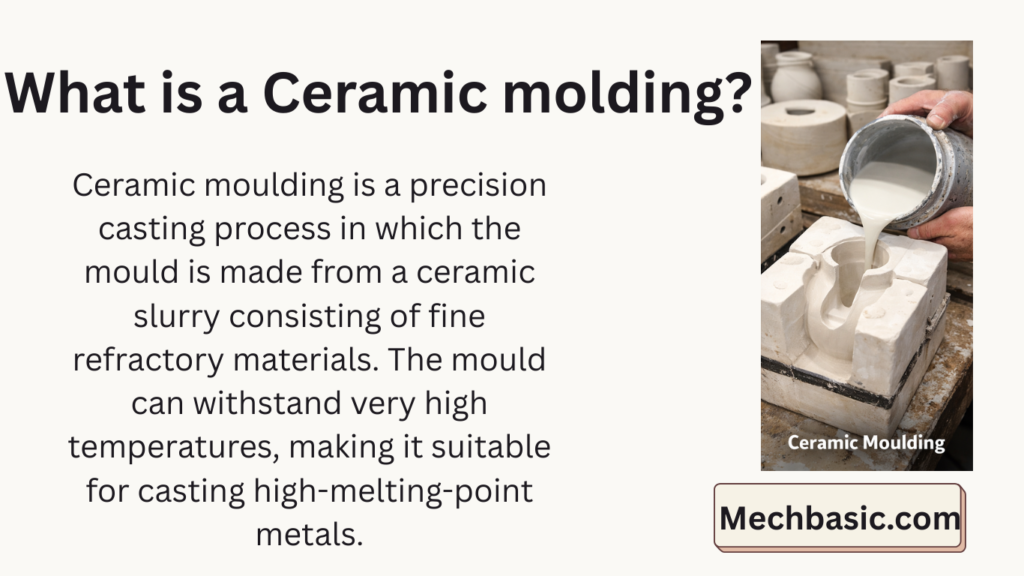
Ceramic moulding is a precision casting process in which the mould is made from a ceramic slurry consisting of fine refractory materials. The mould can withstand very high temperatures, making it suitable for casting high-melting-point metals.
👉 It combines the accuracy of investment casting with the strength of ceramic materials.
Materials Used in Ceramic Moulding
- Refractory powders:
- Silica
- Zircon
- Alumina
- Binders:
- Ethyl silicate
- Phosphate binders
- Additives:
- Plasticizers
- Gelling agents
Main Components of a Ceramic Mould
- Pattern (metal, plastic, or wax)
- Ceramic slurry
- Mould cavity
- Gating system
- Backing ceramic
- Firing furnace
Ceramic Moulding Process (Step-by-Step)
1️⃣ Pattern Preparation
- Pattern is made with high dimensional accuracy.
- Pattern may be reusable (metal/plastic) or expendable (wax).
2️⃣ Slurry Preparation
- Fine ceramic powders mixed with liquid binder.
- Produces a smooth, free-flowing slurry.
3️⃣ Mould Formation
- Pattern is coated or poured with ceramic slurry.
- Multiple layers may be applied for strength.
4️⃣ Drying & Hardening
- Coated pattern is dried at room temperature.
- Removes moisture and improves strength.
5️⃣ Pattern Removal
- Wax patterns are melted out.
- Rigid patterns are mechanically removed.
6️⃣ Firing (Baking)
- Ceramic mould is fired in a furnace (900–1200°C).
- Improves strength, permeability, and thermal stability.
7️⃣ Pouring of Molten Metal
- Molten metal is poured into the hot ceramic mould.
8️⃣ Cooling & Solidification
- Controlled cooling prevents cracks and defects.
9️⃣ Mould Breakout & Finishing
- Ceramic mould is broken to remove casting.
- Minor machining and surface finishing done.
Types of Ceramic Moulding
- Conventional Ceramic Mould Casting
- Shell Ceramic Moulding
- Investment Casting (Ceramic Shell Casting)
Advantages of Ceramic Moulding
✔ Excellent surface finish
✔ High dimensional accuracy
✔ Can cast very complex shapes
✔ Suitable for high-melting metals
✔ Thin-wall castings possible
Disadvantages
❌ High mould preparation cost
❌ Brittle moulds
❌ Long processing time
❌ Not economical for mass production
Metals Commonly Cast
- Stainless steel
- Alloy steel
- Tool steel
- Superalloys
- Titanium
Applications
- Turbine blades
- Aerospace components
- Medical implants
- Precision valves
- Heat-resistant parts
Common Defects
- Cracks in mould
- Gas porosity
- Inclusions
- Incomplete filling
- Shell spalling
Comparison Summary
| Feature | Sand Moulding | Metallic Moulding | Ceramic Moulding |
|---|---|---|---|
| Mould material | Sand | Metal | Ceramic |
| Reusability | No | Yes | No |
| Accuracy | Low | High | Very high |
| Cost | Low | High | Very high |
| Temp resistance | Medium | Low | Very high |
Other courses:





