
Reaming is a finishing machining process used to accurately size and improve the surface finish of a pre-drilled hole. It is carried out using a multi-edge cutting tool called a reamer, which removes a very small amount of material.
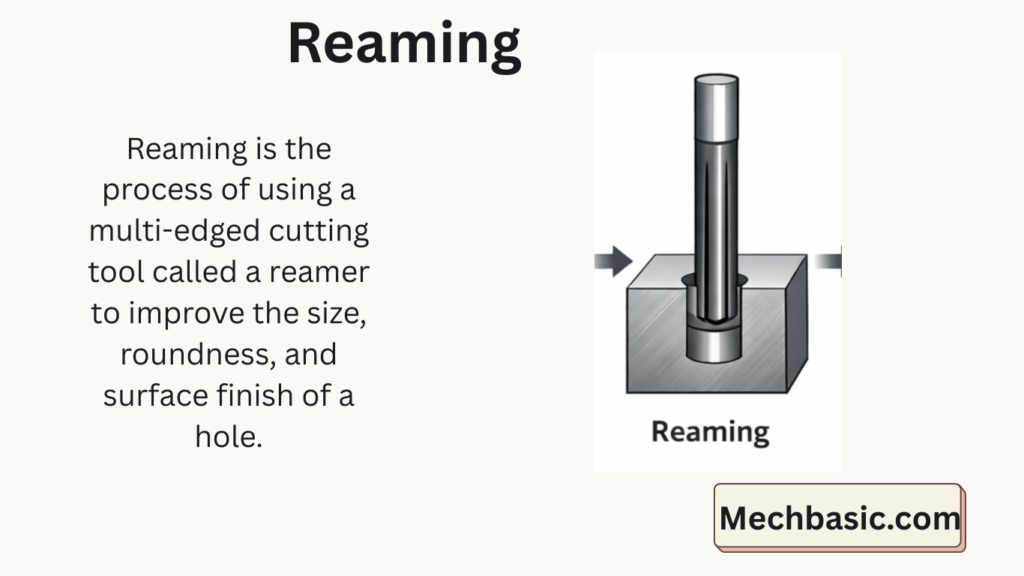
Reaming ensures better dimensional accuracy, roundness, and smoothness of holes and is commonly used where precise fit and alignment are required.
In this article:
Reaming
Reaming is a precision machining process used to enlarge and finish a pre-drilled hole to a high degree of accuracy in diameter, roundness, and surface finish. Unlike drilling, which removes material to create a hole, reaming finishes and slightly enlarges an existing hole.
1. Definition
Reaming is the process of using a multi-edged cutting tool called a reamer to improve the size, roundness, and surface finish of a hole.
- Typically removes a small amount of material (0.05–0.5 mm).
- Provides tight tolerances and smooth surface finishes.
2. Purpose of Reaming
- Achieve accurate hole diameter
- Improve hole surface finish (Ra 0.2–0.8 μm typical)
- Correct minor drill deflection
- Ensure cylindrical roundness
- Prepare holes for press fits, bearings, dowels, or precision fasteners
3. Types of Reamers
| Type | Description | Use |
|---|---|---|
| Hand Reamer | Straight or tapered, turned manually | Low-volume, workshop use |
| Machine Reamer | Straight, tapered, or expansion type | Drill presses, milling, CNC |
| Adjustable / Expansion Reamer | Diameter adjustable by screws | Different hole sizes |
| Tapered Reamer | Conical shape | Guide pins, tapered holes |
| Shell Reamer | Replaceable cutting head on arbor | Large diameter holes |
4. Reaming vs Drilling
| Feature | Reaming | Drilling |
|---|---|---|
| Material Removal | Minimal (finishing) | Major (hole creation) |
| Hole Accuracy | Very high | Moderate |
| Surface Finish | Excellent | Moderate |
| Tool | Multi-edge reamer | Twist drill |
| Application | Precision fit holes | Rough hole preparation |
5. Process Steps
- Pre-drill Hole
- Hole diameter slightly smaller than the reamer (typically 0.1–0.3 mm undersized)
- Drill should be accurate and centered
- Tool Setup
- Select appropriate reamer type and size
- Mount securely in chuck, collet, or arbor
- Speed and Feed Selection
- Lower RPM than drilling
- Steady feed rate to avoid chatter
- Lubrication
- Use cutting oil for metals
- Air or dry for soft plastics
- Reaming Operation
- Align reamer accurately with the pre-drilled hole
- Insert and push or turn smoothly
- Do not reverse rotation while in the hole
- Finishing
- Withdraw tool carefully
- Deburr if needed
6. Cutting Parameters
| Material | Cutting Speed (m/min) | Feed per Rev (mm) | Coolant |
|---|---|---|---|
| Steel | 10–25 | 0.05–0.15 | Oil / Emulsion |
| Aluminum | 30–60 | 0.05–0.15 | Minimal |
| Brass / Copper | 20–40 | 0.05–0.15 | Minimal |
| Plastics | 15–30 | 0.05–0.10 | None / Air |
Note: Always follow the manufacturer’s recommendations for reamer diameter and tolerance.
7. Advantages of Reaming
- High dimensional accuracy
- Excellent surface finish
- Corrects minor misalignment from drilling
- Minimal material removal → longer tool life
- Suitable for press fits and assembly components
8. Limitations
- Requires pre-drilled hole
- Cannot remove large amounts of material
- Expensive for large-scale manual operations
- Sensitive to misalignment → hole may become tapered
- Not suitable for very hard materials without carbide reamers
9. Applications
- Engineering components: bushings, bearings, shafts
- Automotive: engine blocks, gear housings
- Aerospace: precision holes for fasteners and pins
- Hydraulic systems: accurate fluid passages
- Machine assembly: dowel pins, guide holes
10. Best Practices
- Drill undersized hole accurately before reaming
- Use proper alignment to avoid tapering
- Apply appropriate coolant or lubricant
- Avoid backward rotation in the hole
- Ensure steady, consistent feed
Other courses:





