
Core drilling is a machining process used to enlarge an existing hole by removing material from the inner surface of the hole using a core drill. It improves the accuracy and surface finish of the hole and is commonly performed after drilling, especially for producing large-diameter holes with better precision.
In this article:
Core Drilling
1. Definition
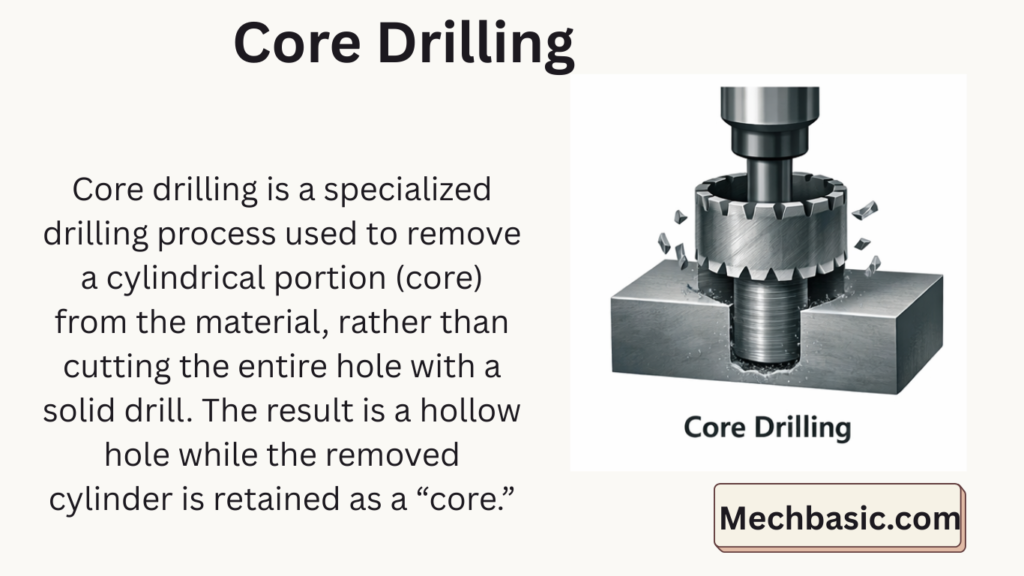
Core drilling is a specialized drilling process used to remove a cylindrical portion (core) from the material, rather than cutting the entire hole with a solid drill. The result is a hollow hole while the removed cylinder is retained as a “core.”
Unlike conventional drilling, which removes all material in the hole, core drilling minimizes material removal, reducing cutting effort and tool wear.
2. Purpose of Core Drilling
- Produce large-diameter holes efficiently
- Minimize cutting forces and energy consumption
- Recover core samples for testing or analysis
- Create holes in concrete, stone, masonry, or metal
- Often used in geotechnical, construction, and metallurgical applications
3. Machines Used
Core drilling can be performed using:
- Handheld core drills (lightweight, portable)
- For concrete, masonry
- Bench/core drilling machines (for metals and small-scale work)
- CNC milling or drilling centers
- Drill rigs / rotary rigs (geological and construction purposes)
4. Tools Used
a) Core Drill Bit
- Hollow cylindrical tool with cutting edges on the outer rim
- Center is empty to remove the core
- Tip can be diamond-coated, carbide, or HSS, depending on material
- Sizes vary from a few mm to several hundred mm
b) Annular Cutter
- Used in metalworking
- Similar to core drill but for steel, aluminum, and alloys
- Removes only the periphery of the hole
c) Concrete Core Bit
- Diamond-tipped
- Used to cut reinforced concrete and masonry
5. Process Steps
- Marking / Layout
- Identify the exact position of the hole
- Workpiece Clamping or Support
- Ensure stability
- For concrete, a guide plate or template may be used
- Tool Selection
- Select proper diameter, type (metal, concrete), and coating
- Speed & Feed Setup
- Lower speed for hard materials
- Light feed to avoid binding
- Drilling Operation
- Drill enters the workpiece
- Cutting occurs only on the periphery
- Core remains intact inside the hollow center
- Coolant / Lubrication (for metals)
- Reduces heat
- Improves tool life
- Core Removal
- Eject the cylindrical core
- Deburr hole edges if necessary
6. Cutting Parameters
| Material | Drill Type | Speed | Feed | Coolant |
|---|---|---|---|---|
| Steel | Annular cutter (HSS / carbide) | Medium | Light | Oil / water-soluble |
| Aluminum | Annular cutter | High | Medium | Minimal |
| Concrete | Diamond core bit | Low | Low | Water for cooling |
| Stone | Diamond core bit | Low | Low | Water |
Note: Core drilling in hard materials often uses water or lubricant to cool and remove dust/chips.
7. Advantages
- Reduces material removal, cutting time, and tool wear
- Can produce large-diameter holes efficiently
- Recovers cores for testing
- Suitable for hard or reinforced materials
- Produces clean, precise holes
8. Limitations
- Requires specialized tools
- Not suitable for very small diameter holes (< 10 mm in metals)
- Slower than conventional drilling for shallow holes
- Requires proper clamping and support for accuracy
9. Applications
- Construction: Concrete cores for structural testing
- Geotechnical Engineering: Soil and rock core sampling
- Metalworking: Large steel or aluminum holes using annular cutters
- Pipeline and Plumbing: Holes in reinforced concrete or metal
- Aerospace and Automotive: Weight reduction and large clearance holes
10. Core Drilling vs Conventional Drilling
| Feature | Core Drilling | Conventional Drilling |
|---|---|---|
| Material Removal | Only periphery | Entire hole volume |
| Tool | Hollow (annular, diamond) | Solid twist drill |
| Cutting Force | Low | High |
| Hole Diameter | Large | Small to medium |
| Applications | Large holes, cores | All-purpose holes |
11. Best Practices
- Always secure workpiece properly
- Use coolant or water for heat and dust removal
- Choose correct drill type and diameter for material
- Start with pilot holes if required for precision
- Clear debris frequently for smooth operation
Other courses:





