
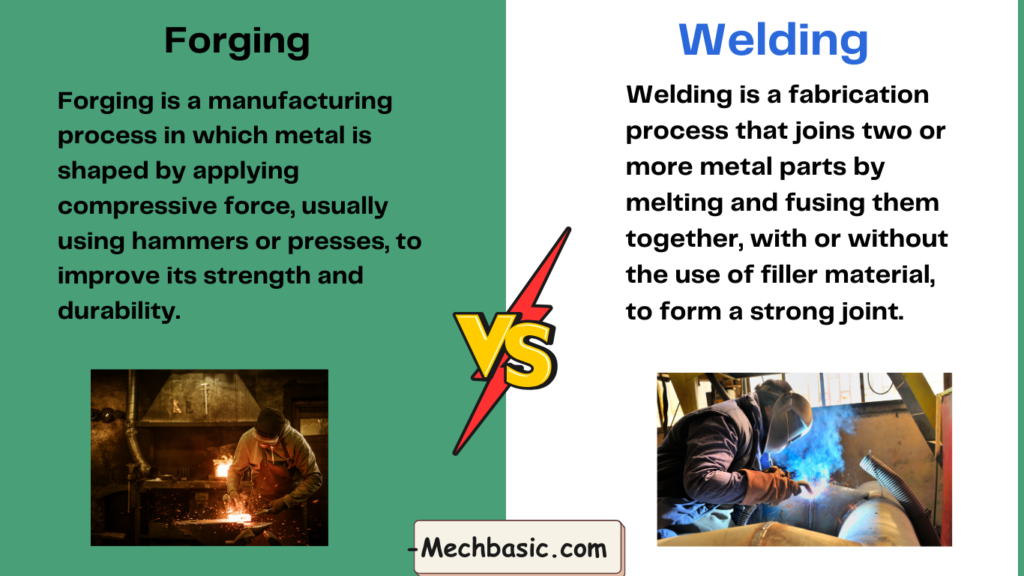
Forging and welding are two widely used metal joining and shaping processes in manufacturing. Forging forms components by deforming solid metal to achieve high strength and reliability, while welding joins separate parts by melting and fusing them together.
Comparing these two processes helps engineers understand which method provides greater strength, durability, and suitability for different applications.
In this article:
- Forging vs Welding: Which Is Stronger?
- 1. Fundamental Difference Between Forging and Welding
- 2. Strength Comparison (Key Reasons Forging Is Stronger)
- 3. Tensile Strength Comparison
- 4. Impact and Shock Resistance
- 5. Corrosion Resistance
- 6. Practical Examples
- 7. Cost vs Strength Trade-Off
- 8. When Welding Can Match Forging (Rare Cases)
- 9. Summary:
- Other courses:
Forging vs Welding: Which Is Stronger?
When comparing forging and welding, the key question is how each process affects material strength, microstructure, and long-term performance.
In most engineering applications, forged components are significantly stronger and more reliable than welded joints, but the reasons are important to understand in detail.
1. Fundamental Difference Between Forging and Welding
| Aspect | Forging | Welding |
|---|---|---|
| Nature of process | Plastic deformation of solid metal | Fusion of two or more metals |
| Material continuity | Continuous | Disrupted at joint |
| Grain structure | Aligned and refined | Melted and re-solidified |
| Defects | Minimal | Possible porosity, cracks |
| Heat-affected zone (HAZ) | None or minimal | Always present |
2. Strength Comparison (Key Reasons Forging Is Stronger)
1. Grain Flow Orientation
- Forging:
- Grain flow follows the shape of the component
- Produces directional strength
- Greatly improves fatigue and impact resistance
- Welding:
- Grain structure is destroyed at the weld zone
- Random re-solidification occurs
- Creates weak points at the joint
📌 Forged parts behave like a single continuous piece of metal.
2. Absence vs Presence of Heat-Affected Zone (HAZ)
- Forging:
- No localized overheating
- Uniform mechanical properties
- Welding:
- Creates a HAZ around the weld
- HAZ often has:
- Reduced toughness
- Residual stresses
- Micro-cracks
📌 Many weld failures initiate in the HAZ.
3. Defect Probability
- Forging:
- Eliminates internal voids and porosity
- Compresses material, closing micro-cracks
- Welding:
- Can introduce:
- Porosity
- Slag inclusions
- Lack of fusion
- Residual stresses
- Can introduce:
📌 Even high-quality welds statistically have more defects than forged material.
4. Fatigue Strength (Most Critical Factor)
- Forging:
- Excellent fatigue life
- Grain flow resists crack propagation
- Welding:
- Fatigue strength is 30–60% lower than base metal
- Weld toe is a common crack initiation site
📌 For cyclic loading (bridges, aircraft, crankshafts), forging is clearly superior.
3. Tensile Strength Comparison
| Condition | Relative Strength |
|---|---|
| Forged part | 100% or more of base metal strength |
| High-quality weld | 70–95% of base metal |
| Poor weld | 40–60% |
⚠ Even a perfect weld rarely exceeds the strength of a well-forged part.
4. Impact and Shock Resistance
- Forging:
- High toughness
- Can absorb shock loads without fracture
- Welding:
- Weld zone may be brittle
- Prone to sudden failure under impact
📌 Forging is preferred in safety-critical parts.
5. Corrosion Resistance
- Forging:
- Uniform microstructure → uniform corrosion
- Welding:
- Weld and HAZ may corrode faster
- Galvanic corrosion can occur
6. Practical Examples
Forged Components
- Crankshafts
- Connecting rods
- Aircraft landing gear
- Pressure vessels
Welded Components
- Structural frames
- Pipelines
- Ship hulls
- Storage tanks
📌 Welding is often chosen for size and fabrication flexibility, not strength.
7. Cost vs Strength Trade-Off
| Factor | Forging | Welding |
|---|---|---|
| Initial cost | High | Low |
| Strength | Very High | Medium–High |
| Reliability | Excellent | Depends on skill |
| Inspection | Minimal | Extensive NDT required |
8. When Welding Can Match Forging (Rare Cases)
Welding can approach forged strength if:
- Advanced welding methods are used (EBW, FSW)
- Proper post-weld heat treatment is applied
- Joint design is optimized
- Strict quality control is followed
Even then, fatigue performance usually remains inferior.
9. Summary:
Forging is stronger than welding because:
✔ Continuous grain flow
✔ No joints or fusion lines
✔ No HAZ
✔ Higher fatigue and impact resistance
✔ Lower defect probability
Welding is essential when:
✔ Parts are too large to forge
✔ Complex assemblies are required
✔ Cost and flexibility are priorities
Conclusion:
A forged part is inherently stronger and more reliable than a welded joint because forging preserves material continuity and optimizes grain structure, while welding introduces a joint and heat-affected zone that act as potential weak points.
Other courses:





