
Drilling is a machining process used to produce round holes in solid materials. Different types of drilling are used depending on the hole size, depth, accuracy, and application requirements.
In this article:
Types of Drilling :
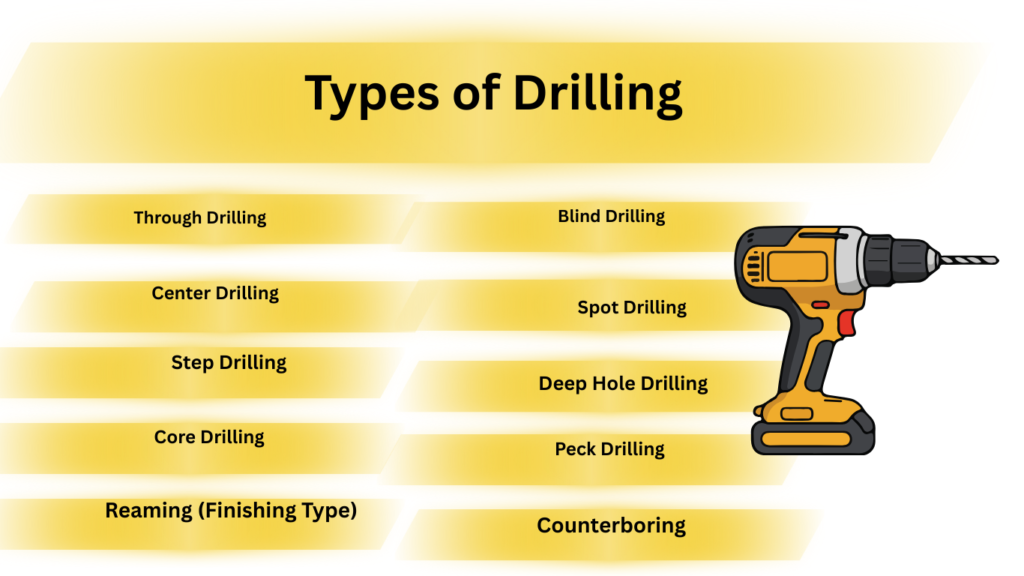
In manufacturing, drilling is not limited to making a simple hole. Depending on hole purpose, accuracy, and geometry, drilling is classified into several types and related operations.
Below are the main types of drilling, explained in detail.
1. Through Drilling
Description:
- Hole is drilled completely through the workpiece.
- Drill exits the bottom surface.
Features:
- Chips exit easily
- Less heat accumulation
Applications:
- Bolt holes
- Rivet holes
- Fastener holes
2. Blind Drilling
Description:
- Hole is drilled to a specific depth without breaking through the workpiece.
Features:
- Depth control is critical
- Often used in tapping
Applications:
- Threaded holes
- Hydraulic components
3. Center Drilling
Description:
- A center drill is used to start a hole accurately.
Purpose:
- Prevents drill wandering
- Provides accurate hole location
Applications:
- Precision drilling
- Lathe work
4. Spot Drilling
Description:
- A spot drill creates a shallow hole before drilling.
Difference from Center Drilling:
- Shallower
- Used mainly in CNC machines
5. Step Drilling
Description:
- Hole is drilled in multiple stages using different drill sizes.
Purpose:
- Reduces cutting force
- Improves accuracy for large holes
Applications:
- Large-diameter holes
- Hard materials
6. Deep Hole Drilling
Description:
- Used when hole depth is greater than 5× drill diameter.
Tools Used:
- Gun drills
- BTA drills
Applications:
- Oil holes
- Hydraulic cylinders
7. Core Drilling
Description:
- Enlarges an existing hole.
Purpose:
- Reduces load on larger drills
- Improves hole straightness
8. Peck Drilling
Description:
- Drill advances and retracts repeatedly.
Purpose:
- Break chips
- Improve cooling
Applications:
- Deep or blind holes
- CNC drilling cycles
9. Reaming (Finishing Type)
Description:
- Improves hole accuracy and surface finish.
Features:
- Very small material removal
- High dimensional accuracy
10. Counterboring
Description:
- Enlarges the top portion of a drilled hole with a flat bottom.
Purpose:
- Seat bolt heads
11. Countersinking
Description:
- Produces a conical recess at the hole opening.
Purpose:
- Seat flat-head screws
12. Tapping
Description:
- Produces internal threads in a drilled hole.
Comparison Table
| Type | Purpose |
|---|---|
| Through drilling | Complete hole |
| Blind drilling | Controlled depth |
| Center drilling | Accurate start |
| Step drilling | Large holes |
| Deep hole drilling | Long holes |
| Peck drilling | Chip removal |
| Reaming | Accuracy & finish |
| Counterboring | Bolt seating |
| Countersinking | Screw seating |
| Tapping | Threaded holes |
Applications of Different Drilling Types
- Automotive components
- Aerospace parts
- Machinery assemblies
- Structural fabrication
- Precision engineering
Conclusion:
Different types of drilling are used to create accurate holes, prepare for fasteners, or improve hole quality.
Other courses:





