
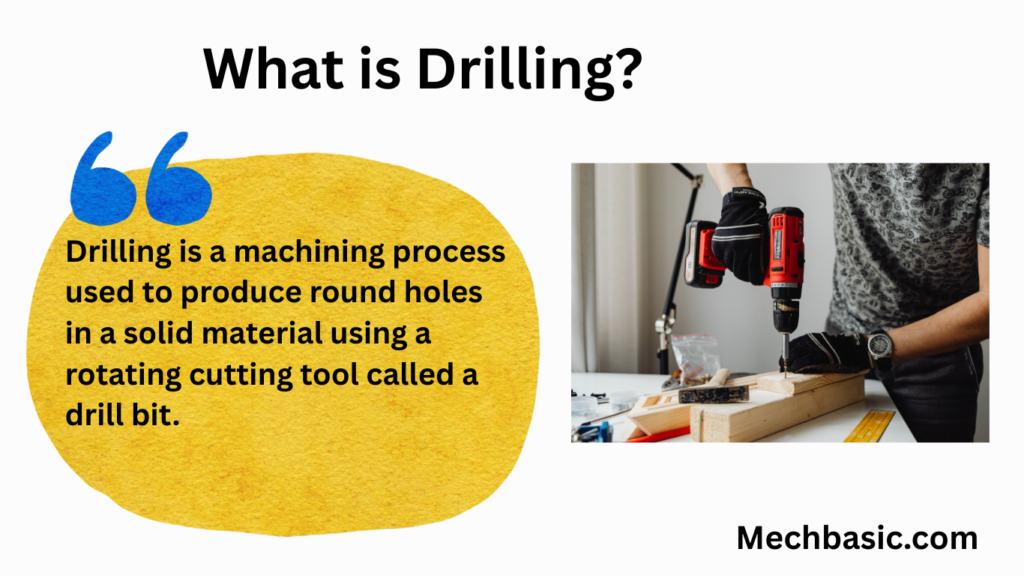
Drilling is a machining process used to produce round holes in a solid material using a rotating cutting tool called a drill bit.
The drill bit removes material by cutting as it advances axially into the workpiece.
Drilling is widely used in manufacturing for making holes for fasteners, assembly, and fluid passages.
In this article:
- Drilling Process in Manufacturing
- 1. What is Drilling?
- 2. Principle of Drilling
- 3. Main Motions in Drilling
- 4. Drilling Machines (Types)
- 5. Types of Drills Used
- 6. Drill Geometry (Important Parts)
- 7. Drilling Operations (Related Processes)
- 8. Drilling Parameters
- 9. Coolant in Drilling
- 10. Advantages of Drilling
- 11. Limitations of Drilling
- 12. Defects in Drilling and Prevention
- 13. Applications of Drilling
- 14. Drilling in CNC Manufacturing
Drilling Process in Manufacturing
1. What is Drilling?
Drilling is a machining process used to create a round hole in a solid material by removing material with a rotating cutting tool called a drill.
- The drill rotates and moves axially (along its axis) into the workpiece
- The process produces cylindrical holes
- It is one of the most common and fundamental machining operations in manufacturing
2. Principle of Drilling
- A drill bit rotates at a specific speed
- Axial force (feed) is applied
- Cutting edges remove material
- Chips are evacuated through flutes
- Hole is formed to required depth
3. Main Motions in Drilling
(a) Cutting Motion
- Rotary motion of the drill
- Provided by the spindle
(b) Feed Motion
- Linear movement of the drill into the workpiece
(c) Depth of Cut
- Distance the drill penetrates the material
4. Drilling Machines (Types)
1. Portable Drilling Machine
- Hand-held
- Light-duty operations
2. Bench Drilling Machine
- Small, accurate work
- Used in workshops and labs
3. Pillar Drilling Machine
- Medium-duty work
- Vertical column support
4. Radial Drilling Machine
- Large and heavy workpieces
- Adjustable arm for flexibility
5. CNC Drilling Machine
- Fully automated
- High accuracy and productivity
5. Types of Drills Used
1. Twist Drill (Most Common)
- Two cutting edges
- Helical flutes
- Used for general drilling
2. Flat Drill
- Simple design
- Used for soft materials
3. Center Drill
- Used to start holes accurately
4. Step Drill
- Produces multiple diameters in one operation
5. Gun Drill
- Used for deep holes
6. Drill Geometry (Important Parts)
- Point angle (typically 118° or 135°)
- Cutting lips
- Flutes
- Chisel edge
- Shank
7. Drilling Operations (Related Processes)
1. Center Drilling
- Creates a starting point
2. Reaming
- Improves hole accuracy and surface finish
3. Counterboring
- Enlarges hole at the top for bolt heads
4. Countersinking
- Produces conical recess for screws
5. Tapping
- Cuts internal threads
8. Drilling Parameters
1. Cutting Speed
- Depends on:
- Material
- Drill diameter
- Tool material
2. Feed Rate
- Axial movement per revolution
3. Depth of Hole
- Blind or through hole
9. Coolant in Drilling
Functions:
- Reduces heat
- Improves tool life
- Helps chip removal
- Improves surface finish
10. Advantages of Drilling
✔ Simple and economical
✔ High productivity
✔ Applicable to many materials
✔ Easy automation
11. Limitations of Drilling
❌ Limited accuracy compared to boring
❌ Poor surface finish (without reaming)
❌ Tool breakage in deep holes
12. Defects in Drilling and Prevention
| Defect | Cause | Prevention |
|---|---|---|
| Oversize hole | Tool wear | Proper tool selection |
| Rough surface | High feed | Optimize feed |
| Drill breakage | Poor chip removal | Use peck drilling |
| Hole deviation | Poor alignment | Use center drilling |
13. Applications of Drilling
- Automotive components
- Aerospace structures
- Machine parts
- Electrical enclosures
- Construction components
14. Drilling in CNC Manufacturing
- Automated tool changes
- High positional accuracy
- Peck drilling cycles
- Multi-hole drilling in one setup
Conclusion:
Drilling creates round holes by rotating a drill and pushing it into the material.
Other courses:





