
4-Axis milling is an advanced CNC machining process in which the cutting tool moves along the X, Y, and Z axes, while the workpiece simultaneously rotates about a fourth axis (usually the A-axis).
This additional rotary motion allows machining of complex geometries and multiple sides without repositioning the part.
It improves accuracy, efficiency, and surface finish compared to 3-axis milling.
In this article:
- 4-Axis Milling
- What is 4-Axis Milling?
- Axes in 4-Axis Milling
- How 4-Axis Milling Works
- Types of 4-Axis Milling
- Common 4-Axis Milling Operations
- Typical 4-Axis Machine Configurations
- Advantages of 4-Axis Milling
- Limitations of 4-Axis Milling
- Applications of 4-Axis Milling
- 4-Axis vs 3-Axis Milling
- 4-Axis vs 5-Axis Milling
- Programming in 4-Axis Milling
4-Axis Milling
What is 4-Axis Milling?
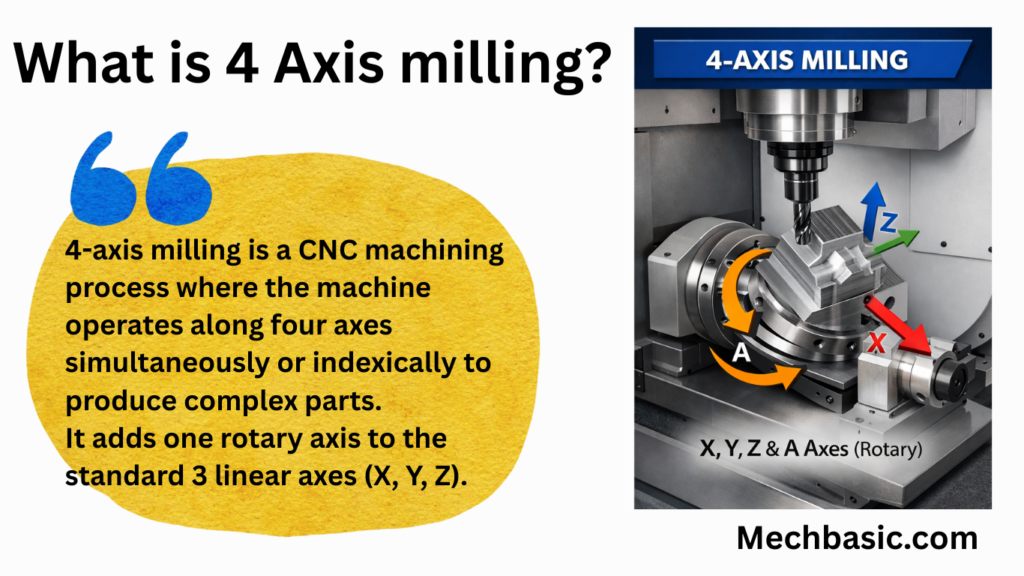
4-axis milling is a CNC machining process where the machine operates along four axes simultaneously or indexically to produce complex parts.
It adds one rotary axis to the standard 3 linear axes (X, Y, Z).
Axes in 4-Axis Milling
| Axis | Motion |
|---|---|
| X | Left–Right |
| Y | Front–Back |
| Z | Up–Down |
| A (4th Axis) | Rotation about X-axis (most common) |
Sometimes the 4th axis is B or C, depending on machine configuration.
How 4-Axis Milling Works
- The workpiece is mounted on a rotary table
- The table rotates around the 4th axis
- The cutting tool machines multiple faces without removing the part
- Can operate in indexing or continuous mode
Types of 4-Axis Milling
1. Indexed (Positional) 4-Axis Milling
- Rotary axis moves to a set angle and locks
- Machining is done using X, Y, Z only
- Most common and economical method
Example:
- Machine one face
- Rotate table 90°
- Machine next face
2. Continuous 4-Axis Milling
- Rotary axis moves continuously during cutting
- Tool and workpiece move together
- Enables complex geometry
Example:
- Helical grooves
- Cam profiles
- Engraving around a cylinder
Common 4-Axis Milling Operations
- Machining multiple faces
- Wrap-around engraving
- Drilling holes on different sides
- Milling keyways on shafts
- Helical slot milling
Typical 4-Axis Machine Configurations
1. Vertical Machining Center + Rotary Table
- Most widely used setup
- Rotary table mounted on machine bed
2. Horizontal Machining Center
- Built-in rotary axis
- High rigidity and productivity
Advantages of 4-Axis Milling
✔ Reduced setup time
✔ Higher accuracy (less re-clamping)
✔ Complex parts possible
✔ Improved productivity
Limitations of 4-Axis Milling
❌ Higher cost than 3-axis
❌ More complex programming
❌ Skilled operator required
Applications of 4-Axis Milling
- Aerospace components
- Automotive parts
- Medical devices
- Mold components
- Complex brackets and housings
4-Axis vs 3-Axis Milling
| Feature | 3-Axis | 4-Axis |
|---|---|---|
| Axes | X, Y, Z | X, Y, Z + Rotary |
| Setup changes | Multiple | Minimal |
| Complex shapes | Limited | Advanced |
| Productivity | Lower | Higher |
4-Axis vs 5-Axis Milling
| Feature | 4-Axis | 5-Axis |
|---|---|---|
| Rotary axes | 1 | 2 |
| Complexity | Medium | High |
| Cost | Moderate | High |
| Capability | Complex | Very complex |
Programming in 4-Axis Milling
- Uses G-code with rotary axis commands (A/B/C)
- CAM software commonly used
- Supports:
- Indexing
- Simultaneous motion
Conclusion:
4-axis milling allows the workpiece to rotate, enabling machining on multiple sides in one setup.
Other courses:





