
Materials That Are Easy to Bend
In sheet metal bending, the ease of bending depends primarily on the material’s mechanical properties, including ductility, yield strength, elongation, and work hardening. Choosing a material that bends easily is critical for efficient manufacturing, low tooling cost, and high-quality bends.
1. Properties for Easy Bending :
A material is easy to bend if it has:
- High Ductility
- Ability to plastically deform without cracking.
- High ductility allows the sheet to stretch and compress during bending.
- Low to Moderate Yield Strength
- Requires less force to bend.
- Materials with very high strength need special tooling and may have springback.
- High Elongation (%)
- Indicates how much the material can stretch before fracture.
- Higher elongation → allows sharper bends and tighter radii.
- Low Work Hardening Rate
- Materials that harden slowly during bending are easier to form.
- Good Surface Finish and Homogeneity
- Avoids cracking or surface defects during bending.
2. Common Materials That Are Easy to Bend
| Material | Properties | Advantages for Bending | Typical Applications |
|---|---|---|---|
| Mild Steel (Low Carbon Steel) | Low carbon ≤0.3%, moderate ductility, elongation 20–30% | Easy to bend, widely available, low cost | Automotive panels, brackets, enclosures |
| Aluminum and Aluminum Alloys | Lightweight, ductile, corrosion-resistant | Very easy to bend, minimal springback, can handle thin sheets | Aircraft, ducts, lightweight enclosures |
| Copper | Highly ductile, soft | Can bend into tight radii, excellent for intricate shapes | Electrical components, plumbing, decorative panels |
| Brass | Alloy of copper and zinc, ductile | Smooth bending, decorative finish | Decorative fittings, electrical connectors |
| Annealed Mild Steel | Heat-treated to increase ductility | Even easier to bend than cold-rolled steel | Structural components, frames |
| Low-Carbon Aluminum Alloys (e.g., 1100, 3003 series) | High elongation, corrosion-resistant | Can bend easily at room temperature | Roofing, HVAC ducts, sheet metal crafts |
| Tinplate | Thin coated steel sheet | Very flexible, easy to bend and form | Food cans, packaging, decorative items |
3. Why These Materials Bend Easily
- High Ductility & Elongation
- During bending, the outer fibers stretch, and inner fibers compress.
- High ductility allows the material to accommodate these stresses without cracking.
- Low to Moderate Strength
- Lower yield strength → requires less force to initiate plastic deformation.
- Work Hardening Behavior
- Materials like mild steel and aluminum harden slowly, making multiple bends possible without fracturing.
- Thin Sheets
- Thin sheets are generally easier to bend than thick sheets of the same material.
4. Factors Affecting Bendability of “Easy-to-Bend” Materials
Even ductile materials can be hard to bend if:
- Bend Radius is too Small
- R/t ratio (inside bend radius / thickness) < 1 may cause cracking.
- Temperature Conditions
- Extremely cold conditions may reduce ductility (especially for steel).
- Bending Method
- Air bending, bottoming, coining – some methods require more force.
- Work Hardening History
- Cold-worked materials are less ductile than annealed ones.
5. Comparison of Easy-to-Bend Materials
| Material | Elongation (%) | Yield Strength (MPa) | Bendability | Notes |
|---|---|---|---|---|
| Mild Steel (Annealed) | 25–30% | 150–250 | Excellent | Economical, widely used |
| Aluminum 1100 | 30–35% | 60–100 | Very Good | Lightweight, corrosion-resistant |
| Copper | 35–50% | 70–210 | Excellent | Soft, suitable for tight bends |
| Brass | 30–40% | 200–300 | Good | Decorative bends, moderate springback |
| Tinplate | 20–25% | 180–220 | Excellent | Very thin, flexible |
6. Summary
- Easy-to-bend materials are ductile, low-to-moderate strength, and have high elongation.
- Best examples: Mild steel, aluminum, copper, brass, annealed steel, and tinplate.
- Factors such as bend radius, sheet thickness, bending method, and temperature influence actual bendability.
- These materials are ideal for automotive parts, ducts, electrical enclosures, and decorative applications.
Rule of Thumb:
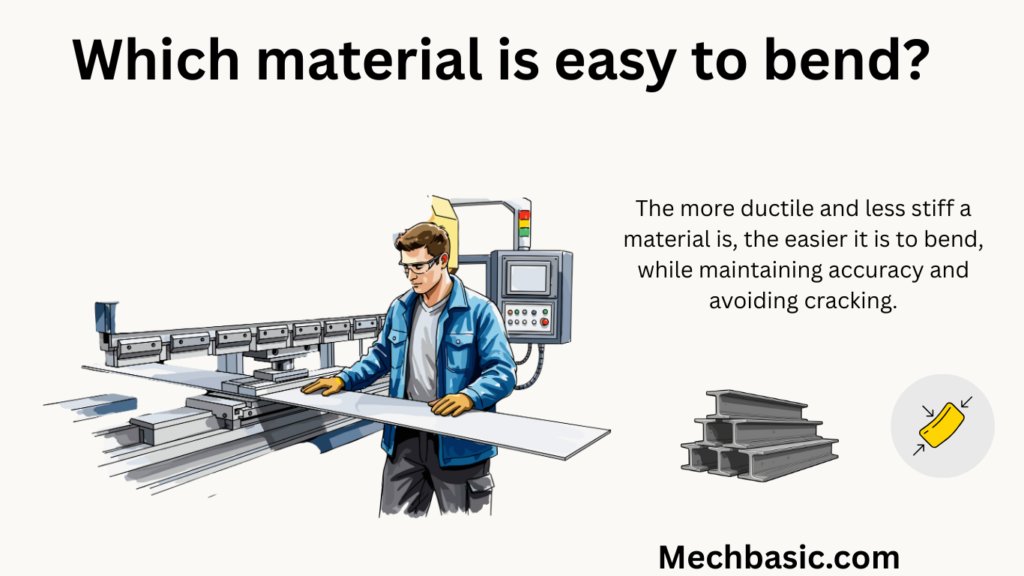
The more ductile and less stiff a material is, the easier it is to bend, while maintaining accuracy and avoiding cracking.
Other courses:





