Bend allowance is the amount of material length required to accommodate a bend in sheet metal during the bending process.
When a sheet is bent, the outer surface stretches and the inner surface compresses, while a neutral axis remains unchanged in length. Bend allowance accounts for this behavior and helps determine the correct flat length of the sheet before bending.
It is an important factor in sheet metal design to ensure accurate dimensions and proper fit of the final component.
In this article:
Bend Allowance in Sheet Metal :
Bend allowance (BA) is a critical concept in sheet metal design and fabrication. It is used to calculate the flat (developed) length of a sheet that will form a bent part of a desired geometry. Understanding bend allowance ensures accurate blank size and minimizes errors in the final formed part.
1. Definition of Bend Allowance
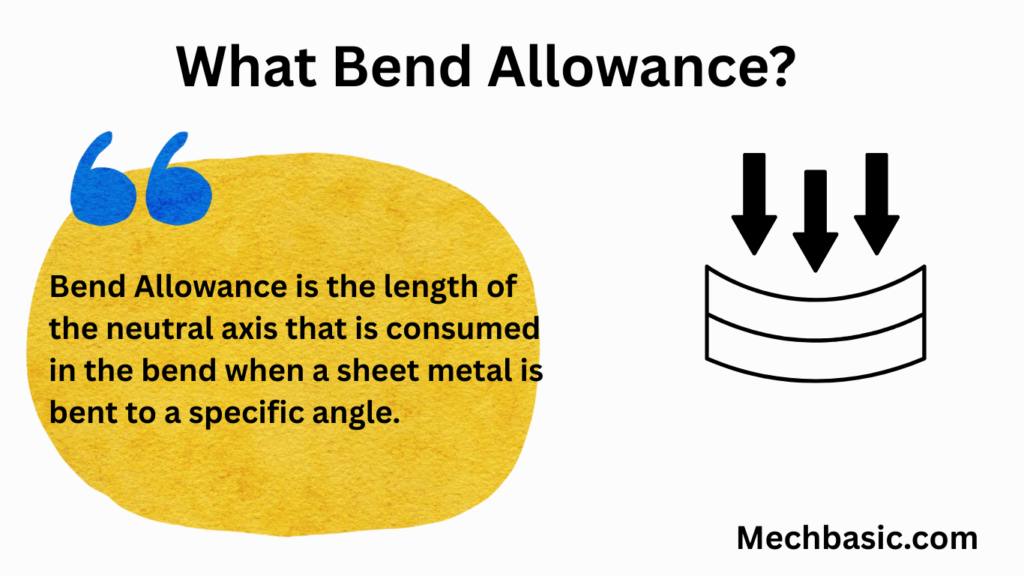
Bend Allowance is the length of the neutral axis that is consumed in the bend when a sheet metal is bent to a specific angle.
- It is not the outer or inner length of the bend, but the length along the neutral axis, which neither stretches nor compresses during bending.
- The neutral axis lies somewhere inside the sheet thickness and depends on the material, bend radius, and bending method.
Bend allowance is the extra length of sheet needed to make a bend so that after bending, the final dimensions are correct.
2. Importance of Bend Allowance
- Determines flat pattern/blank size.
- Ensures accurate dimensions after bending.
- Accounts for material stretching and compression during bending.
- Helps in calculating bend deduction and overall flat length.
- Essential in manual and CNC sheet metal fabrication.
3. Parameters Affecting Bend Allowance
- Sheet Thickness (t) – Thicker sheets increase bend allowance.
- Inside Bend Radius (R) – Larger radius → more material consumed in bend → larger BA.
- Bend Angle (θ) – Larger angles require more material along neutral axis.
- Material Type – Ductile metals may stretch more, affecting BA.
- K-Factor or Y-Factor (k or Y) – Represents the position of neutral axis; affects BA.
- Bending Method – Air bending, bottoming, or coining changes neutral axis location.
4. Bend Allowance Formulas
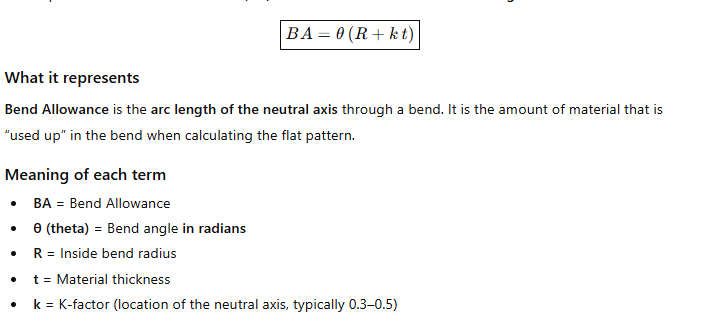
4.1 Using K-Factor
4.2 Using Y-Factor
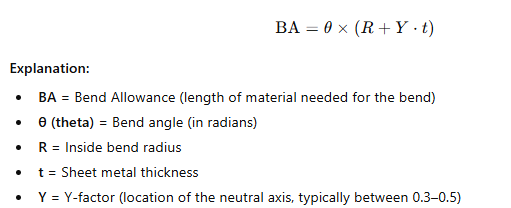
Where:
- (Y) = Y-factor, dimensionless coefficient representing neutral axis location
- Formula is simpler for practical applications and CAD programming.
4.3 Using Bend Deduction
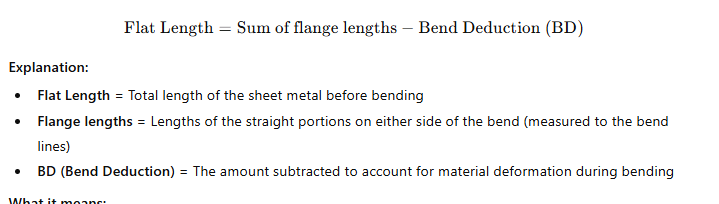
- Bend deduction is derived from bend allowance.
- BD = (Sum of flange lengths) – Flat length
5. Steps to Calculate Bend Allowance
1. Identify sheet thickness (t) and inside bend radius (R).
2. Determine bend angle (θ).
3. Choose K-factor or Y-factor based on material and bend radius.
4. Apply the formula:

Use BA to calculate flat pattern/blank length.
6. Example Calculation
The calculation demonstrates how to use the bend allowance formula to find the length of material required to form a 90° bend.
Explanation:
- Given the sheet thickness, inside bend radius, bend angle, and K-factor
- The bend angle is converted to radians
- These values are substituted into the bend allowance equation
The result, BA ≈ 7.54 mm, represents the arc length of the neutral axis during bending. This value is used to determine the flat length of the sheet metal before bending so that the final bent part has accurate dimensions.
Result: The neutral axis consumes 7.54 mm along the bend, which is added to the flat pattern.
7. Relationship Between Bend Allowance and Bend Deduction
| Concept | Definition |
|---|---|
| Bend Allowance (BA) | Length of material along neutral axis in the bend |
| Bend Deduction (BD) | Amount subtracted from total flange lengths to get flat length |
| Relationship | BD = Sum of flange lengths – Flat length = Sum of flange lengths – (Flange lengths + BA) |
8. Applications of Bend Allowance
- Calculating blank size in sheet metal bending.
- Designing flanges, brackets, enclosures, ducts.
- Programming CNC press brakes.
- Ensuring accurate part dimensions in mass production.
9. Summary
- Bend allowance = extra sheet length consumed in bending along the neutral axis.
- Depends on sheet thickness, bend radius, bend angle, and material.
- Can be calculated using K-factor or Y-factor formulas.
- Essential for accurate flat pattern and blank size calculation.
Other courses: