
Tube Drawing is a metal forming process used to reduce the diameter and wall thickness of a tube by pulling it through a hardened die.
In this process, the tube is drawn with or without a mandrel (internal support) to control the inside diameter and improve surface finish. The material undergoes plastic deformation, resulting in improved dimensional accuracy and mechanical properties.
Tube drawing is commonly used to manufacture precision tubes for automotive, aerospace, medical, and structural applications.
In this article:
- Tube Drawing Process
- 1. Definition
- 2. Principle of Tube Drawing
- 3. Tube Drawing Setup and Components
- Main Components
- 4. Working Steps of Tube Drawing
- 5. Types of Tube Drawing
- 6. Drawing Parameters
- 7. Materials Used in Tube Drawing
- 8. Lubrication in Tube Drawing
- 9. Defects in Tube Drawing
- 10. Advantages of Tube Drawing
- 11. Limitations
- 12. Applications
- 13. Comparison with Tube Extrusion
- 14. Summary
Tube Drawing Process
1. Definition
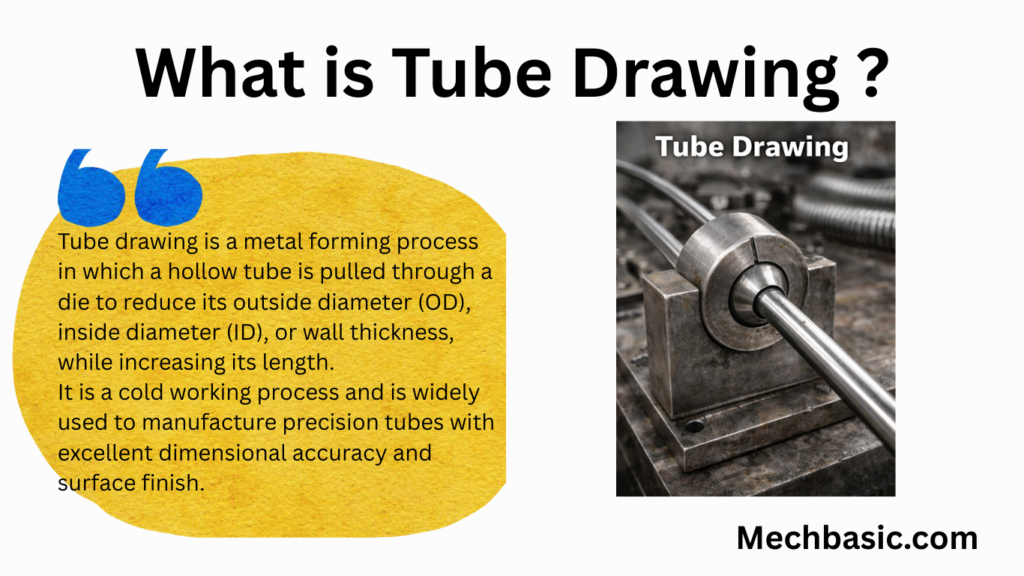
Tube drawing is a metal forming process in which a hollow tube is pulled through a die to reduce its outside diameter (OD), inside diameter (ID), or wall thickness, while increasing its length.
It is a cold working process and is widely used to manufacture precision tubes with excellent dimensional accuracy and surface finish.
2. Principle of Tube Drawing
- A tube is subjected to tensile force and drawn through a converging die.
- Plastic deformation occurs as the tube passes through the die.
- Internal tools such as mandrels or plugs may be used to control the internal diameter and wall thickness.
3. Tube Drawing Setup and Components
Main Components
- Tube (hollow blank)
- Drawing die
- Mandrel or plug (optional)
- Drawing bench or draw machine
- Lubrication system
4. Working Steps of Tube Drawing
- Tube Preparation
- Tube is cut to length.
- Cleaned to remove scale and dirt.
- One end is pointed or swaged for gripping.
- Lubrication
- Lubricant applied inside and outside tube.
- Drawing Operation
- Tube is pulled through the die using a drawing bench.
- Tube undergoes plastic deformation.
- Intermediate Annealing
- Restores ductility after work hardening.
- Finishing
- Straightening, cutting, and inspection.
5. Types of Tube Drawing
5.1 Tube Drawing without Mandrel (Hollow Drawing)
Description
- Tube drawn without internal support.
Effect
- OD reduces
- Wall thickness increases slightly
- ID reduces slightly
Applications
- Thick-walled tubes
5.2 Tube Drawing with Fixed Mandrel
Description
- Mandrel held stationary inside tube.
Advantages
- Better control of internal diameter
- Uniform wall thickness
Applications
- Precision tubes
5.3 Tube Drawing with Moving Mandrel
Description
- Mandrel moves with the tube.
Advantages
- Excellent surface finish inside tube
- Reduced friction
Applications
- High-quality tubes
5.4 Tube Drawing with Plug
Description
- Plug located near die exit.
Advantages
- Controls both OD and wall thickness
- Simple setup
Applications
- Heat exchanger tubes
- Condenser tubes
6. Drawing Parameters
6.1 Reduction Ratio
- Limited to prevent cracking.
- Multiple passes often required.
6.2 Die Angle
- Typically 6°–12°
- Affects drawing force and surface finish
6.3 Lubrication
- Critical for surface quality and tool life
7. Materials Used in Tube Drawing
- Carbon steel
- Stainless steel
- Copper and brass
- Aluminum alloys
- Titanium alloys
8. Lubrication in Tube Drawing
| Material | Lubricant |
|---|---|
| Steel | Soap, lime |
| Copper | Oil |
| Aluminum | Wax |
9. Defects in Tube Drawing
| Defect | Cause |
|---|---|
| Central bursting | Excessive reduction |
| Surface scratches | Poor lubrication |
| Eccentricity | Misalignment |
| Cracking | Excessive tensile stress |
10. Advantages of Tube Drawing
- High dimensional accuracy
- Excellent surface finish
- Improved mechanical properties
- Suitable for thin-walled tubes
11. Limitations
- Limited reduction per pass
- Requires annealing
- Tooling and setup cost
- Tensile stress risk
12. Applications
- Heat exchangers
- Boiler tubes
- Medical tubing
- Automotive components
- Hydraulic and pneumatic lines
13. Comparison with Tube Extrusion
| Feature | Tube Drawing | Tube Extrusion |
|---|---|---|
| Stress | Tensile | Compressive |
| Accuracy | High | Moderate |
| Surface finish | Excellent | Fair |
| Reduction | Limited | Large |
14. Summary
Tube drawing is a precision cold working process used to produce high-quality seamless tubes with tight dimensional tolerances. The use of mandrels or plugs allows precise control over internal dimensions, making it essential for industries requiring high-performance tubular products.
Other courses:





