
Drawing is a metal forming process in which a metal rod, wire, tube, or sheet is pulled through a die to reduce its cross-sectional area and improve length, strength, and surface finish. It is commonly used in the production of wires, bars, tubes, and deep-drawn sheet metal components.
In this article:
- Drawing Process in Manufacturing :
- 1. Definition
- 2. Principle of Drawing
- 3. Types of Drawing Processes
- 4. Drawing Equipment
- 5. Working Steps of Drawing Process
- 6. Drawing Dies
- 7. Temperature Conditions
- 8. Lubrication in Drawing
- 9. Defects in Drawing
- 10. Advantages of Drawing
- 11. Limitations
- 12. Applications
- 13. Comparison with Extrusion
- 14. Summary
Drawing Process in Manufacturing :
1. Definition
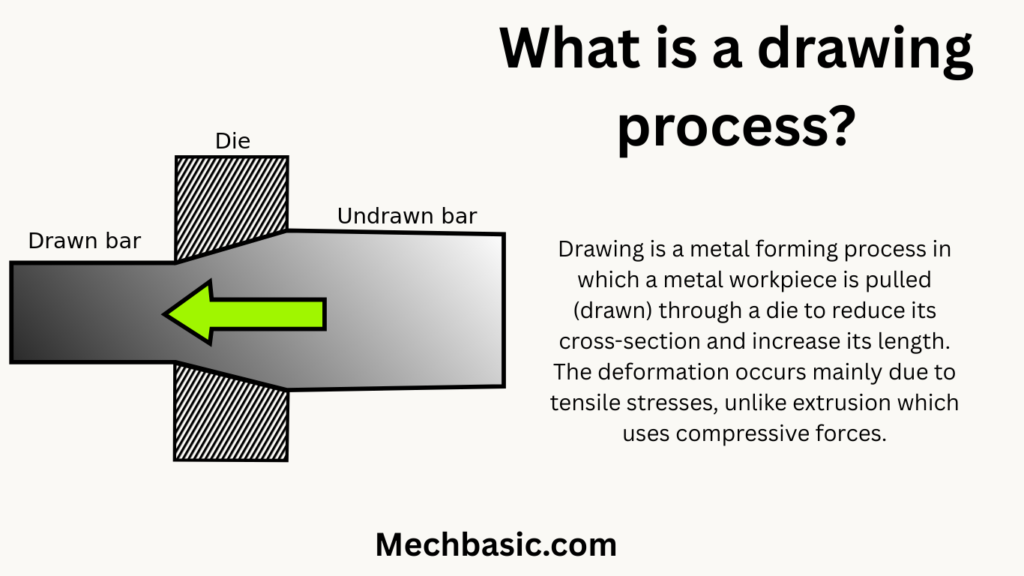
Drawing is a metal forming process in which a metal workpiece is pulled (drawn) through a die to reduce its cross-section and increase its length. The deformation occurs mainly due to tensile stresses, unlike extrusion which uses compressive forces.
Drawing is commonly used for producing wires, rods, bars, and tubes with accurate dimensions and good surface finish.
2. Principle of Drawing
- The material is subjected to tensile stress.
- The pulling force must be greater than the material’s yield strength.
- Plastic deformation occurs as the metal flows through the die.
- The die opening determines the final size and shape.
3. Types of Drawing Processes
3.1 Wire Drawing
- Used to produce small-diameter wires.
- Carried out in multiple passes through successively smaller dies.
Materials
- Copper, aluminum, steel
Applications
- Electrical wires
- Cables
- Springs
3.2 Bar and Rod Drawing
- Used for larger diameters than wire drawing.
- Single or multiple passes.
Applications
- Shafts
- Bolts
- Structural rods
3.3 Tube Drawing
Used to reduce tube diameter and wall thickness.
(a) Tube Drawing without Mandrel
- Diameter reduces, wall thickness increases slightly.
(b) Tube Drawing with Fixed Mandrel
- Controls internal diameter.
(c) Tube Drawing with Moving Mandrel
- Better dimensional accuracy.
(d) Tube Drawing with Plug
- Controls both ID and wall thickness.
4. Drawing Equipment
Main Components
- Drawing die
- Drawing bench
- Pulling mechanism
- Mandrel or plug (for tubes)
- Lubrication system
5. Working Steps of Drawing Process
- Preparation of Stock
- Rod, wire, or tube is cleaned and pointed (tapered).
- Lubrication
- Reduces friction and die wear.
- Drawing
- Stock is pulled through the die.
- Intermediate Annealing
- Performed between passes to restore ductility.
- Finishing
- Straightening, cutting, and coiling.
6. Drawing Dies
Die Materials
- Tungsten carbide
- Diamond (for fine wires)
- Tool steels
Die Geometry
- Entry angle
- Bearing length
- Exit angle
7. Temperature Conditions
- Mostly cold working
- Hot drawing used for difficult materials
8. Lubrication in Drawing
| Material | Lubricant |
|---|---|
| Steel | Soap, lime |
| Copper | Oil |
| Aluminum | Wax |
9. Defects in Drawing
| Defect | Cause |
|---|---|
| Central bursting | Excessive reduction |
| Surface scratches | Poor lubrication |
| Die marks | Worn die |
| Fracture | High tensile stress |
10. Advantages of Drawing
- Excellent surface finish
- High dimensional accuracy
- Improved mechanical properties
- High production rate
11. Limitations
- Limited reduction per pass
- Requires annealing
- Tensile stresses may cause failure
- Equipment cost
12. Applications
- Electrical wires
- Automotive parts
- Bicycle spokes
- Medical needles
- Heat exchanger tubes
13. Comparison with Extrusion
| Aspect | Drawing | Extrusion |
|---|---|---|
| Stress type | Tensile | Compressive |
| Force direction | Pulling | Pushing |
| Cross-section | Constant | Constant |
| Surface finish | Excellent | Moderate |
14. Summary
The drawing process is a precision metal forming operation used to produce long products with small cross-sections and high dimensional accuracy. It is widely used in the wire, tube, and rod manufacturing industries due to its ability to improve surface quality and mechanical strength.
FAQ Section:
- What is the drawing process in manufacturing?
Drawing is a metal forming process in which material is pulled through a die to reduce its cross-section and increase its length. - What materials are commonly used in the drawing process?
Common materials include steel, aluminum, copper, brass, and other ductile metals. - What products are made using the drawing process?
Typical products include wires, rods, bars, tubes, and pipes with precise dimensions. - How does drawing differ from extrusion?
In drawing, the material is pulled through the die, whereas in extrusion, the material is pushed through the die. - What are the main types of drawing processes?
The main types include wire drawing, bar drawing, tube drawing, and deep drawing. - What role does a die play in drawing?
The die controls the final shape, size, and surface finish of the drawn product. - Why is lubrication important in drawing?
Lubrication reduces friction, prevents surface damage, lowers drawing force, and improves tool life. - What defects can occur during the drawing process?
Common defects include surface scratches, central bursting, uneven thickness, and breakage. - Is drawing performed as a hot or cold process?
Drawing is usually a cold working process, but hot drawing may be used for large reductions. - What are the advantages of the drawing process?
Advantages include good dimensional accuracy, smooth surface finish, improved mechanical properties, and efficient material usage.
Other courses:





