
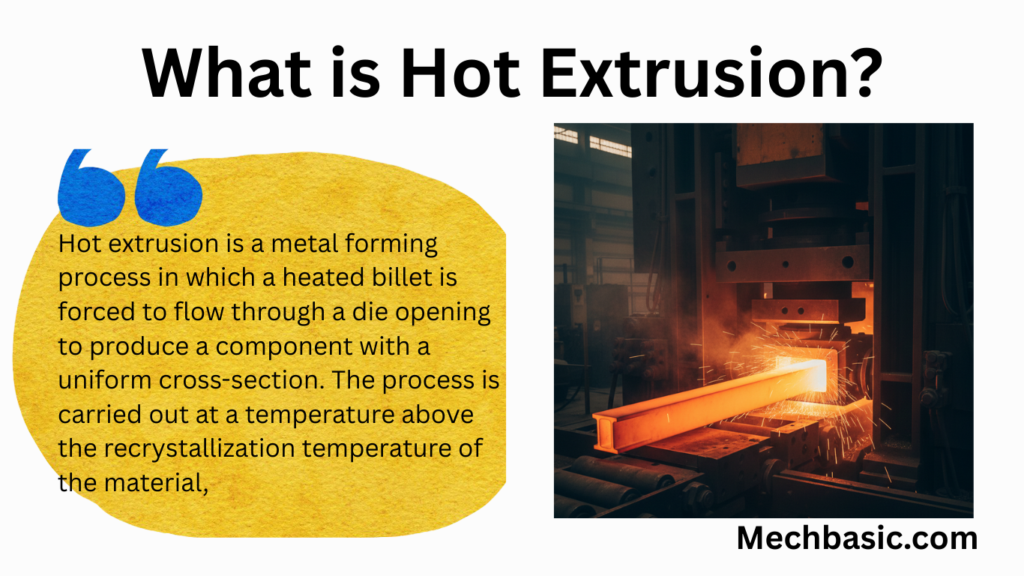
Hot extrusion is a metal forming process in which a heated metal billet is forced through a shaped die to produce a continuous cross-sectional profile. The material is heated above its recrystallization temperature, which makes it softer and easier to deform.
This process is commonly used for manufacturing aluminum, copper, and steel sections such as rods, tubes, and structural shapes. Hot extrusion allows the production of complex shapes with good surface finish and improved mechanical properties.
In this article:
- Hot Extrusion Process
- 1. Definition
- 2. Principle of Hot Extrusion
- 3. Hot Extrusion Setup and Equipment
- 4. Working Steps of Hot Extrusion
- 5. Types of Hot Extrusion
- 6. Materials Used in Hot Extrusion
- 7. Lubrication in Hot Extrusion
- 8. Defects in Hot Extrusion
- 9. Advantages of Hot Extrusion
- 10. Limitations
- 11. Applications of Hot Extrusion
- 12. Comparison with Cold Extrusion
- 13. Summary
Hot Extrusion Process
1. Definition
Hot extrusion is a metal forming process in which a heated billet is forced to flow through a die opening to produce a component with a uniform cross-section. The process is carried out at a temperature above the recrystallization temperature of the material, which prevents strain hardening and allows large plastic deformation.
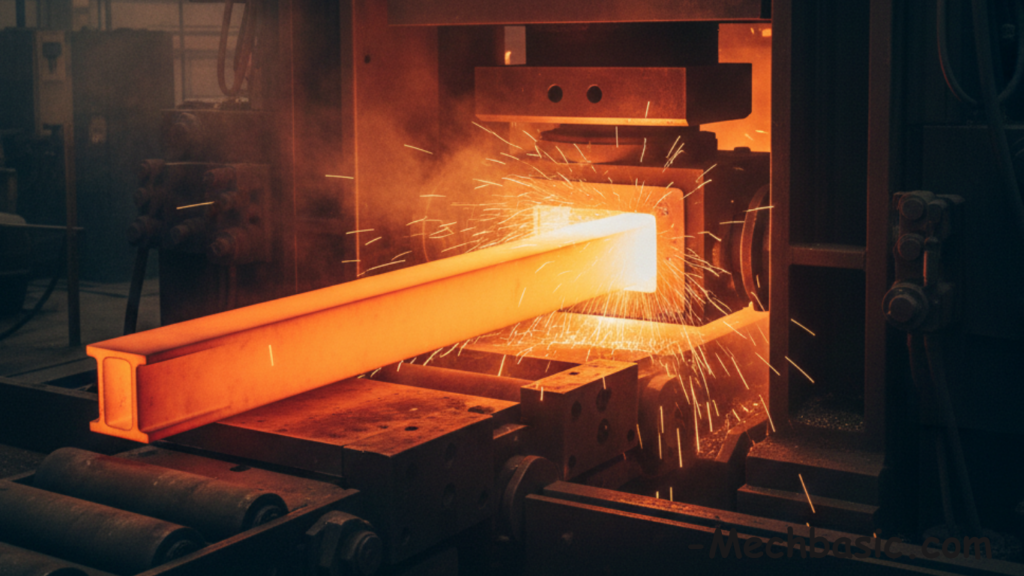
2. Principle of Hot Extrusion
When a metal is heated above its recrystallization temperature:
- Flow stress decreases
- Ductility increases
- New grains form continuously during deformation
As a result, the metal can be extruded easily with lower force and without work hardening.
3. Hot Extrusion Setup and Equipment
Main Components
- Billet (heated metal)
- Furnace (billet heating)
- Container
- Ram / Plunger
- Die
- Extrusion press (usually hydraulic)
- Run-out table and cooling system
4. Working Steps of Hot Extrusion
- Billet Preparation
- Metal billet is cast and homogenized.
- Surface is cleaned and lubricated.
- Billet Heating
- Billet is heated in a furnace to the required temperature.
- Example:
- Aluminum: 400–500 °C
- Steel: 1100–1250 °C
- Loading
- Heated billet is placed inside the container.
- Extrusion
- Ram applies high pressure.
- Metal flows plastically through the die opening.
- Product Exit
- Continuous extrudate comes out with constant cross-section.
- Cooling
- Product is cooled by air or water.
- Cutting and Finishing
- Extrudate is cut to required length.
- Further heat treatment or machining may follow.
5. Types of Hot Extrusion
5.1 Hot Direct (Forward) Extrusion
- Metal flows in same direction as ram.
- High friction at billet–container interface.
5.2 Hot Indirect (Backward) Extrusion
- Die moves into billet.
- Lower friction and lower force.
5.3 Hot Hydrostatic Extrusion
- Pressurized fluid used.
- Eliminates friction and prevents cracking.
6. Materials Used in Hot Extrusion
- Aluminum and aluminum alloys
- Copper and brass
- Magnesium alloys
- Steel and stainless steel
- Titanium alloys
7. Lubrication in Hot Extrusion
| Material | Lubricant |
|---|---|
| Aluminum | Glass powder, graphite |
| Steel | Glass lubricant |
| Copper | Graphite |
Lubrication:
- Reduces friction
- Prevents sticking
- Improves surface finish
8. Defects in Hot Extrusion
| Defect | Cause |
|---|---|
| Surface cracking | Excessive temperature |
| Pipe (tail pipe) | Oxidation and friction |
| Die lines | Die wear |
| Internal cracks | Improper speed or temp |
| Oxide pickup | Poor surface cleaning |
9. Advantages of Hot Extrusion
- Large deformation possible
- Lower extrusion force
- Suitable for brittle materials
- Complex shapes can be produced
- No strain hardening
10. Limitations
- Poor surface finish
- Oxidation and scaling
- Die wear
- Less dimensional accuracy
- High energy consumption
11. Applications of Hot Extrusion
- Aluminum window frames
- Pipes and tubes
- Heat sinks
- Structural profiles
- Automotive and aerospace components
12. Comparison with Cold Extrusion
| Feature | Hot Extrusion | Cold Extrusion |
|---|---|---|
| Temperature | Above recrystallization | Room temperature |
| Force | Low | High |
| Surface finish | Poor | Excellent |
| Accuracy | Moderate | High |
| Strength | Lower | Higher |
13. Summary
Hot extrusion is a widely used manufacturing process that allows the production of long components with complex cross-sections. Operating above the recrystallization temperature ensures low flow stress and continuous grain refinement, making it ideal for large deformation and difficult-to-form materials.
Other courses:





