
Extrusion in Tyre Manufacturing is a process in which heated rubber compound is forced through a shaped die to produce continuous tyre components such as tread, sidewall, and inner liner.
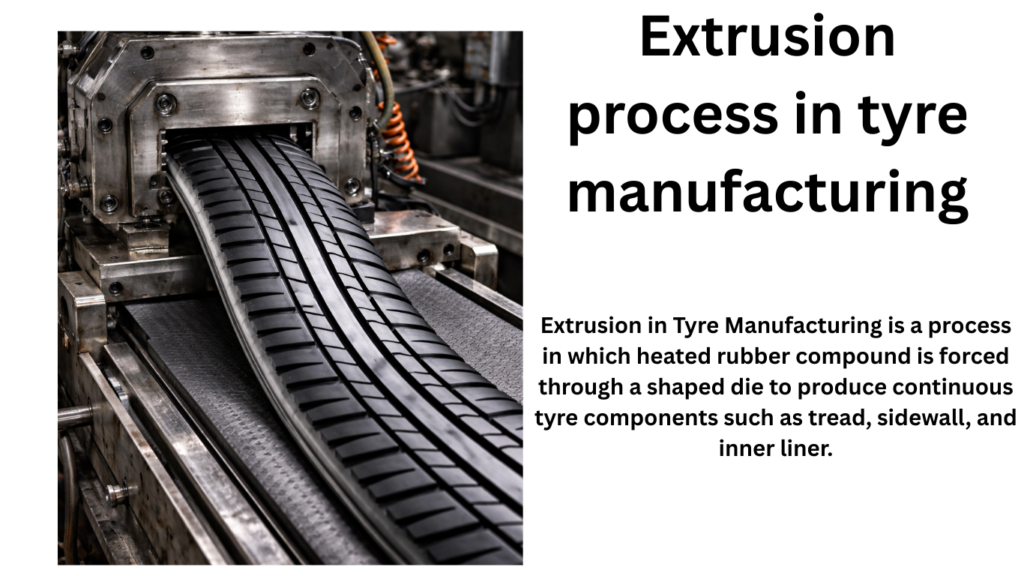
In this process, raw rubber is fed into an extruder, where it is heated, mixed, and pushed by a rotating screw through a die that gives the rubber its required cross-sectional shape. The extruded rubber strip is then cooled and cut to the required length before being assembled into the tyre.
Extrusion ensures uniform thickness, accurate shape, and consistent quality, making it a crucial step in tyre production.
In this article:
- Extrusion Process in Tyre Manufacturing
- 1. Purpose of Extrusion in Tyre Manufacturing
- 2. Raw Material for Tyre Extrusion
- 3. Extruder Used in Tyre Manufacturing
- 4. Working Principle of Tyre Extrusion
- 5. Types of Extrusion in Tyre Manufacturing
- 6. Co-Extrusion in Tyre Manufacturing
- 7. Temperature Control in Tyre Extrusion
- 8. Defects in Tyre Extrusion
- 9. Advantages of Extrusion in Tyre Manufacturing
- 10. Limitations
- 11. Quality Control in Tyre Extrusion
- 12. Comparison with Other Tyre Processes
- 13. Summary
Extrusion Process in Tyre Manufacturing
In tyre manufacturing, extrusion is a critical rubber-processing operation used to form continuous rubber components of specific cross-sections before tyre assembly. Unlike metal extrusion, tyre extrusion deals with rubber compounds that are viscoelastic and processed at controlled temperatures.
1. Purpose of Extrusion in Tyre Manufacturing
Extrusion is used to produce continuous rubber profiles such as:
- Tread
- Sidewall
- Inner liner
- Apex (bead filler)
- Chafers and strips
These extruded components are later cut to length and assembled on the tyre building machine.
2. Raw Material for Tyre Extrusion
2.1 Rubber Compounds
- Natural rubber (NR)
- Synthetic rubber (SBR, BR, Butyl rubber)
2.2 Additives
- Carbon black
- Sulphur
- Accelerators
- Plasticizers
- Anti-oxidants
Rubber compounds are prepared earlier in internal mixers or mills and fed to the extruder in strip or pellet form.
3. Extruder Used in Tyre Manufacturing
3.1 Screw Extruder (Most Common)
- Single-screw extruder is widely used.
- Screw rotates inside a heated barrel.
3.2 Main Parts
- Hopper
- Barrel with heating zones
- Rotating screw
- Extrusion head
- Die
- Cooling system
- Conveyor / take-off unit
4. Working Principle of Tyre Extrusion
- Feeding
- Rubber compound is fed through the hopper.
- Plasticizing
- Heat and shear soften the rubber inside the barrel.
- Conveying
- Screw transports rubber forward.
- Pressurization
- Rubber is compressed near the die.
- Shaping
- Rubber passes through a profile die giving required cross-section.
- Cooling
- Extrudate is cooled using air or water.
- Cutting
- Continuous strip is cut to required length.
5. Types of Extrusion in Tyre Manufacturing
5.1 Tread Extrusion
- Produces the outer running surface of the tyre.
- Requires high dimensional accuracy.
- Often uses dual or co-extrusion for cap and base layers.
5.2 Sidewall Extrusion
- Produces rubber for tyre sidewalls.
- Focus on surface finish and flexibility.
5.3 Inner Liner Extrusion
- Uses butyl rubber.
- Acts as an air-retaining layer.
- Requires smooth, defect-free extrusion.
5.4 Apex Extrusion
- Hard rubber placed above bead.
- Improves tyre stiffness and handling.
6. Co-Extrusion in Tyre Manufacturing
- Two or more rubber compounds extruded simultaneously.
- Example: Tread cap + tread base
- Improves performance and reduces assembly steps.
7. Temperature Control in Tyre Extrusion
- Barrel temperature: 70–120°C
- Die temperature carefully controlled
- Prevents premature vulcanization (scorch)
8. Defects in Tyre Extrusion
| Defect | Cause |
|---|---|
| Die swell | Elastic recovery of rubber |
| Surface roughness | Poor temperature control |
| Scorching | Excessive heat |
| Dimensional variation | Uneven pressure |
| Air entrapment | Improper feeding |
9. Advantages of Extrusion in Tyre Manufacturing
- Continuous and uniform production
- High dimensional accuracy
- Smooth surface finish
- Easy integration with tyre assembly
- Capability for multi-layer structures
10. Limitations
- High initial equipment cost
- Requires precise temperature control
- Material waste during startup
- Die maintenance required
11. Quality Control in Tyre Extrusion
- Profile measurement (laser gauges)
- Weight and thickness checks
- Surface inspection
- Temperature monitoring
12. Comparison with Other Tyre Processes
| Process | Purpose |
|---|---|
| Mixing | Compound preparation |
| Extrusion | Profile shaping |
| Calendaring | Fabric coating |
| Building | Tyre assembly |
| Curing | Vulcanization |
13. Summary
In tyre manufacturing, extrusion is an essential shaping process used to form critical rubber components like treads, sidewalls, and inner liners. Using screw extruders and precision dies, rubber compounds are plastically deformed into accurate profiles, ensuring tyre performance, durability, and safety.
Other courses:





