
Casting and forging are two widely used metal shaping processes in manufacturing. Casting involves pouring molten metal into a mold to obtain the desired shape, while forging shapes metal in the solid state using compressive forces. Both processes differ in their method of production, mechanical properties, cost, and applications, making them suitable for different engineering requirements.
In this article:
Casting Vs Forging-11 Differences :
Casting and forging are both fundamental metal manufacturing processes, but they differ greatly in how the metal is shaped, material properties achieved, cost, and typical applications. Below is a detailed, structured comparison.
1. Basic Definition
Casting
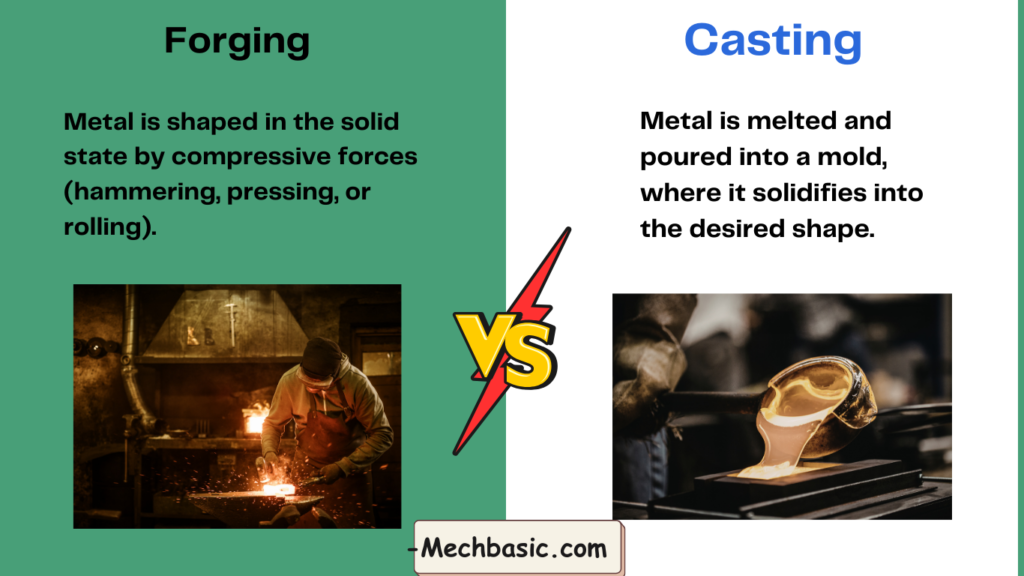
- Metal is melted and poured into a mold, where it solidifies into the desired shape.
- The mold cavity defines the final geometry.
Forging
- Metal is shaped in the solid state by compressive forces (hammering, pressing, or rolling).
- Deformation occurs below the melting point.
2. Process Steps
Casting Process
- Pattern creation
- Mold preparation (sand, ceramic, metal)
- Melting metal
- Pouring molten metal
- Solidification and cooling
- Mold removal
- Finishing (machining, cleaning)
Forging Process
- Heating metal (hot forging) or using room temperature (cold forging)
- Placing metal in dies
- Applying compressive force
- Trimming excess material
- Heat treatment (if required)
- Finishing
3. Mechanical Properties
| Aspect | Casting | Forging |
|---|---|---|
| Grain structure | Random, often coarse | Refined and aligned |
| Strength | Lower | Higher |
| Toughness | Lower | Higher |
| Fatigue resistance | Moderate to poor | Excellent |
| Impact resistance | Lower | Higher |
Reason:
- Forging realigns grains along the shape of the part, eliminating voids.
- Casting may introduce porosity, shrinkage, and inclusions.
4. Defects
Common Casting Defects
- Porosity (gas and shrinkage)
- Cold shuts
- Misruns
- Inclusions
- Hot tears
Common Forging Defects
- Laps
- Cracks (from improper temperature)
- Incomplete die filling
- Scale pits
Overall: Casting has a higher defect risk than forging.
5. Shape Complexity
Casting
- Excellent for complex geometries
- Internal cavities and thin sections possible
- Minimal machining needed
Forging
- Limited shape complexity
- Internal cavities difficult
- Often requires additional machining
6. Size Capability
| Feature | Casting | Forging |
|---|---|---|
| Very small parts | Yes | Yes (cold forging) |
| Very large parts | Yes (e.g., turbine housings) | Yes (shafts, crankshafts) |
| Thin sections | Easier | Harder |
7. Material Utilization
- Casting: Near-net shape, minimal waste
- Forging: More material waste due to flash and trimming
8. Production Volume & Cost
Casting
- Lower tooling cost
- Economical for low to medium production
- Slower cycle times
Forging
- High tooling and die cost
- Economical for high-volume production
- Faster cycle times after setup
9. Surface Finish & Accuracy
| Feature | Casting | Forging |
|---|---|---|
| Surface finish | Rougher (sand casting) | Better |
| Dimensional accuracy | Moderate | Higher |
(Precision casting can rival forging)
10. Types
Casting Types
- Sand casting
- Die casting
- Investment casting
- Centrifugal casting
Forging Types
- Open-die forging
- Closed-die forging
- Cold forging
- Hot forging
11. Applications
Typical Casting Applications
- Engine blocks
- Pump housings
- Valve bodies
- Machine tool bases
Typical Forging Applications
- Crankshafts
- Connecting rods
- Gears
- Aircraft structural components
- Hand tools
12. Summary Table
| Factor | Casting | Forging |
|---|---|---|
| Metal state | Liquid | Solid |
| Strength | Lower | Higher |
| Shape complexity | Very high | Moderate |
| Defects | More likely | Fewer |
| Cost (low volume) | Lower | Higher |
| Cost (high volume) | Higher | Lower |
| Fatigue life | Lower | Higher |
Conclusion:
- Choose casting for complex shapes, internal cavities, and lower cost at small volumes.
- Choose forging for high strength, durability, and fatigue resistance.
Other courses:





