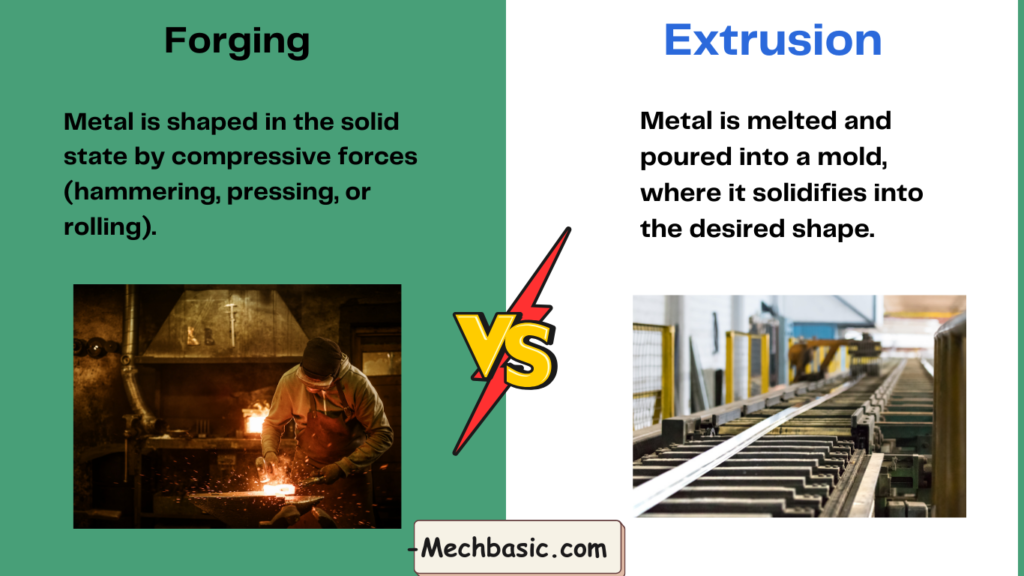
Extrusion and forging are important metal forming processes used to shape materials by plastic deformation under compressive forces.
While extrusion produces long components with a uniform cross-section by forcing metal through a die, forging shapes metal by applying compressive loads to obtain strong, durable components. Understanding the differences between extrusion and forging helps in selecting the appropriate process based on shape, mechanical properties, and application requirements.
Extrusion Vs Forging: 15 Differences you need to know
Below is a detailed, point-by-point comparison of Extrusion vs Forging, written in a clear, exam-ready format, including principle, process, characteristics, advantages, and applications.
1. Basic Definition
Aspect
Extrusion
Forging
Definition
A metal forming process in which material is forced to flow through a die to produce a uniform cross-section
A metal forming process in which metal is shaped by compressive forces using hammers or presses
2. Principle of Operation
Extrusion
Forging
Metal flows under compressive stress through a die opening
Metal is plastically deformed by compressive impact or squeezing forces
Material flows in the direction of extrusion
Material flows in multiple directions to fill the die cavity
3. Type of Forces
Aspect
Extrusion
Forging
Nature of force
Continuous compressive force
Intermittent or continuous compressive force
Stress state
Predominantly compressive and shear
Purely compressive
4. Temperature of Operation
Extrusion
Forging
Can be cold, warm, or hot extrusion
Mostly hot forging; also cold and warm forging
Hot extrusion reduces force requirement
Hot forging improves ductility
5. Shape and Geometry
Extrusion
Forging
Produces long components with uniform cross-section
Produces complex shapes with varying cross-sections
Extrusion is preferred for long products with uniform cross-section, while forging is chosen for high-strength components where superior mechanical properties are required.