
Forging defects are imperfections or irregularities that occur in forged components due to improper material properties, incorrect process parameters, poor die design, or handling errors during the forging operation.
These defects may affect the strength, durability, surface finish, and dimensional accuracy of the forged part, and in severe cases can lead to premature failure. Understanding forging defects is essential for improving product quality and ensuring reliable performance of forged components.
In this article:
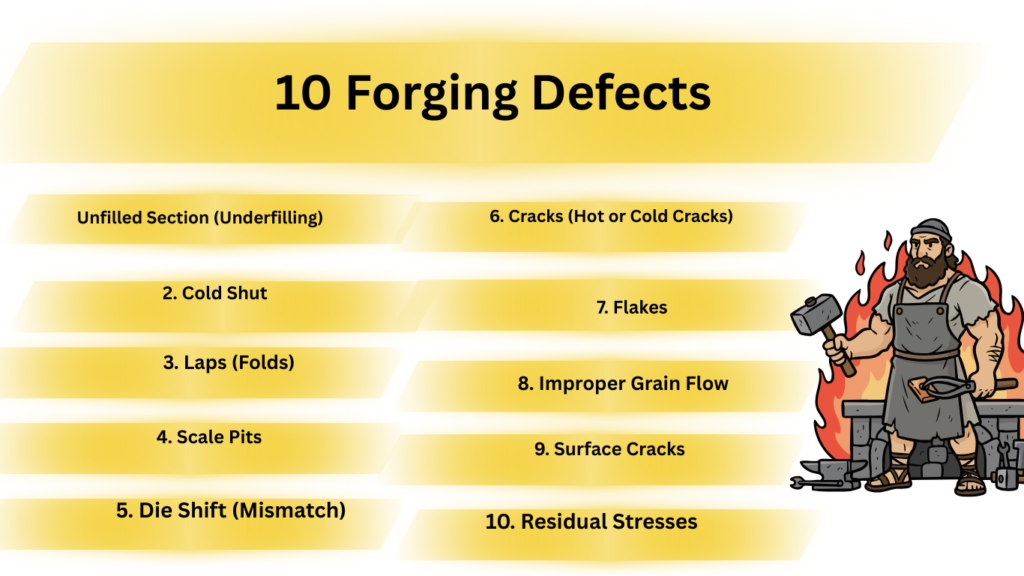
10 Forging defects :
Forging defects are flaws that occur in a forged component due to improper material, tooling, process parameters, or handling. Below is a detailed, exam-oriented explanation of the major forging defects, including causes, effects, and prevention methods.
1. Unfilled Section (Underfilling)
Description:
Incomplete filling of the die cavity, resulting in missing or thin sections.
Causes:
- Insufficient forging temperature
- Low forging pressure
- Improper die design
- Inadequate material volume
Effects:
- Reduced strength
- Dimensional inaccuracy
Prevention:
- Proper billet size
- Correct forging temperature
- Improved die design
- Adequate press/hammer force
2. Cold Shut
Description:
A crack-like line formed when two metal streams fail to fuse properly.
Causes:
- Low forging temperature
- Oxide formation on metal surfaces
- Poor metal flow
- Sharp corners in die
Effects:
- Acts as a stress concentrator
- May cause failure under load
Prevention:
- Proper temperature control
- Rounded die corners
- Clean billet surface
- Improved metal flow paths
3. Laps (Folds)
Description:
Folded-over metal surface that is forged into the component without welding.
Causes:
- Excessive metal flow
- Poor die design
- Over-sized billet
- Improper forging sequence
Effects:
- Weak surface regions
- Crack initiation points
Prevention:
- Correct billet size
- Proper die design
- Controlled metal flow
4. Scale Pits
Description:
Small depressions on the surface caused by oxide scales.
Causes:
- Oxidation at high temperatures
- Improper descaling
- Long heating time
Effects:
- Poor surface finish
- Reduced fatigue strength
Prevention:
- Descale billet before forging
- Use protective atmosphere
- Minimize heating time
5. Die Shift (Mismatch)
Description:
Misalignment of the top and bottom dies, causing offset geometry.
Causes:
- Improper die setting
- Worn guide pins
- Press misalignment
Effects:
- Dimensional inaccuracies
- Additional machining required
Prevention:
- Proper die alignment
- Regular die inspection
- Accurate press setup
6. Cracks (Hot or Cold Cracks)
(a) Hot Cracks
Description:
Cracks formed at high temperature during forging.
Causes:
- Excessive working temperature
- High strain rates
- Poor material ductility
Prevention:
- Controlled forging temperature
- Proper strain rate
(b) Cold Cracks
Description:
Cracks formed after forging during cooling.
Causes:
- Residual stresses
- Rapid cooling
- High carbon content
Prevention:
- Controlled cooling
- Stress-relief heat treatment
7. Flakes
Description:
Internal cracks usually visible after machining or heat treatment.
Causes:
- Hydrogen embrittlement
- Rapid cooling
- Improper heat treatment
Effects:
- Sudden brittle failure
Prevention:
- Degassing treatment
- Slow cooling
- Proper heat treatment
8. Improper Grain Flow
Description:
Grain orientation does not follow the shape of the forged part.
Causes:
- Poor die design
- Incorrect forging method
Effects:
- Reduced strength and fatigue life
Prevention:
- Proper die design
- Correct forging sequence
9. Surface Cracks
Description:
Fine cracks on the surface of the forging.
Causes:
- Excessive deformation
- Low forging temperature
- Sharp corners
Prevention:
- Adequate temperature
- Rounded die corners
- Proper lubrication
10. Residual Stresses
Description:
Locked-in stresses remaining after forging.
Causes:
- Uneven deformation
- Rapid cooling
Effects:
- Distortion during machining
- Reduced service life
Prevention:
- Stress-relief annealing
- Uniform cooling
Summary Table
| Defect | Main Cause | Key Prevention |
|---|---|---|
| Cold Shut | Low temp, oxide | Proper heating |
| Laps | Excess material | Correct billet size |
| Cracks | Thermal stress | Controlled cooling |
| Scale pits | Oxidation | Descaling |
| Die shift | Misalignment | Proper die setup |
Other courses:





