Casting is the manufacturing process in which molten metal is poured into a mould and allowed to solidify into a desired shape, while a mould is the hollow cavity or form that gives the casting its shape.
In this article
Difference Between Casting and Mould
This is a foundry fundamentals question that often shows up in manufacturing exams, vivas, and interviews. I’ll explain it clearly and in detail, starting from basic definitions and then moving to a point-by-point comparison.
1. What is Casting?
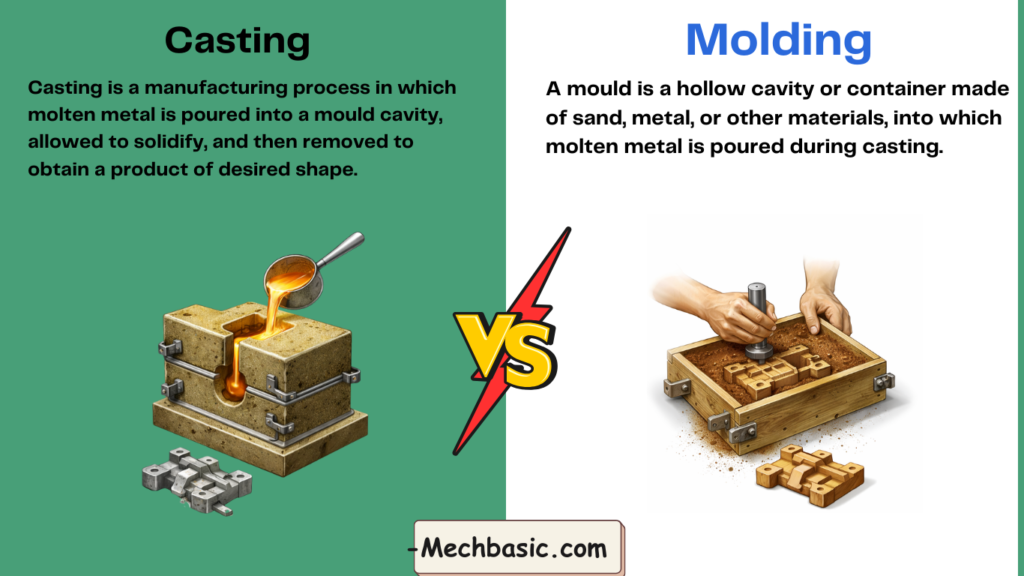
Casting is a manufacturing process in which molten metal is poured into a mould cavity, allowed to solidify, and then removed to obtain a product of desired shape.
Key points about Casting
- It is a process and also refers to the final solid product
- Involves melting, pouring, solidification, and finishing
- Can produce complex shapes, including internal cavities (with cores)
Examples
- Engine block
- Machine bed
- Pump casing
- Valve body
2. What is a Mold?
A mould is a hollow cavity or container made of sand, metal, or other materials, into which molten metal is poured during casting.
Key points about Mould
- It is a tool or form, not the product
- Gives shape to the molten metal
- Can be single-use (sand mould) or reusable (metal mould)
Examples
- Sand mould
- Die (die casting mould)
- Permanent mould
3. Role in Manufacturing
- Mould → gives shape
- Casting → shaped product obtained after solidification
So:
Mould is the negative cavity, casting is the positive replica
4. Casting vs Mould
| Aspect | Casting | Mould |
|---|---|---|
| Definition | Final solid product / process | Hollow cavity or container |
| Nature | Process or product | Tool or equipment |
| Material | Metal or alloy | Sand, metal, ceramic |
| Purpose | To produce component | To shape molten metal |
| Reusability | Used as final part | May be reusable or disposable |
| Removal | Removed from mould after solidification | Broken or opened to remove casting |
| Shape | Positive shape | Negative impression |
| Lifetime | Permanent part | Temporary or permanent |
| Example | Engine block | Sand mould |
5. Casting vs Mould
Think of ice cubes:
- Ice tray → mould
- Ice cube → casting
The tray shapes the water, but the cube is the final usable object.
6. Relationship with Pattern and Core
To avoid confusion:
- Pattern → used to make the mould
- Mould → cavity that holds molten metal
- Core → creates internal holes
- Casting → final product
Flow:
Pattern → Mould → (Core inside mould) → Casting
7. Advantages of Casting Process
- Produces complex shapes
- Suitable for large components
- Wide range of materials
- Cost-effective for mass production
8. Summary
- Casting is the manufacturing process and final product
- Mould is the shaping tool
- Mould is destroyed or opened, casting is retained
- Casting cannot exist without a mould
Other courses: