
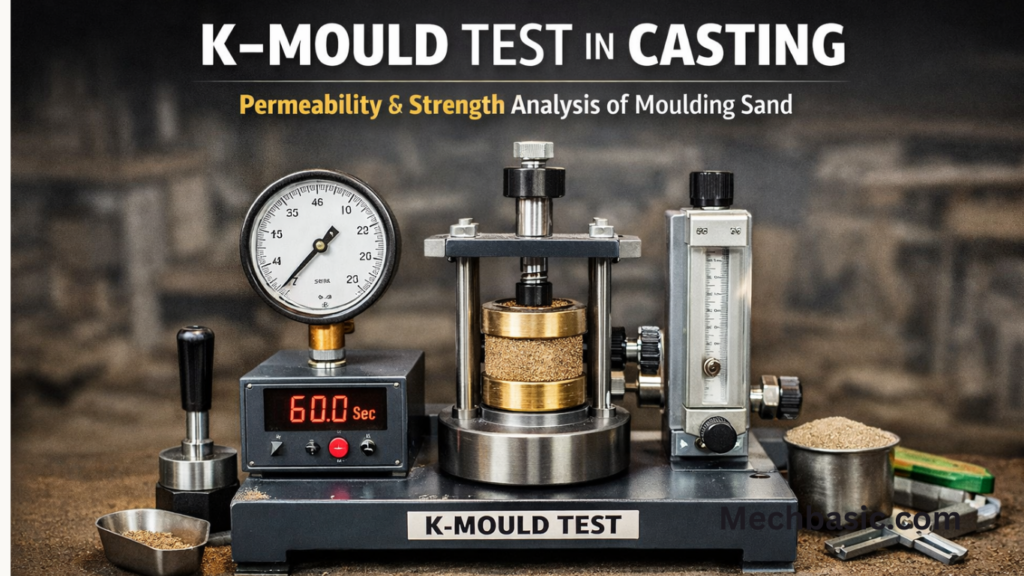
The K-mould test in casting is a standard sand-testing method used to determine the permeability of moulding sand. It measures how easily gases can pass through the sand, helping to prevent defects like blowholes during casting.
The K-mould test is a special foundry test used to evaluate the performance of moulding sand under actual molten-metal conditions. It is mainly used to study metal–mould interaction defects that cannot be predicted accurately by simple laboratory tests.
In this article:
- K-Mould Test in Casting
- 1. What is the K-Mould Test?
- 2. Purpose of the K-Mould Test
- 3. Construction of the K-Mould
- 4. Procedure of the K-Mould Test
- 5. Defects Evaluated in K-Mould Test
- 6. Interpretation of Results
- 7. Importance of K-Mould Test
- 8. Advantages of K-Mould Test
- 9. Limitations of K-Mould Test
- 10. Comparison with Standard Sand Tests
- 11. Conclusion:
- 12. Summary
K-Mould Test in Casting
The K-Mould Test is a sand testing method used in foundry practice to evaluate the moulding sand’s permeability and strength under controlled conditions. It helps determine whether the sand can allow gases to escape during casting while maintaining sufficient strength to hold the mould shape, thereby reducing casting defects such as blowholes and pinholes.
1. What is the K-Mould Test?
The K-mould test is a practical foundry test in which molten metal is poured into a specially designed K-shaped sand mould to evaluate the resistance of moulding sand to defects such as metal penetration, erosion, burn-on, and scabbing.
👉 It simulates actual casting conditions, unlike ordinary sand tests.
2. Purpose of the K-Mould Test
The test is used to determine:
- Metal penetration tendency
- Mould erosion resistance
- Burn-on and fusion defects
- Overall moulding sand quality
- Suitability of sand for steel and cast-iron castings
3. Construction of the K-Mould
- The mould cavity has a K-shaped cross-section
- Made using the same moulding sand used in production
- Contains sharp corners and thin sections to create severe thermal and metallurgical conditions
Why “K” shape?
- Causes high metal velocity
- Produces localized heating
- Exaggerates defects → easy evaluation
4. Procedure of the K-Mould Test
Step-by-step Process
- Prepare mould using test moulding sand
- Form the K-shaped cavity
- Pour molten metal (usually cast iron or steel)
- Allow solidification and cooling
- Break the mould and examine the casting
5. Defects Evaluated in K-Mould Test
(A) Metal Penetration
- Molten metal enters sand pores
- Produces rough, gritty surface
(B) Burn-On / Fusion
- Sand partially melts and sticks to casting surface
(C) Erosion
- Sand washed away due to metal flow
(D) Scabbing
- Sand surface lifts and creates surface projections
6. Interpretation of Results
The severity and location of defects on the casting indicate sand quality:
| Observation | Sand Property Indicated |
|---|---|
| Heavy penetration | Coarse sand / low refractoriness |
| Burn-on | Low refractoriness |
| Erosion | Low strength |
| Smooth surface | Good sand quality |
7. Importance of K-Mould Test
- Gives realistic assessment of moulding sand
- Helps select proper sand composition
- Prevents costly casting defects
- Especially useful for high-temperature alloys
8. Advantages of K-Mould Test
- Simulates actual casting conditions
- Detects defects not found by lab tests
- Simple interpretation
- Highly reliable for quality control
9. Limitations of K-Mould Test
- Requires molten metal
- Costlier than routine sand tests
- Not suitable for quick shop-floor testing
10. Comparison with Standard Sand Tests
| Test | What it Measures |
|---|---|
| Permeability test | Gas flow ability |
| Green strength test | Mould strength |
| Clay content test | Binder amount |
| K-mould test | Actual casting performance |
11. Conclusion:
K-mould test is a foundry test in which molten metal is poured into a specially shaped mould to evaluate moulding sand resistance to penetration, erosion, burn-on, and other metal–mould interaction defects.
12. Summary
- K-mould test = practical moulding sand evaluation
- Uses K-shaped cavity
- Detects penetration, erosion, burn-on
- Simulates real casting conditions
- Important for high-quality castings
Other courses:





