
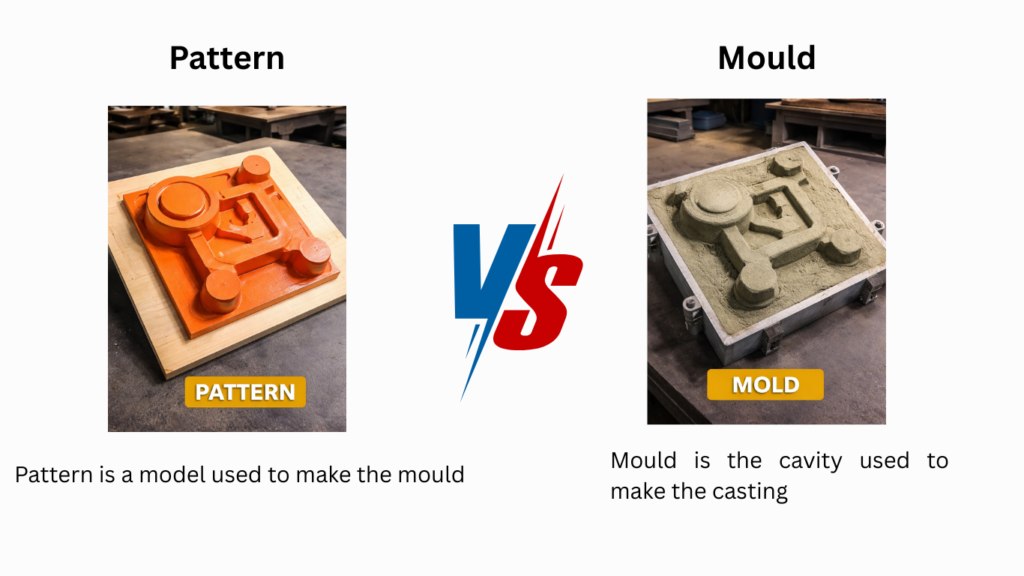
A pattern is a solid replica of the final casting used to create the mould cavity, while a mould is the hollow form made from sand or other materials into which molten metal is poured to produce the casting.
In this article:
Difference Between Pattern and Mould
In manufacturing, especially in casting processes, a pattern and a mould serve different but closely related purposes.
A pattern is a replica of the final product used to create the cavity, while a mould is the hollow form that receives the molten material to produce the actual component.
Understanding the difference between the two is essential for accurate production and quality control.
1. What is a Pattern?
A pattern is a replica or model of the casting to be produced, made slightly larger than the actual casting to account for various allowances (shrinkage, machining, draft, etc.).
Key points about Pattern
- Used to form the mould cavity
- Includes allowances
- Usually made of wood, metal, or plastic
- Removed before pouring molten metal
Example
A wooden model of an engine block used to create the mould cavity.
2. What is a Mould?
A mould is a hollow cavity formed around the pattern, usually made of moulding sand, into which molten metal is poured and allowed to solidify.
Key points about Mould
- Acts as the container for molten metal
- Gives final shape to the casting
- May be single-use or reusable
- Destroyed or opened to remove casting (sand mould)
Example
A sand cavity left behind after removing the pattern.
3. Functional Difference
- Pattern → creates the mould
- Mould → creates the casting
So:
Pattern is the positive shape, mould is the negative cavity
4. Pattern vs Mould – Comparison Table
| Aspect | Pattern | Mould |
|---|---|---|
| Definition | Replica of final casting | Hollow cavity to receive molten metal |
| Purpose | To form mould cavity | To shape molten metal |
| Material | Wood, metal, plastic | Sand, metal, ceramic |
| Allowances | Provided | Not provided |
| Reusability | Used repeatedly | Disposable (sand mould) or permanent |
| Position in process | Used before pouring | Used during pouring |
| Removal | Removed before pouring | Broken or opened after casting |
| Accuracy | High (depends on pattern quality) | Depends on moulding quality |
| Example | Wooden pattern | Sand mould cavity |
5. Relationship with Core (For Clarity)
- Pattern forms external shape
- Core forms internal cavities
- Mould holds molten metal
Flow:
Pattern → Mould → Core inside mould → Casting
6. Advantages of Using Patterns
- Ensures dimensional accuracy
- Allows mass production
- Enables complex shapes
- Reduces casting defects
7. Summary
- Pattern is a model used to make the mould
- Mould is the cavity used to make the casting
- Pattern includes allowances; mould does not
- Pattern is removed first; mould is destroyed later
Conclusion:
A pattern is a replica of the casting used to make the mould cavity, whereas a mould is the hollow cavity into which molten metal is poured to form the casting.
Other courses:





