
A pattern is a replica of the final casting, slightly modified with allowances, used in the manufacturing process to create the mould cavity into which molten metal is poured.
In this article:
- Pattern in Manufacturing Process (Casting)
- 1. Definition of Pattern
- 2. Purpose / Functions of a Pattern
- 3. Materials Used for Patterns
- 4. Types of Patterns (Basic)
- 5. Pattern Allowances (Very Important)
- 6. Pattern Colour Coding (Foundry Practice)
- 7. Characteristics of a Good Pattern
- 8. Difference Between Pattern and Casting (Quick View)
- 9. Applications of Patterns
- 10. Summary
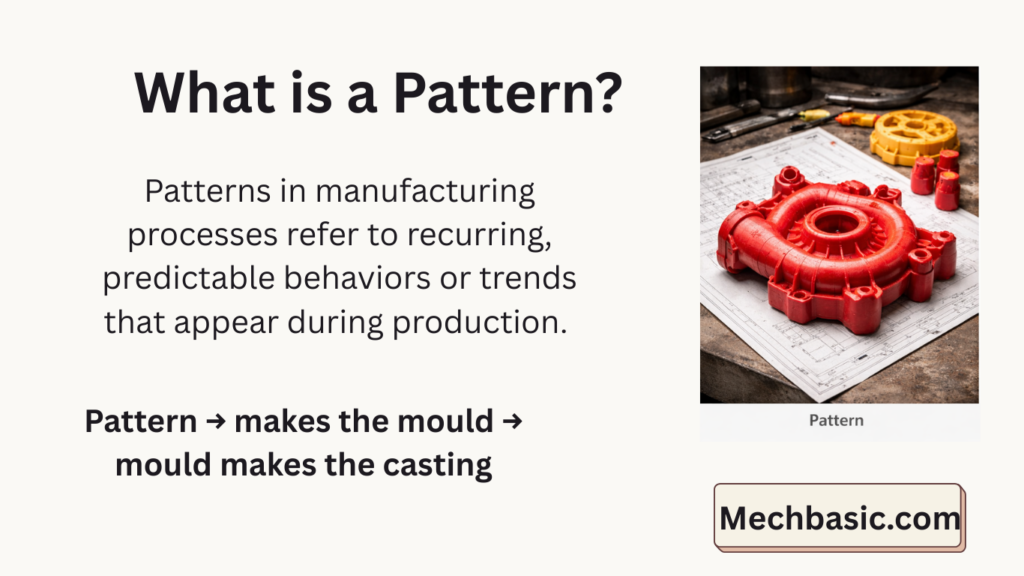
Pattern in Manufacturing Process (Casting)
Patterns in manufacturing processes refer to recurring, predictable behaviors or trends that appear during production.
These patterns help engineers and managers understand how materials, machines, and people interact over time, enabling better process control, quality improvement, and efficiency optimization.
By identifying and analyzing these patterns, manufacturers can reduce defects, minimize waste, and improve overall productivity.
1. Definition of Pattern
A pattern is a replica or model of the casting to be produced, used to form the mould cavity in the casting process.
It is made slightly larger than the actual casting to account for various allowances.
Pattern → makes the mould → mould makes the casting
2. Purpose / Functions of a Pattern
A pattern is used to:
- Form the mould cavity of desired shape
- Provide dimensional accuracy
- Include casting allowances
- Facilitate easy withdrawal from mould
- Provide support for cores (core prints)
3. Materials Used for Patterns
Patterns are made from materials that are easy to shape, durable, and dimensionally stable.
Common pattern materials:
- Wood – low cost, easy to make, short life
- Metal (Al, CI, steel) – high accuracy, long life
- Plastic / Resin – lightweight, smooth surface
- Wax – used in investment casting
4. Types of Patterns (Basic)
Some commonly used pattern types are:
- Solid (single-piece) pattern
- Split (two-piece) pattern
- Match-plate pattern
- Sweep pattern
- Skeleton pattern
- Loose-piece pattern
(Choice depends on shape, size, and production quantity.)
5. Pattern Allowances (Very Important)
Since metal shrinks and is machined later, allowances are added to the pattern.
Main allowances:
- Shrinkage allowance – compensates metal contraction
- Machining allowance – extra metal for finishing
- Draft allowance – helps pattern removal
- Rapping allowance – compensates mould enlargement
- Distortion allowance – accounts for warping
6. Pattern Colour Coding (Foundry Practice)
| Colour | Meaning |
|---|---|
| Red | Machined surfaces |
| Black | Unmachined surfaces |
| Yellow | Core prints |
| Green | Stop-off surfaces |
7. Characteristics of a Good Pattern
A good pattern should:
- Be dimensionally accurate
- Be strong and durable
- Allow easy withdrawal
- Provide smooth surface finish
- Be economical
8. Difference Between Pattern and Casting (Quick View)
- Pattern → model used before casting
- Casting → final metal product
9. Applications of Patterns
Used in manufacturing of:
- Engine blocks
- Machine tool beds
- Pump housings
- Valves
- Pipes and fittings
10. Summary
- A pattern is a model of the casting
- Used to form the mould cavity
- Made larger to include allowances
- Choice of pattern depends on shape and production volume
- Essential element of the casting process
Conclusion:
A pattern is a replica of the desired casting, used to form the mould cavity and made with suitable allowances to obtain accurate castings.
Other courses:





