
The two main types of die casting are hot chamber die casting and cold chamber die casting, classified based on how molten metal is fed into the die.
In this article:
Two Types of Die Casting :
In manufacturing, die casting is mainly classified into two types based on how molten metal is injected into the die. These two types are hot-chamber die casting and cold-chamber die casting.
1. Hot-Chamber Die Casting
Definition
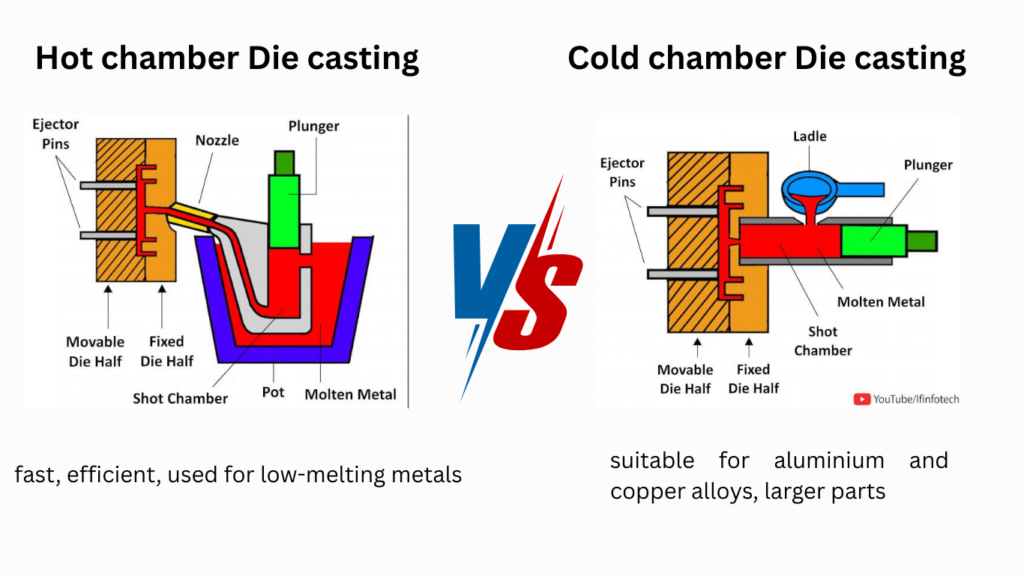
Hot-chamber die casting is a process in which the metal melting furnace is an integral part of the die casting machine, and molten metal is injected directly into the die.
Working Principle
- Metal is melted in a furnace attached to the machine
- A gooseneck mechanism is immersed in molten metal
- A piston pushes molten metal into the die cavity under high pressure
- Metal solidifies quickly
- Die opens and casting is ejected
Suitable Metals
- Zinc alloys (Zamak)
- Magnesium
- Lead and tin alloys
❌ Not suitable for aluminium and copper alloys (they damage the gooseneck)
Advantages
- Very fast cycle time
- High production rate
- Low metal wastage
- Better surface finish
- Less oxidation of molten metal
Disadvantages
- Limited to low-melting-point metals
- Machine cannot handle aluminium or copper
- Smaller casting size
Applications
- Electrical fittings
- Hardware components
- Automotive small parts
- Consumer goods
2. Cold-Chamber Die Casting
Definition
Cold-chamber die casting is a process in which molten metal is melted in a separate furnace and then poured into the shot chamber for injection.
Working Principle
- Metal is melted in a separate furnace
- Molten metal is ladled into the shot sleeve
- A hydraulic piston injects metal into the die under high pressure
- Metal solidifies
- Die opens and casting is removed
Suitable Metals
- Aluminium alloys
- Copper alloys
- Magnesium (sometimes)
Advantages
- Suitable for high-melting-point alloys
- Can produce larger and thicker castings
- Less machine corrosion
Disadvantages
- Slower cycle time than hot-chamber
- More oxidation during transfer
- Higher operating cost
Applications
- Automotive engine components
- Gear housings
- Structural aluminium parts
- Heavy industrial components
3. Comparison Table
| Feature | Hot-Chamber | Cold-Chamber |
|---|---|---|
| Furnace | Built into machine | Separate |
| Injection method | Gooseneck system | Shot sleeve |
| Suitable metals | Zn, Mg, Pb, Sn | Al, Cu, Mg |
| Cycle time | Very fast | Slower |
| Casting size | Small | Medium to large |
| Machine wear | High with Al | Lower |
| Production rate | Very high | High |
4. Summary
- Hot-chamber die casting → fast, efficient, used for low-melting metals
- Cold-chamber die casting → suitable for aluminium and copper alloys, larger parts
Conclusion
The two types of die casting are hot-chamber die casting, used for low-melting-point alloys, and cold-chamber die casting, used for high-melting-point alloys like aluminium and copper.
Other courses:





