
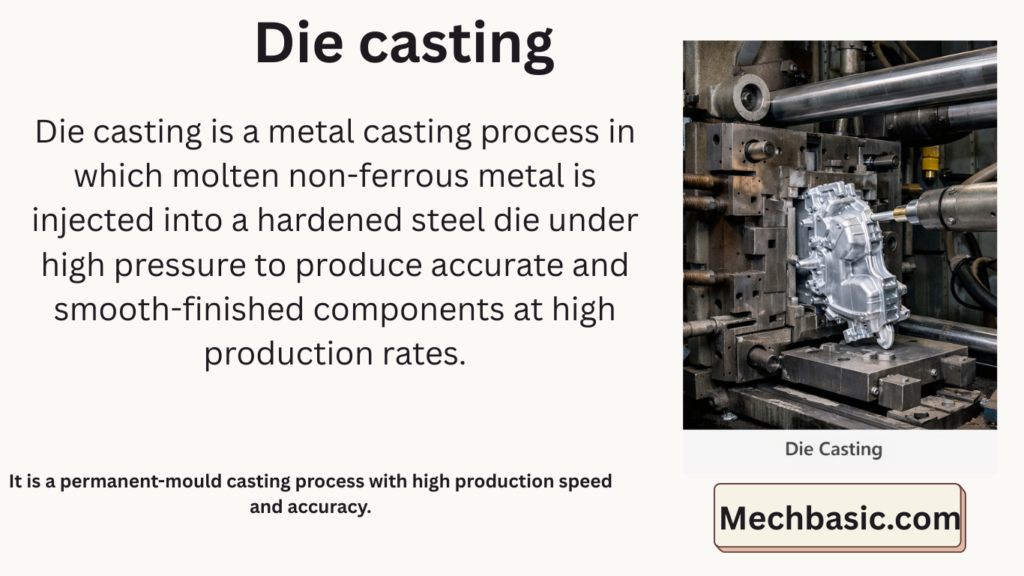
Die casting is a manufacturing process in which molten metal is injected into a reusable metal mould (die) under high pressure to produce precise, smooth-finished components.
In this article:
- Die Casting
- 1. Definition of Die Casting
- 2. Principle of Die Casting
- 3. Main Components of a Die Casting System
- 4. Types of Die Casting
- 5. Die Casting Process Steps
- 6. Materials Used in Die Casting
- 7. Advantages of Die Casting
- 8. Disadvantages of Die Casting
- 9. Defects in Die Casting (Common)
- 10. Applications of Die Casting
- 11. Comparison with Other Casting Processes
- 12. Summary
Die Casting
Below is a complete, structured, exam-ready explanation of DIE CASTING, written in clear technical language and suitable for manufacturing / mechanical engineering students, interviews, and shop-floor understanding.
1. Definition of Die Casting
Die casting is a metal casting process in which molten non-ferrous metal is injected into a hardened steel mould (called a die) under high pressure, allowed to solidify, and then ejected to produce a high-precision component.
It is a permanent-mould casting process with high production speed and accuracy.
2. Principle of Die Casting
- Molten metal is forced into a closed metal die at high pressure (10–200 MPa)
- The metal fills even thin and complex sections
- Rapid cooling occurs due to metal-to-metal contact
- Casting solidifies quickly and is ejected
3. Main Components of a Die Casting System
(a) Die (Mould)
- Made of hardened tool steel
- Consists of:
- Fixed die half
- Moving die half
- Cores and slides
- Ejector system
- Cooling channels
(b) Injection System
- Shot sleeve
- Plunger (piston)
- Hydraulic system
(c) Clamping System
- Keeps die closed against injection pressure
(d) Furnace
- Melts metal (built-in or separate)
4. Types of Die Casting
1. Hot-Chamber Die Casting
- Furnace is part of the machine
- Metal injected via gooseneck
- Suitable for low-melting-point metals
Metals used:
Zinc, magnesium, lead, tin
2. Cold-Chamber Die Casting
- Metal melted in separate furnace
- Ladled into shot sleeve
- Used for high-melting-point metals
Metals used:
Aluminium, copper alloys, magnesium
5. Die Casting Process Steps
- Die preparation
- Cleaned and sprayed with lubricant
- Clamping
- Die halves closed and locked
- Injection
- Molten metal injected under high pressure
- Solidification
- Rapid cooling in die
- Ejection
- Die opens and casting is ejected
- Trimming
- Gates, runners, flash removed
- Inspection
- Dimensional and quality checks
6. Materials Used in Die Casting
Common Alloys
- Aluminium alloys (A380, ADC12)
- Zinc alloys (Zamak series)
- Magnesium alloys
- Copper alloys (limited use)
Die Materials
- Tool steels (H13, H11)
7. Advantages of Die Casting
- High dimensional accuracy
- Excellent surface finish
- High production rate
- Thin walls and complex shapes possible
- Reusable dies
- Minimal machining required
- Good mechanical properties
- Low per-unit cost for mass production
8. Disadvantages of Die Casting
- High initial die cost
- Limited to non-ferrous metals
- Size limitation of castings
- Porosity due to trapped gases
- Design changes are expensive
- Not economical for small batches
9. Defects in Die Casting (Common)
- Gas porosity
- Shrinkage porosity
- Cold shut
- Misrun
- Flash
- Blister
- Soldering
- Die erosion
10. Applications of Die Casting
- Automotive parts (gear housings, engine covers)
- EV components
- Electrical and electronics housings
- Consumer appliances
- Aerospace components
- Industrial machinery parts
11. Comparison with Other Casting Processes
| Feature | Die Casting | Sand Casting |
|---|---|---|
| Mould | Steel (permanent) | Sand (temporary) |
| Accuracy | High | Moderate |
| Surface finish | Excellent | Rough |
| Production | Mass | Low-medium |
| Cost | High initial | Low initial |
12. Summary
- Die casting is a high-pressure permanent mould process
- Used for mass production of precision non-ferrous components
- Two types: hot-chamber and cold-chamber
- High accuracy and finish but high initial cost
Conclusion:
Die casting is a metal casting process in which molten non-ferrous metal is injected into a hardened steel die under high pressure to produce accurate and smooth-finished components at high production rates.
Other courses:





