
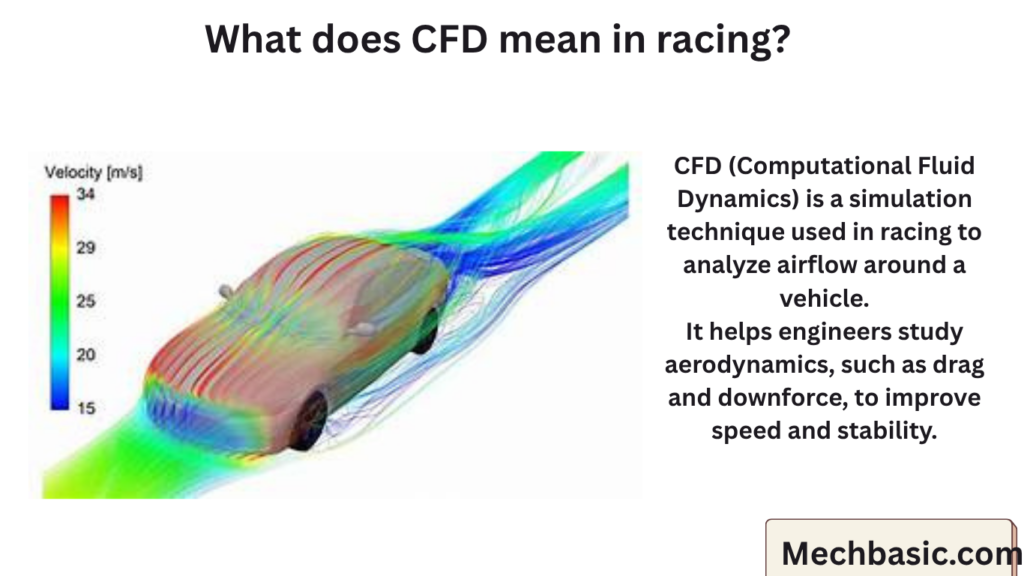
CFD (Computational Fluid Dynamics) is a simulation technique used in racing to analyze airflow around a vehicle.
It helps engineers study aerodynamics, such as drag and downforce, to improve speed and stability.
Teams use CFD software to optimize car design without extensive wind tunnel testing.
In this article:
In racing, CFD stands for Computational Fluid Dynamics, a powerful simulation technique used to analyze how air flows around a race car. It is critical for maximizing speed, stability, and performance without relying only on physical testing.
What is CFD in Racing?
CFD is based on the principles of Computational Fluid Dynamics, where computers solve fluid flow equations to simulate aerodynamics digitally.
CFD = “Virtual wind tunnel” inside a computer
Why CFD is Important in Racing
Airflow has a huge impact on race performance:
- Reduces drag → increases top speed
- Increases downforce → improves grip and cornering
- Enhances cooling → prevents engine overheating
- Improves fuel efficiency
How CFD Works in Racing
1. 3D Model Creation
- A detailed car model is created using CAD tools like:
- CATIA
- Siemens NX
2. Meshing
- The air around the car is divided into millions of small cells (mesh)
- Finer mesh = more accurate results
3. Boundary Conditions
- Define:
- Air speed (e.g., 300 km/h)
- Air pressure
- Temperature
- Ground motion (moving road effect)
4. Solving Fluid Equations
CFD solves equations based on:
- Navier–Stokes equations
👉 These equations describe how air moves and behaves.
5. Post-Processing
Results are visualized as:
- Airflow streamlines
- Pressure contours
- Velocity fields
Key Aerodynamic Parameters in Racing
1. Drag
- Resistance caused by air
- Lower drag → higher speed
2. Downforce
- Force pushing the car downward
- Higher downforce → better grip
3. Lift
- Opposite of downforce (undesirable in racing)
4. Drag Coefficient (Cd)
- Measures aerodynamic efficiency
Where CFD is Used in Race Cars
1. Front Wing
- Controls airflow over the car
- Generates downforce
2. Rear Wing
- Provides stability at high speeds
3. Diffuser
- Accelerates airflow under the car
- Increases downforce
4. Side Pods
- Direct airflow for cooling
5. Underbody (Ground Effect)
- Critical for modern race cars
- Generates massive downforce
Real Racing Applications
Formula 1
- Teams like Scuderia Ferrari and Mercedes-AMG Petronas Formula One Team rely heavily on CFD
- Strict regulations limit wind tunnel usage → CFD becomes essential
Motorsport Categories
- Formula 1
- MotoGP
- NASCAR
- Le Mans
CFD vs Wind Tunnel Testing
| CFD | Wind Tunnel |
|---|---|
| Virtual simulation | Physical testing |
| Lower cost (long term) | Expensive |
| Faster iterations | Slower |
| Highly flexible | Limited changes |
👉 Both are used together for best results.
Advantages of CFD in Racing
- Faster design improvements
- Reduced development cost
- Ability to test extreme conditions
- Detailed airflow visualization
- No need for full-scale prototypes initially
Limitations
- Requires high computing power
- Results depend on accuracy of model
- Needs expert knowledge
- Validation with real tests still required
Summary:
CFD in racing is like seeing the invisible air around a car and shaping it to make the car:
- Faster on straights 🚀
- More stable in corners 🏎️
- Safer at high speeds
Other courses:





