
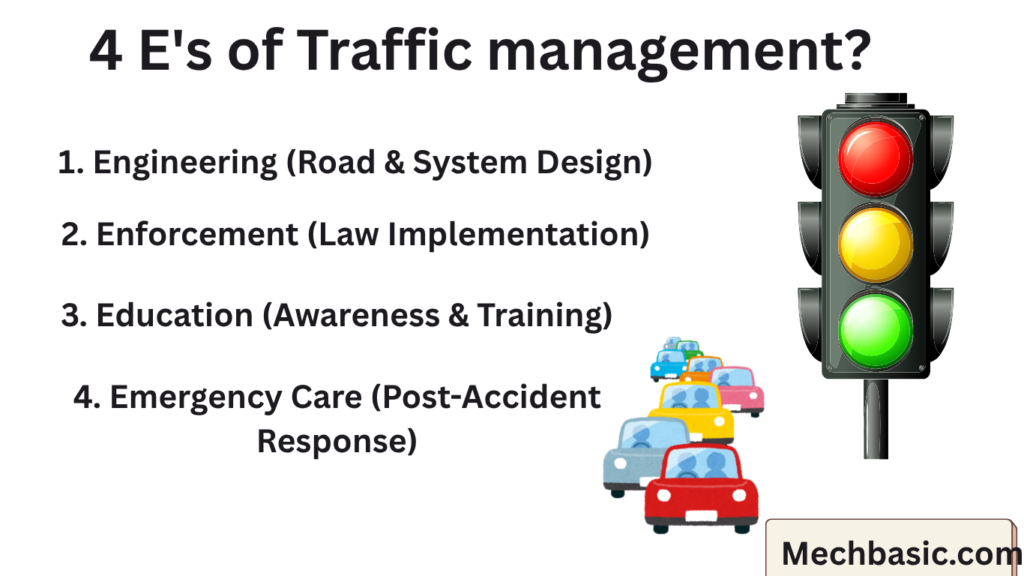
The 4 E’s of traffic management are Engineering, Enforcement, Education, and Emergency care.
Engineering focuses on road design and infrastructure, while Enforcement ensures traffic laws are followed.
Education creates awareness among road users, and Emergency care provides quick response to accidents.
In this article:
The “4 E’s of Traffic Management” are a foundational framework used worldwide to improve road safety and traffic efficiency. They represent four coordinated approaches: Engineering, Enforcement, Education, and Emergency Care.
The 4 E’s of Traffic Management
1. Engineering (Road & System Design)
This focuses on designing and maintaining safe road infrastructure to prevent accidents.
Key aspects:
- Road layout design (junctions, roundabouts, flyovers)
- Traffic signal systems (adaptive signals like SCATS)
- Road markings and signage
- Pedestrian crossings, footpaths, and cycling lanes
- Street lighting
- Speed breakers and barriers
Goal:
👉 Reduce the chances of accidents before they happen by making roads safer.
Example:
- Installing better signals and lane markings at accident-prone intersections in Chennai
2. Enforcement (Law Implementation)
This ensures that people follow traffic rules through monitoring and penalties.
Key aspects:
- Traffic police supervision
- Speed cameras and red-light cameras
- Fines and penalties for violations
- Use of technologies like ANPR (Automatic Number Plate Recognition)
Supported by:
- Traffic Police
Goal:
👉 Deter unsafe behavior like speeding, drunk driving, and signal jumping.
Example:
- E-challan systems for automatic fines
3. Education (Awareness & Training)
This involves teaching road users about traffic rules and safe behavior.
Key aspects:
- Road safety campaigns
- Driver education programs
- School awareness initiatives
- Public campaigns via media
Supported by:
- World Health Organization
- Ministry of Road Transport and Highways
Goal:
👉 Create responsible road users who follow rules voluntarily.
Example:
- Helmet and seatbelt awareness campaigns
4. Emergency Care (Post-Accident Response)
This focuses on reducing fatalities after accidents occur.
Key aspects:
- Ambulance services
- Trauma care centers
- Quick accident reporting systems
- First aid and bystander training
Critical concept:
- Golden Hour — the first hour after an accident is crucial for saving lives.
Goal:
👉 Minimize deaths and injuries through fast and effective response.
Example:
- Emergency ambulance services like 108 Emergency Response Service
How the 4 E’s Work Together
- Engineering prevents accidents
- Enforcement discourages violations
- Education builds awareness
- Emergency Care saves lives after accidents
👉 All four must work together for an effective traffic management system.
Summary:
“Safe Roads = Smart Design + Strict Rules + Aware People + Fast Help”
Other courses:





