
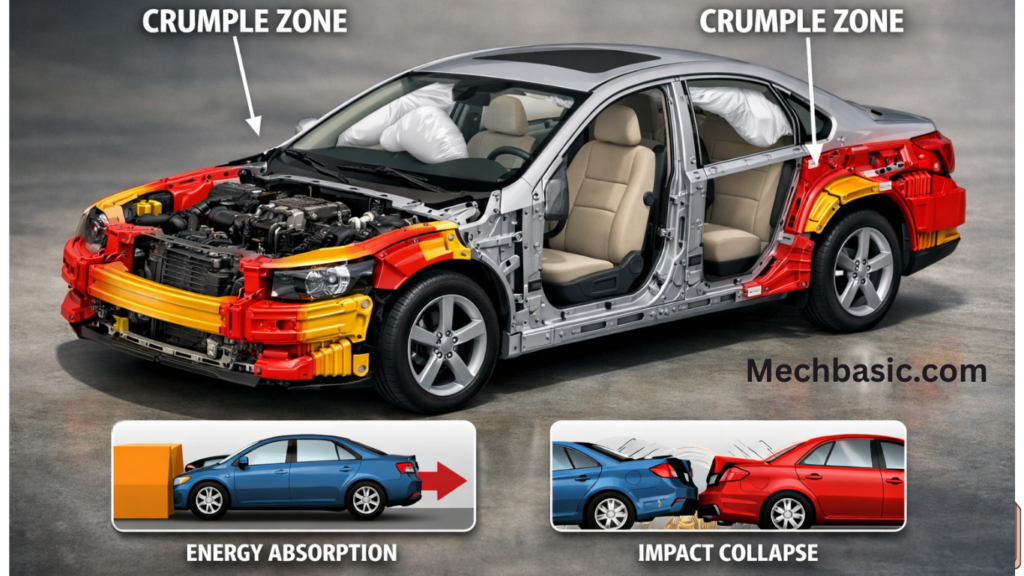
Crumple zones are parts of a car designed to absorb impact during a collision.
They deform in a controlled way to reduce the force transferred to passengers.
This helps protect occupants by slowing down the impact more gradually.
In this article:
Crumple zones:
Crumple zones are one of the most important safety features in modern cars. They are specially designed areas of a vehicle that deform (crumple) in a controlled way during a crash to protect the people inside.
What are crumple zones?
Crumple zones are sections—usually at the front and rear of a car—built to:
- Absorb crash energy
- Reduce the force reaching passengers
- Increase survival chances
They work based on the principle of conservation of energy:
- Energy from the crash must go somewhere
- Instead of transferring to your body, it’s absorbed by the car structure
How crumple zones work (step-by-step)
1. Before impact
- Car is moving with kinetic energy
- Structure is intact and rigid where needed
2. At impact
- Front/rear sections begin to collapse intentionally
- Metal folds in a controlled pattern
3. Energy absorption
- The crumpling:
- Converts kinetic energy into deformation
- Slows down the car gradually (even if only milliseconds)
4. Passenger protection
- The passenger cabin (called the safety cell) stays rigid
- Combined with seat belts and airbags:
- Forces on the body are reduced
Key parts of crumple zone design
Progressive deformation
- Designed to collapse in stages
- Prevents sudden, violent deceleration
Weak + strong zones
- Front/rear → weaker (crumple easily)
- Passenger cabin → very strong (doesn’t deform)
Fold patterns
- Engineers design metal to:
- Bend
- Fold
- Crush predictably
Materials used
- Mix of:
- High-strength steel
- Aluminum
- Composites
Where crumple zones are located
- Front engine bay
- Rear trunk area
- Sometimes side structures (doors, pillars)
Real-world example
At 50 km/h crash:
- Without crumple zones → force hits passengers almost instantly
- With crumple zones → impact is spread over a slightly longer time
👉 Even a tiny increase in time dramatically reduces injury due to impulse (force × time relationship)
Advantages of crumple zones:
1. Reduced injuries
- Less force on chest, head, spine
2. Works with safety systems
- Seat belts hold you in place
- Airbags cushion impact
3. Prevents cabin collapse
- Keeps survival space intact
Disadvantages of crumple zones:
1. Severe crashes
- At very high speeds, even crumple zones may not be enough
2. Repair cost
- Cars are designed to sacrifice themselves
- Repairs can be expensive
3. Small cars vs large vehicles
- Larger vehicles often have more crumple space
Crumple zones vs rigid cars
| Feature | Old cars (rigid) | Modern cars (crumple zones) |
|---|---|---|
| Body damage | Less | More |
| Passenger safety | Worse | Much better |
| Energy absorption | Poor | Excellent |
👉 A car that looks “more damaged” often protected its occupants better.
Summary
Crumple zones sacrifice the car to save your life.
Conclusion:
- Crumple zones absorb crash energy
- They reduce force using controlled deformation
- They work with seat belts + airbags
- They are a major reason modern cars are much safer
Other courses:





