
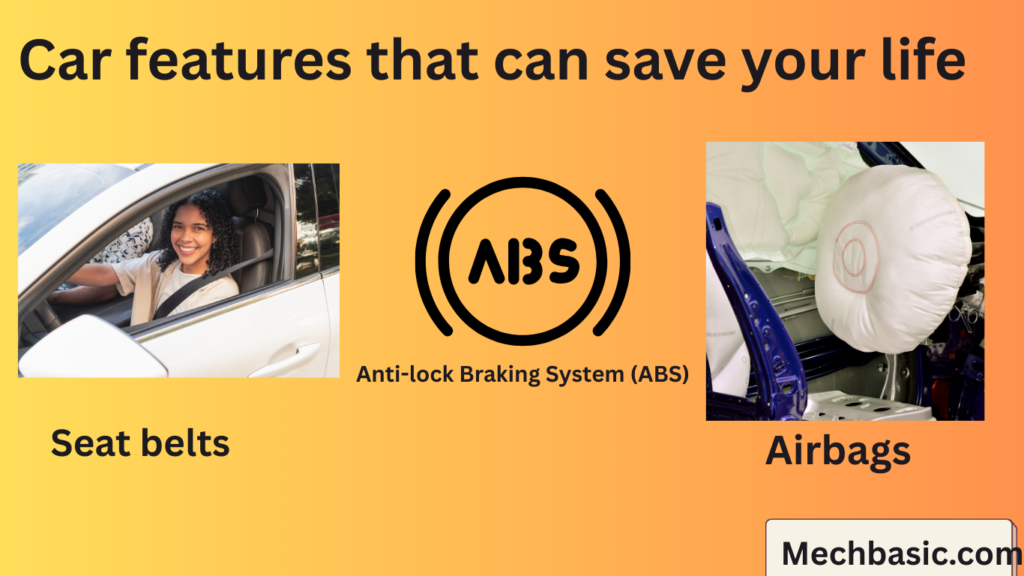
Modern cars are designed with advanced safety features to protect drivers and passengers during accidents. These technologies help prevent crashes and reduce injuries if a collision happens. Features like airbags, ABS, seat belts, electronic stability control, and rearview cameras can help save lives on the road.
In this article:
5 car features that can save your life
Modern cars include many safety technologies that can prevent accidents and protect passengers during a crash. Some features are designed to avoid accidents, while others reduce injuries if an accident occurs. Below are five important car features that can save your life, explained in detail.
1. Seat Belts
Definition
A seat belt is a safety restraint system designed to keep the driver and passengers securely in their seats during sudden braking or a collision.
Working
- When a car stops suddenly, passengers tend to move forward due to inertia.
- The seat belt restrains the body and holds it in place.
- The force of impact is spread across stronger body parts such as the chest and pelvis.
Key Components
- Webbing: Strong fabric strap.
- Retractor: Allows the belt to extend and retract automatically.
- Pretensioner: Tightens the belt instantly during a crash.
- Load limiter: Reduces pressure on the chest.
Importance
Seat belts can reduce the risk of death by about 45–50% in serious car accidents.
2. Airbags
Definition
Airbags are inflatable cushions that deploy instantly during a collision to protect passengers from hitting hard surfaces inside the vehicle.
Working
- Crash sensors detect sudden deceleration.
- The electronic control unit activates the inflator.
- Gas fills the airbag within milliseconds.
- The airbag cushions the passenger and then deflates quickly.
Types of Airbags
- Front airbags – protect the head and chest.
- Side airbags – protect the torso.
- Curtain airbags – protect the head in side collisions.
- Knee airbags – protect legs and knees.
Importance
Airbags work together with seat belts to reduce severe head and chest injuries.
3. Anti-lock Braking System (ABS)
Definition
ABS is a braking system that prevents the wheels from locking during emergency braking.
Working
- Wheel speed sensors monitor the rotation of each wheel.
- If a wheel stops rotating suddenly, the system reduces brake pressure.
- Brake pressure is applied repeatedly many times per second.
Advantages
- Prevents skidding.
- Allows the driver to maintain steering control.
- Improves braking performance on slippery roads.
Importance
ABS helps drivers maintain control during sudden braking, reducing the chance of accidents.
Also Read: Anti-lock Braking System (ABS)
4. Electronic Stability Control (ESC)
Definition
ESC is an advanced safety system that helps maintain vehicle stability and prevents skidding during turns or sudden maneuvers.
Working
- Sensors detect steering angle, wheel speed, and vehicle direction.
- If the vehicle begins to lose control, the system automatically applies brakes to individual wheels.
- It may also reduce engine power.
Advantages
- Prevents loss of control.
- Reduces rollover accidents.
- Improves handling on slippery roads.
Importance
ESC significantly reduces the chances of serious crashes caused by skidding or oversteering.
5. Automatic Emergency Braking (AEB)
Definition
Automatic Emergency Braking is an advanced driver assistance system that detects possible collisions and automatically applies the brakes if the driver does not respond.
Working
- Uses radar, cameras, or sensors to detect obstacles.
- Calculates the distance between the car and the object ahead.
- If a collision risk is detected, the system warns the driver.
- If the driver does not react, the system automatically brakes.
Advantages
- Prevents front-end collisions.
- Protects pedestrians and cyclists.
- Reduces accident severity.
Conclusion
The following five car features play a major role in saving lives:
- Seat Belts – protect passengers during a crash.
- Airbags – cushion impact and reduce injuries.
- ABS – prevents wheel lock and improves braking control.
- ESC – prevents skidding and loss of control.
- Automatic Emergency Braking – automatically stops the car to avoid collisions.
Together, these technologies greatly increase vehicle safety and reduce the risk of fatal accidents.
Other courses:





