
MAN B&W MC-C and ME-C engines are both two-stroke low-speed marine engines, but they differ greatly in how fuel injection and exhaust timing are controlled. MC-C uses mechanical systems, while ME-C is modern, camless, and electronically managed.
In this article:
1. What is an MC-C Engine?
MC-C is a MAN B&W two-stroke, low-speed marine diesel engine that uses a mechanical camshaft to control fuel injection, exhaust valve timing, and starting air distribution. It is a compact version of the older MC series, designed with lighter structure and improved power-to-weight ratio.
Fuel injection and valve operation are mechanically driven, giving fixed timing characteristics. MC-C engines are reliable and simple but less flexible for modern emission and efficiency requirements.
Example: MAN B&W 6S50MC-C
2. What is an MC-E Engine?
ME-C is a MAN B&W two-stroke, low-speed marine diesel engine that operates without a camshaft, using electronic control and hydraulic actuators for fuel injection and exhaust valve operation. An ECU manages timing, injection pressure, and combustion parameters for each cylinder independently.
This gives higher efficiency, lower emissions, and excellent performance at low loads. ME-C engines require fewer mechanical components and provide advanced automation compared to MC-C.
Example: MAN B&W 6S60ME-C
3. MC-C Vs MC-E Engine: 10 Differences
Below is a full, detailed, technical comparison between MAN B&W MC-C (mechanical) and ME-C (electronically controlled) two-stroke low-speed marine engines.
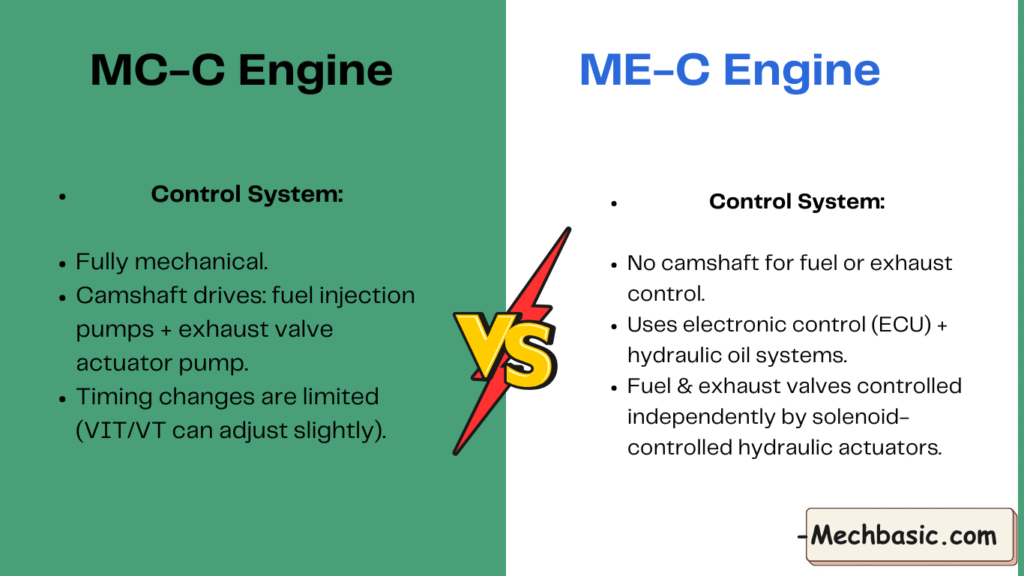
1. CONTROL SYSTEM DESIGN
MC-C
- Mechanical camshaft runs the entire timing system.
- Camshaft drives:
- Fuel injection pumps (plunger type)
- Exhaust valve actuator pump
- Starting air distributor
- Injection duration, timing, and exhaust opening are fixed by cam shape.
- Any timing adjustments (VIT, VEC) give only limited range.
ME-C
- No camshaft for fuel or exhaust valves.
- Fully electronically controlled by an Engine Control Unit (ECU).
- Uses hydraulic actuators controlled by solenoid valves for:
- Fuel injection
- Exhaust valve opening
- Timing, injection pressure, and rate shaping are all freely adjustable by software.
2. FUEL INJECTION SYSTEM
MC-C
- Plunger-type fuel pumps driven by the camshaft.
- Injection pressure depends on:
- Cam profile
- Plunger size
- Engine RPM
- Pressure is not fully controllable; changes require mechanical modifications.
- Injection profile is fixed (no rate shaping).
ME-C
- Fuel injection is electronically timed hydraulic injection.
- High-pressure servo oil opens fuel valves independently.
- ECU controls:
- Start of injection
- End of injection
- Injection rate (rate shaping)
- Multiple injections if required
- Enables precise combustion control → lower SFOC & emissions.
3. EXHAUST VALVE OPERATION
MC-C
- Exhaust valves open hydraulically but actuation pump is cam-driven.
- Timing depends on cam shape.
- No independent control of each cylinder’s valve timing.
ME-C
- Exhaust valves opened by electronically controlled hydraulic actuators.
- Each cylinder valve timing can be adjusted independently.
- Allows:
- Late or early exhaust timing
- Optimized scavenging
- Better slow-steaming performance
- Reduced NOx emissions
4. CAMSHAFT & MECHANICAL SYSTEMS
MC-C
- Has full camshaft train, chain drive, rollers, followers, and gears.
- Mechanical wear components → high maintenance.
- Requires accurate adjustment of:
- Fuel pump timing
- Exhaust actuator timing
- Starting air distributor
ME-C
- No camshaft → removes:
- Camshaft
- Camshaft chain drive
- Cam rollers/followers
- Mechanical timing mechanisms
- Fewer moving parts → less mechanical wear.
- Maintenance shifts to hydraulic blocks & electronics.
5. LUBRICATION SYSTEM
MC-C
- Cylinder lubrication can be mechanical or electronically controlled (Alpha system optional).
- Oil feed rate controlled by mechanical linkage or Alpha software.
ME-C
- Always uses Alpha Lubricator system.
- ECU controls cylinder oil injection based on:
- Load
- Sulfur content
- Wear rate
- Lower cylinder oil consumption.
6. ELECTRONICS & CONTROL SYSTEM
MC-C
- Basic automation: alarms, monitoring.
- No electronically controlled timing.
- Control relies on:
- Governors
- Mechanical actuation
- Pneumatic/hydraulic systems
ME-C
- Full computer-based control:
- ECU
- EICU (Cylinder control)
- Hydraulic control blocks
- Redundant sensors
- Allows:
- Optimization based on load
- Combustion monitoring
- Data logging
- Automatic diagnosis
7. STARTING SYSTEM
MC-C
- Starting air distributor mechanically driven by the camshaft.
- Timing is fixed mechanically.
ME-C
- Starting valves activated by solenoid valves.
- ECU controls exact cylinder firing order & timing.
- Gives safer and smoother starting, especially in low RPM.
8. MAINTENANCE
MC-C
- High maintenance due to mechanical parts:
- Camshaft alignment
- Roller wear
- Plunger pump wear
- Timing adjustments
- Requires more manual calibration.
ME-C
- Lower mechanical wear.
- Maintenance focused on:
- Hydraulic servo blocks
- Electronic units
- Injection valves
- Real-time diagnostics reduce troubleshooting time.
9. FUEL CONSUMPTION AND EMISSIONS
MC-C
- Higher SFOC (Specific Fuel Oil Consumption).
- Harder to comply with strict NOx emission regulations.
- Limited optimization at part load.
ME-C
- Lower SFOC due to optimized combustion.
- Meets IMO Tier II/Tier III (with EGR/SCR).
- Better at slow steaming (30–60% load) with high efficiency.
10. OPERATIONAL FLEXIBILITY
MC-C
- Best efficiency at design load.
- Poor flexibility for slow steaming.
- Limited adaptation to fuel type.
ME-C
- Excellent low-load performance.
- Easy switching between fuel types (HFO → MGO → LSFO).
- Software updates upgrade performance without hardware changes.
SUMMARY TABLE: MC-C vs ME-C
| Feature | MC-C | ME-C |
|---|---|---|
| Fuel control | Mechanical plunger pump | Electronic hydraulic |
| Exhaust valve | Cam-driven hydraulic | Electronically controlled |
| Camshaft | Yes | No |
| Timing flexibility | Low | Very high |
| SFOC | Higher | Lower |
| Emissions | Higher | Lower |
| Maintenance | Mechanical-heavy | Electronics + hydraulics |
| Slow steaming | Poor | Excellent |
| Cylinder lubrication | Mechanical or Alpha | Alpha (ECU controlled) |
| Part count | Higher | Lower mechanical complexity |
Conclusion:
Lets conclude with these 5 major differences:
1. Control System: MC-C uses a mechanical camshaft; ME-C uses full electronic ECU-based control.
2. Fuel Injection: MC-C has cam-driven plunger pumps; ME-C has electronically timed hydraulic injection.
3. Exhaust Valves: MC-C timing is cam-controlled; ME-C valves operate via electronic solenoid-hydraulic actuators.
4. Efficiency: ME-C offers lower fuel consumption and better low-load performance; MC-C is less flexible.
5. Maintenance: MC-C requires heavy mechanical upkeep; ME-C has fewer mechanical parts but more electronics/hydraulics.
Other courses:





