
A radiator in an automobile is a vital component of the engine’s cooling system, responsible for preventing overheating and maintaining optimal operating temperatures. It works as a heat exchanger, transferring excess heat from the hot engine coolant to the outside air as the vehicle moves or the cooling fan operates.
By keeping the engine at a stable temperature, the radiator helps ensure efficient combustion, protects engine components from thermal damage, and supports the overall reliability and performance of the vehicle.
Radiators in Automobiles
A radiator is a crucial component of a vehicle’s cooling system. Its main function is to dissipate heat from the engine coolant, preventing the engine from overheating and ensuring optimal performance.
1. Purpose and Function of a Radiator
- Removes excess heat absorbed by the coolant flowing through the engine.
- Helps maintain the ideal engine operating temperature (80–105°C).
- Prevents overheating, engine knocking, lubricant breakdown, and component damage.
- Ensures efficient fuel combustion by keeping engine temperature stable.
2. Construction of an Automobile Radiator
Key Parts
a) Core
- The central heat-exchanging unit.
- Made of multiple tubes and fins that increase surface area and improve cooling.
- Usually rectangular in shape for efficient airflow.
b) Tubes
- Coolant flows through these narrow channels.
- Made from aluminum or copper.
- Designs include:
- Flat tubes (better heat transfer)
- Multi-flow tubes for modern high-performance systems
c) Fins
- Thin metal sheets attached to tubes.
- Increase heat dissipation by exposing more area to air.
- Types: louvered fins, serpentine fins.
d) Tanks/Headers
- Coolant enters and exits the core through side tanks.
- Produced from plastic (Nylon-reinforced), brass, or aluminum.
e) Pressure Cap
- Maintains a specific pressure in the cooling system (typically 1.0–1.5 bar).
- Allows the coolant to reach higher boiling temperature.
- Contains a spring-loaded valve for overflow.
f) Inlet & Outlet Ports
- Connect radiator to the engine through hoses.
3. Working Principle of a Radiator
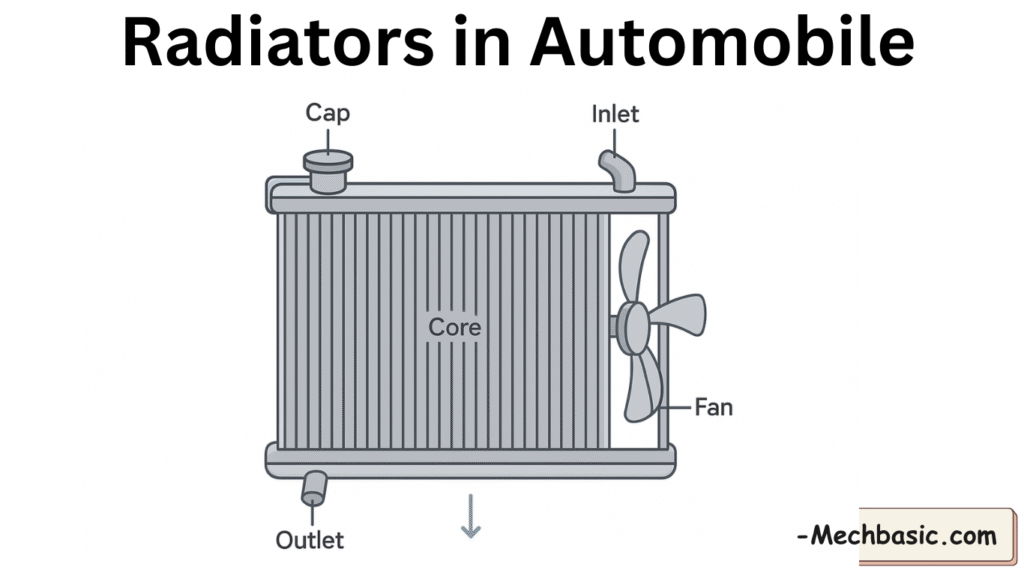
- Coolant absorbs heat from the engine block.
- Hot coolant flows into the radiator through the upper hose.
- The coolant passes through the tubes.
- Air flowing across the fins (via forward motion or cooling fan) removes heat.
- The now-cooled coolant exits through the bottom hose back to the engine.
- Cycle repeats continuously while the engine runs.
4. Types of Radiators Used in Automobiles
A) Based on Construction
1. Tubular Radiators
- Traditional design with tubes and fins.
- Widely used in most passenger cars.
2. Cross-Flow Radiators
- Coolant flows horizontally across the radiator.
- Cap is on the low-pressure tank.
- Better for modern vehicles with slanted hoods.
3. Down-Flow Radiators
- Coolant flows vertically from top to bottom.
- Common in older vehicles and trucks.
B) Based on Material
1. Aluminum Radiators
- Lightweight and excellent heat conductivity.
- Most modern vehicles use them.
2. Copper-Brass Radiators
- Superior heat transfer, strong.
- Used in heavy-duty engines and older models.
3. Plastic-Aluminum Composite Radiators
- Plastic side tanks + aluminum core.
- Cost-effective and corrosion-resistant.
5. Materials Used in Radiators
| Part | Common Materials | Reason |
|---|---|---|
| Tubes | Aluminum, Copper | High heat conductivity |
| Fins | Aluminum | Lightweight, corrosion-resistant |
| Tanks | Plastic (Nylon-reinforced), Aluminum | Lightweight, low cost |
| Core | Aluminum | Efficient heat transfer |
6. Radiator Cooling Methods
a) Air Cooling
- Air flows over fins to cool coolant.
- Helped by radiator fans at low speeds.
b) Liquid Cooling
- Uses coolant + water mixture (typically 50:50).
- More effective than air alone.
c) Forced Convection
- Radiator fans push/pull air through fins.
7. Radiator Fans
Radiator fans improve cooling when airflow is low.
Types
- Mechanical Fan (driven by engine)
- Electric Fan (controlled by ECU and temperature sensor)
- Thermostatic Fan (engages at preset temperature)
8. Coolant Used in Radiators
A mixture of:
- Ethylene glycol or propylene glycol
- Water (distilled)
- Corrosion inhibitors & anti-freeze compounds
Functions:
- Raises boiling point, lowers freezing point, prevents rust, lubricates water pump.
9. Common Radiator Problems
1. Leaks in tubes or tanks
From corrosion or physical damage.
2. Clogged fins or tubes
Reduces heat transfer.
3. Faulty radiator cap
Causes pressure loss and overheating.
4. Air pockets
Prevent efficient coolant circulation.
5. Sediment buildup
Due to old coolant or contamination.
10. Modern Advancements in Radiator Technology
- Dual-pass and triple-pass radiators for higher efficiency.
- High-efficiency louvered fins to maximize airflow.
- Lightweight aluminum alloys for better strength-to-weight ratio.
- Integrated transmission coolers in some vehicles.
- Smart thermal management used in electric and hybrid vehicles.
Other courses:





