
Electric vehicles (EVs) have some of the most optimized weight distributions in automotive engineering, and this is one of the major reasons EVs handle smoothly, feel stable, and deliver a comfortable ride.
Below is a complete, engineering-level explanation of EV weight distribution: what it is, how it works, and why it matters.
In this article:
- 1. Why Weight Distribution Is So Important in EVs
- 2. Typical EV Weight Distribution Ratios
- 3. How EV Layout Enables Excellent Weight Distribution
- 4. How EV Weight Distribution Improves Driving Dynamics
- 5. Weight Distribution in Different Types of EV Layouts
- 6. Weight Distribution Challenges Unique to EVs
- 7. How Manufacturers Tune EV Weight Distribution
- 8. Summary
1. Why Weight Distribution Is So Important in EVs
EVs have:
- Heavy battery packs
- Compact electric motors
- Low center of gravity (thanks to battery placement)
- Flexible packaging compared to internal combustion vehicles
Because of this, EV engineers can design weight distribution more freely and more precisely than in gasoline or diesel vehicles.
2. Typical EV Weight Distribution Ratios
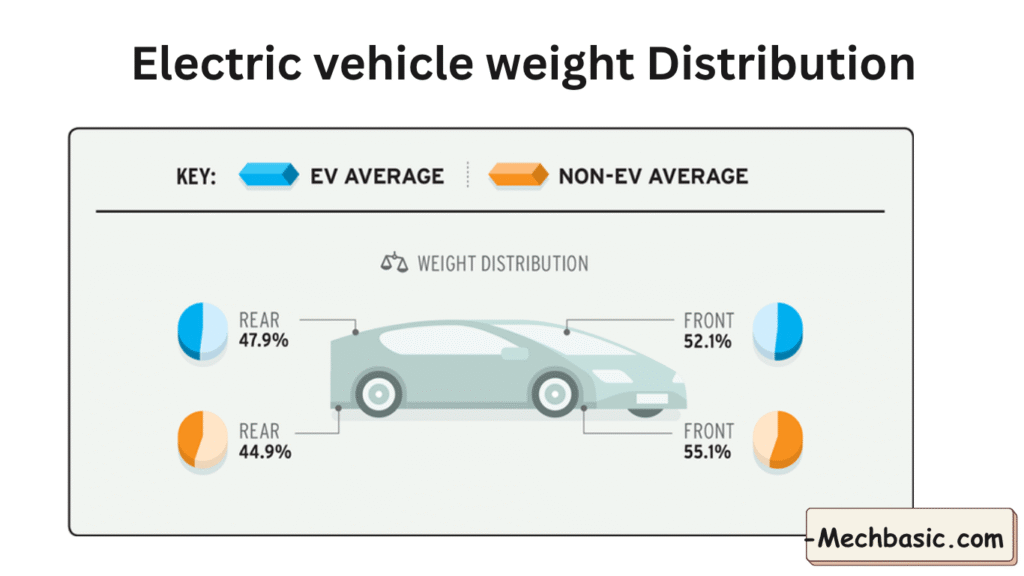
Most modern EVs aim for near 50/50 weight distribution, meaning:
- 50% weight on the front axle
- 50% weight on the rear axle
This is ideal for:
- Stability
- Handling
- Even tire loading
- Predictable cornering
However, some EVs are intentionally slightly rear-biased:
- Porsche Taycan: ~48/52
- Tesla Model 3: ~47/53
- BMW i4: ~48/52
Rear-biased balance improves:
- Traction during acceleration
- Cornering agility
3. How EV Layout Enables Excellent Weight Distribution
A. Battery Pack Placement
The battery is the heaviest component in an EV.
Typical EV battery mass: 350–700 kg
In many EVs, the battery makes up 20–30% of the vehicle’s total weight.
Where is it located?
→ Under the floor, spread evenly between the axles.
This gives:
- A low center of gravity
- Even weight spread front-to-rear
- Reduced pitch and roll
- Strong rollover resistance
This placement is sometimes called a “skateboard platform”.
B. Electric Motor Placement
EV motors are:
- Much smaller than engines
- Very light (20–90 kg)
- Can be mounted directly on the axle
This allows engineers to “fine-tune” weight balance by positioning motors:
- Front axle (FWD EVs)
- Rear axle (RWD EVs)
- Both axles (AWD EVs)
Dual-motor AWD EVs typically achieve the best balance.
C. Absence of Heavy Front Engine
EVs do not have:
- A heavy cast-iron block engine
- A transmission bell housing
- Radiators, exhaust systems, fuel tanks
This frees up space and reduces front-heavy bias.
The front of an EV is usually:
- Lighter
- A crumple zone
- Sometimes a “frunk”
This helps tune weight more evenly.
D. Flexibility in Component Placement
EVs can place:
- Power electronics
- Inverter
- DC/DC converters
- Onboard chargers
- Cooling systems
…in locations that balance weight, often behind or around the battery.
4. How EV Weight Distribution Improves Driving Dynamics
1. Better Handling
Even weight distribution reduces:
- Understeer (common in FWD ICE cars)
- Oversteer (common in rear-engine cars)
Balanced EVs feel “planted” and stable.
2. High-Speed Stability
Low CG + balanced weight =
Less body movement at highway speeds.
3. Smooth Ride Quality
EVs have:
- Low unsprung weight (due to simpler drivetrains)
- Heavy mass very low and centered
→ Less body bounce
→ Better ride over bumps
→ Reduced “nose dive” when braking
4. Better Traction
Rear-biased EVs improve acceleration traction because weight transfers rearward under acceleration.
5. Enhanced Cornering
Even weight = even tire loading = more predictable grip.
5. Weight Distribution in Different Types of EV Layouts
A. Single-Motor RWD EVs
Example: Tesla Model 3 RWD
Weight distribution: typically 47/53
Benefits:
- Excellent traction
- Good handling balance
- Stable during acceleration
B. Single-Motor FWD EVs
Example: Nissan Leaf
Weight distribution: 55/45 to 58/42
More front-heavy because the motor sits up front.
C. Dual-Motor AWD EVs
Examples: Tesla Model Y, Hyundai Ioniq 5
Weight distribution: 49/51, 50/50, or 51/49
Best balanced and most stable.
D. High-Performance EVs
Example: Porsche Taycan, Audi e-tron GT
Weight distribution: 48/52
Intentionally rear-biased for:
- Launch traction
- Cornering agility
- Sports-car handling
6. Weight Distribution Challenges Unique to EVs
Despite advantages, EVs face some challenges:
A. High Overall Vehicle Weight
EVs are heavier because of the large battery pack.
Even if balanced, higher mass affects:
- Braking distance
- Tire wear
- Energy consumption
- Crash forces
B. Uneven weight over each wheel
If a battery is not perfectly centered, engineers compensate with suspension tuning.
C. Front axle steering load
Even with good weight distribution, steering may feel heavier in cheaper EVs.
7. How Manufacturers Tune EV Weight Distribution
Automakers use:
- Suspension stiffness (spring rate changes)
- Roll centers and anti-roll bars
- Battery module placement adjustments
- Software-controlled torque vectoring
- Motor power split between axles
- Aerodynamic balancing
These methods let EVs feel agile despite weight.
8. Summary
Electric vehicles have the best weight distribution engineering in the modern automotive world.
✔ Why?
- Heavy battery placed low and centered
- Flexible motor placement
- No large front engine
- Designed around a flat “skateboard” base
✔ Benefits:
- Near-perfect 50/50 balance
- Low center of gravity
- Excellent handling
- Smooth ride comfort
- High traction and stability
- Predictable cornering
✔ Typical Ratios:
- RWD EVs: 47/53
- FWD EVs: 55/45
- Dual-motor EVs: 50/50
- Performance EVs: 48/52
Other courses:





