
Here is a comprehensive, clear, and well-structured explanation of Hybrid Electric Vehicles (HEVs):
In this article:
Hybrid Electric Vehicle (HEV):
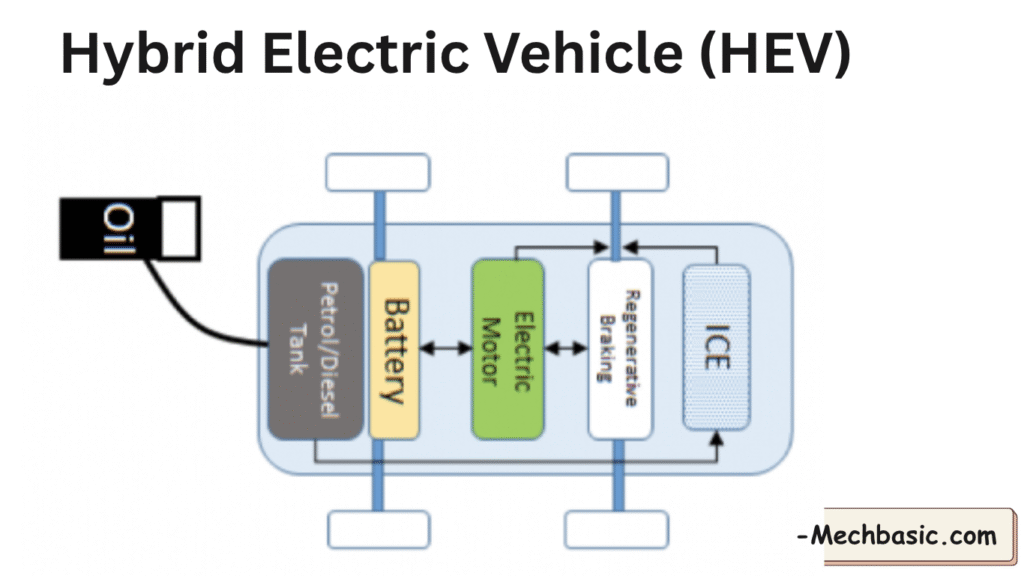
A Hybrid Electric Vehicle (HEV) uses both an internal combustion engine (ICE) and an electric motor, together with a battery pack, to power the vehicle.
The electric motor assists the engine to improve fuel efficiency and reduce emissions, but HEVs cannot be plugged in for charging—the battery charges automatically through regenerative braking and the engine.
Examples: Toyota Prius, Honda Insight, Toyota Camry Hybrid.
1. How an HEV Works
An HEV integrates three main systems:
1.1 Internal Combustion Engine (ICE)
- Usually gasoline-based; sometimes diesel.
- Designed to operate efficiently with hybrid assistance.
1.2 Electric Motor & Generator
- The motor assists with propulsion.
- The generator mode recharges the battery through engine power.
1.3 High-Voltage Battery Pack
- Smaller than BEV batteries (typically 1–2 kWh; some up to 3–4 kWh).
- Designed for high power, not high energy capacity.
- Uses Nickel-Metal Hydride (NiMH) or Lithium-ion.
1.4 Power Control Unit (PCU)
- Includes inverter, DC–DC converter, and control electronics.
- Manages power flow between engine, motor, and battery.
1.5 Regenerative Braking
- Converts braking energy into electricity to recharge the battery.
1.6 Transmission
- e-CVT (planetary gear system) is common in Toyota hybrids.
- Some HEVs use dual-clutch transmissions or parallel hybrid setups.
2. Types of HEVs
There are three main hybrid architectures:
2.1 Series Hybrid
- Engine does not drive the wheels.
- Engine → generator → electric motor → wheels.
- The motor is the only propulsion source.
Used rarely in cars; more common in buses.
2.2 Parallel Hybrid
- Engine and electric motor both drive the wheels.
- Most common layout after Toyota’s system.
Example: Honda hybrid system.
2.3 Series–Parallel (Power-split) Hybrid
- Combines both architectures.
- Offers flexibility: engine, motor, or both can power the wheels.
Example: Toyota Hybrid Synergy Drive (Toyota Prius).
3. Energy Flow in an HEV
During Acceleration
- Electric motor assists engine.
- Reduces engine workload and improves fuel economy.
During Cruising
- Engine runs mainly; motor may assist slightly.
During Low-Speed Driving
- Motor-only mode possible for short distances.
- Reduces fuel consumption in city traffic.
During Braking
- Regenerative braking recharges the battery.
During Idling
- Engine may shut off (start-stop system).
4. Advantages of HEVs
4.1 Better Fuel Efficiency
- Combined use of motor + engine reduces fuel consumption by 20–50%.
4.2 Lower Emissions
- Ideal for city driving with stop-and-go conditions.
4.3 No Need to Charge
- Battery charges on its own; no charging stations required.
4.4 Smooth & Quiet Operation
- Electric motor makes low-speed operation nearly silent.
4.5 High Reliability
- Proven technology with millions of units sold over decades.
5. Limitations of HEVs
5.1 Limited Electric-Only Range
- Usually only 1–3 km on electric power.
- Not designed for EV-style driving.
5.2 More Complex Powertrain
- More components than BEVs or ICE vehicles.
- More complex repairs in some cases.
5.3 Higher Upfront Cost
- Batteries and hybrid systems raise manufacturing costs.
5.4 Battery Degradation
- Smaller batteries but still subject to long-term capacity loss.
5.5 Not Zero-Emission
- Still emits CO₂ and pollutants due to the combustion engine.
6. Battery Technology in HEVs
NiMH Batteries
- Durable, tolerant to temperature, lower cost.
- Found in many Toyota hybrids.
Li-ion Batteries
- Higher energy density and lighter weight.
- Used in newer hybrid models.
HEV batteries are optimized for:
- High power output (rapid charge/discharge)
- Long lifecycle
- Small size
7. Future of HEVs
- Increasing shift to strong hybrids (more electric assist).
- More efficient engines (Atkinson cycle + hybridization).
- Use of 48V mild hybrids in mass-market cars.
- Gradual transition from HEVs to PHEVs and BEVs as battery prices drop.
Summary
A Hybrid Electric Vehicle (HEV):
- Combines an engine + electric motor + battery.
- Does not require external charging.
- Improves fuel economy and reduces emissions.
- Ideal for urban driving and fuel-conscious users.
- Still produces emissions and has limited electric-only capability.
Other courses:





