Let’s dive into Electric Vehicles (EVs) in detail, covering everything from definition, types, components, working, advantages, challenges, and the future.
An Electric Vehicle (EV) is a vehicle that is powered by electricity instead of fossil fuels like petrol or diesel. It uses electric motors and batteries to move, eliminating the need for an internal combustion engine (ICE).
Key feature: Zero tailpipe emissions (no CO₂, NOx, or particulates).
Examples: Tesla Model 3, Nissan Leaf, Hyundai Kona Electric.
Electric vehicles.
2. Types of Electric Vehicles
EVs can be classified based on power source:
Type
Description
Energy Source
Battery Electric Vehicle (BEV)
Runs entirely on electricity
Rechargeable battery pack
Hybrid Electric Vehicle (HEV)
Combines ICE & electric motor
Engine + small battery (charges via engine/braking)
Plug-in Hybrid Electric Vehicle (PHEV)
Can run on battery alone or engine
Engine + larger battery, charges via plug
Fuel Cell Electric Vehicle (FCEV)
Generates electricity from hydrogen
Hydrogen fuel cell
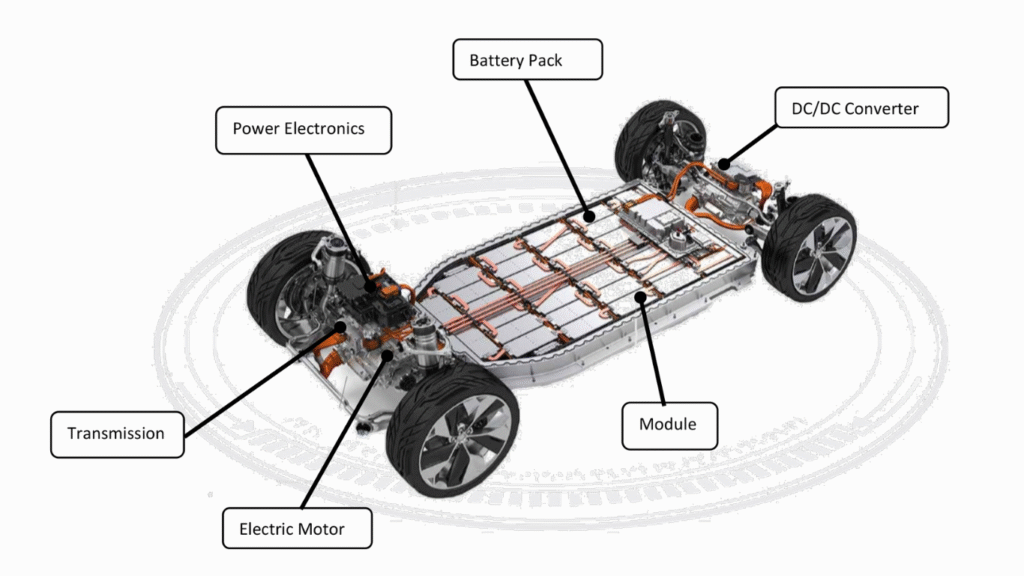
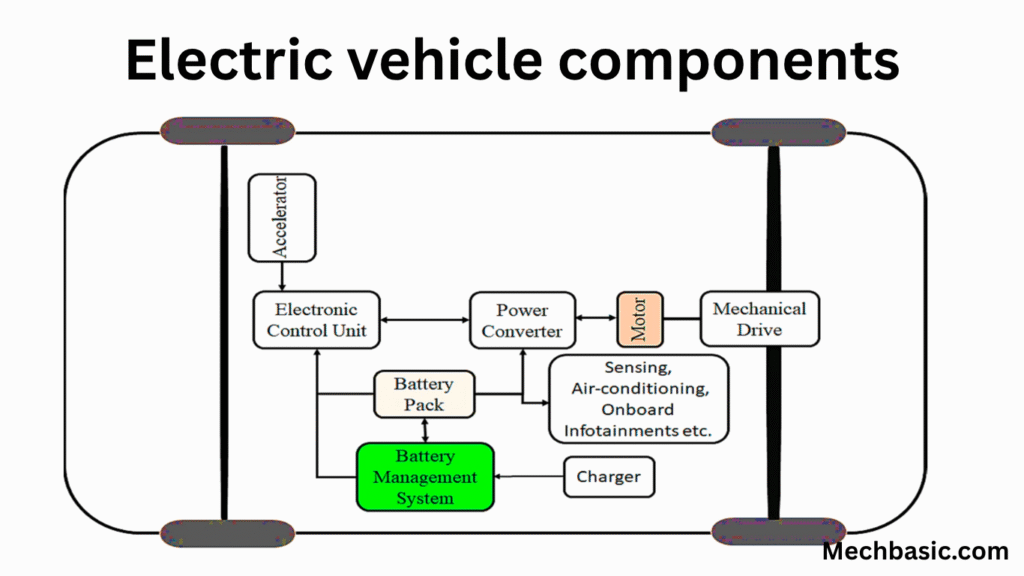
3. Main Components of an EV
Components of electric vehicles.
Component
Function
Electric Motor
Converts electrical energy into mechanical motion
Battery Pack (Li-ion or Li-Polymer)
Stores electrical energy
Battery Management System (BMS)
Monitors battery health, temperature, and charge
Power Electronics Controller (Inverter)
Converts DC from battery to AC for motor
Onboard Charger
Converts AC from grid to DC for battery charging
Regenerative Braking System
Recovers kinetic energy back to battery
Thermal Management System
Maintains battery/motor temperature
Charging Port
Connects vehicle to external charging station
4. How Electric Vehicles Work
Energy Storage: Battery stores electricity.
Power Conversion: Inverter converts DC battery power to AC for the motor.
Motor Drive: Electric motor drives wheels directly.
Regenerative Braking: When braking, the motor acts as a generator, recharging the battery.
Control System: ECU controls motor, battery, and regenerative braking for smooth operation.
5. Charging Methods
Type
Description
Time (Approx.)
Level 1 (Home)
Standard 120V outlet
8–20 hours
Level 2 (Home/Station)
240V AC outlet
4–8 hours
DC Fast Charging
High-power DC charger
30–60 min (80% charge)
Wireless Charging
Inductive pad under car
2–6 hours
6. Advantages of Electric Vehicles
Zero Tailpipe Emissions – Environmentally friendly.
Low Operating Cost – Electricity cheaper than petrol/diesel.
Low Maintenance – Fewer moving parts than ICE; no oil changes.
Instant Torque – Smooth acceleration.
Noise Reduction – Quieter than combustion engines.
Regenerative Braking – Extends battery range and reduces brake wear.
7. Challenges / Disadvantages
Challenge
Explanation
Battery Cost
High initial cost for lithium-ion packs
Range Anxiety
Limited range per charge compared to petrol cars
Charging Infrastructure
Need for more fast-charging stations
Battery Degradation
Capacity reduces over time, affecting range
Long Charging Time
Even fast chargers take 30–60 minutes
Weight
Batteries add significant weight to vehicles
8. EV Performance Metrics
Metric
Typical Value / Importance
Range
200–600 km per full charge
Charging Time
30 min (fast) – 20 hours (home)
Efficiency
3–5 miles/kWh
Acceleration
0–100 km/h in 3–8 sec (varies by model)
Battery Lifespan
8–15 years / 1,500–2,000 full charge cycles
9. Environmental Impact
Pros: No tailpipe emissions; reduces urban air pollution.
Cons: Battery manufacturing and electricity generation may produce CO₂.
Recycling: EV batteries are recyclable, though costly.
10. Future of Electric Vehicles
Solid-State Batteries – Safer, higher energy density, faster charging.
Autonomous EVs – Combining electric drivetrains with self-driving tech.
Vehicle-to-Grid (V2G) – EVs supplying power back to the grid.
Expansion of Charging Infrastructure – Faster, more widespread chargers.
Cost Reduction – Battery prices are dropping, making EVs more affordable.
11. Key Tips for EV Owners
Avoid frequent fast charging to extend battery life.
Maintain battery between 20% and 80% for optimal lifespan.
Keep tires properly inflated – reduces energy consumption.
Precondition cabin temperature while plugged in to save battery.
Regular software updates improve performance and efficiency.
12. Summary Table
Feature
EV
ICE Car
Fuel
Electricity
Petrol/Diesel
Emissions
Zero (tailpipe)
CO₂, NOx, particulates
Maintenance
Low
High
Torque
Instant
Gradual
Noise
Quiet
Loud
Efficiency
80–90%
25–30%
Refueling
Charging (30 min–20 hrs)
Petrol/Diesel (<5 min)
✅ In Simple Terms:
Electric Vehicles are quiet, low-maintenance, and eco-friendly vehicles powered entirely by electricity, but require good battery care, charging infrastructure, and smart driving to maximize their potential.