
In this article:
- Manufacturing processes of automobile
- 1. Concept & Design Phase
- 2. Material Selection & Procurement
- 3. Stamping / Pressing
- 4. Body Shop / Welding
- 5. Painting Process
- 6. Engine and Powertrain Manufacturing
- 7. Chassis and Suspension Assembly
- 8. Final Assembly (Trim and Accessories)
- 9. Quality Control & Inspection
- 10. Packaging and Delivery
- 11. Manufacturing Techniques Used
- 12. Modern Innovations in Auto Manufacturing
Manufacturing processes of automobile
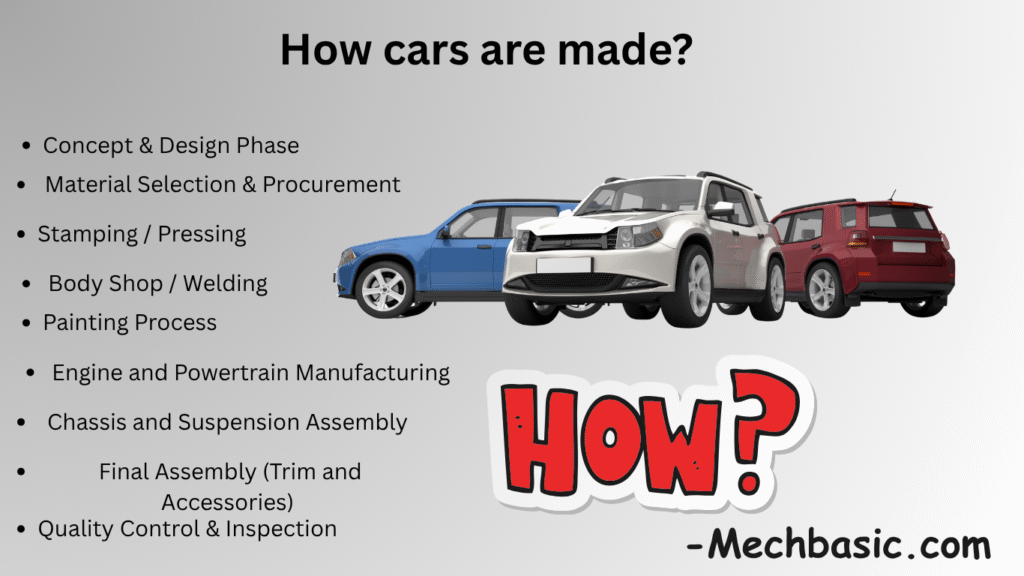
Here’s a detailed overview of the manufacturing processes of an automobile, from design to final assembly:
1. Concept & Design Phase
Before manufacturing, the vehicle must be conceptualized and designed.
- Market Research: Identify customer needs, trends, and regulatory requirements.
- Concept Design: Sketches, 3D models, and virtual simulations.
- Engineering Design: CAD (Computer-Aided Design) software is used for detailed parts and assembly planning.
- Prototyping: Physical prototypes or clay models are made to visualize the final product.
2. Material Selection & Procurement
- Material Selection: Decide materials for body, engine, chassis, interior, and electronics (steel, aluminum, plastics, composites).
- Supplier Coordination: Purchase raw materials, engines, electronics, tires, and other components.
- Inventory Management: Just-in-time (JIT) systems are often used to reduce storage costs.
3. Stamping / Pressing
- Process:
- Sheet metal is pressed into body panels like doors, hoods, roof, fenders.
- High-tonnage presses shape steel or aluminum sheets using dies.
- Output: Flat sheets become curved, three-dimensional panels ready for assembly.
4. Body Shop / Welding
- Process:
- Stamped panels are assembled into a vehicle body (body-in-white).
- Welding techniques include:
- Spot welding – for steel sheets.
- Laser welding – for precision joins, often aluminum.
- Adhesive bonding / Riveting – in lightweight vehicles or composites.
- Output: A rigid, joined vehicle frame ready for painting.
5. Painting Process
- Purpose: Protect vehicle from corrosion and give desired aesthetics.
- Stages:
- Cleaning & Pre-treatment – Remove oil, dust, and prepare the metal.
- Primer Coat – Provides adhesion and corrosion protection.
- Base Coat – Provides the color.
- Clear Coat – Protects paint and gives glossy finish.
- Techniques: Electro-coating (E-coat), spray booths, curing ovens.
6. Engine and Powertrain Manufacturing
- Engine Assembly: Blocks, pistons, crankshafts, camshafts, and cylinder heads are machined and assembled.
- Transmission / Gearbox Assembly: Manual, automatic, or CVT systems are built.
- Powertrain Testing: Engines are tested for performance, emissions, and quality.
7. Chassis and Suspension Assembly
- Sub-frame construction: Chassis, suspension arms, and mounts are assembled.
- Suspension Installation: Shock absorbers, springs, anti-roll bars.
- Brake System: Disc/drum brakes, brake lines, ABS sensors installed.
8. Final Assembly (Trim and Accessories)
- Interior Installation: Seats, dashboard, steering wheel, airbags, infotainment.
- Exterior Fittings: Lights, bumpers, mirrors, windows, doors.
- Electrical Wiring: ECU, sensors, wiring harnesses for all electronics.
- Fluid Filling: Fuel, brake fluid, coolant, engine oil.
9. Quality Control & Inspection
- Visual Inspection: Check panel gaps, paint finish, and interior fitting.
- Functional Testing:
- Engine start, brakes, lights, air-conditioning, electronics.
- Safety systems like airbags and seatbelts.
- Road Testing: Vehicles are driven to ensure handling, acceleration, and braking meet standards.
10. Packaging and Delivery
- Final Cleaning & Detailing: Cars are polished and prepared for delivery.
- Shipping: Vehicles are sent to dealerships by rail, truck, or ship.
11. Manufacturing Techniques Used
| Technique | Purpose |
|---|---|
| Casting | Engine blocks, cylinder heads, brake components |
| Forging | Crankshafts, connecting rods, suspension parts |
| Stamping / Pressing | Body panels, structural components |
| Machining | Precision engine and transmission components |
| Welding / Bonding | Assembling body-in-white and chassis |
| Painting / Coating | Corrosion resistance and aesthetics |
| Assembly Line / Automation | Efficient, repeatable vehicle assembly |
12. Modern Innovations in Auto Manufacturing
- Robotics & Automation: Welding, painting, and assembly using robots.
- 3D Printing / Additive Manufacturing: Rapid prototyping and small parts.
- Lightweight Materials: Aluminum, carbon fiber, and composites.
- Electric Vehicle Production: Battery pack integration, high-voltage safety measures.
- Digital Twin & Simulation: Virtual testing before physical production.
✅ In Short
Automobile manufacturing is a complex, multi-stage process involving:
Design → Material Selection → Stamping → Body Assembly → Painting → Engine & Powertrain → Final Assembly → Quality Control → Delivery.
Modern manufacturing integrates automation, robotics, lightweight materials, and advanced testing to produce safe, efficient, and high-quality vehicles.
Other courses:





