
In a car, ACC typically refers to Adaptive Cruise Control (though contextually it can sometimes mean “Accessory” mode in ignition). Let’s break it down in detail:
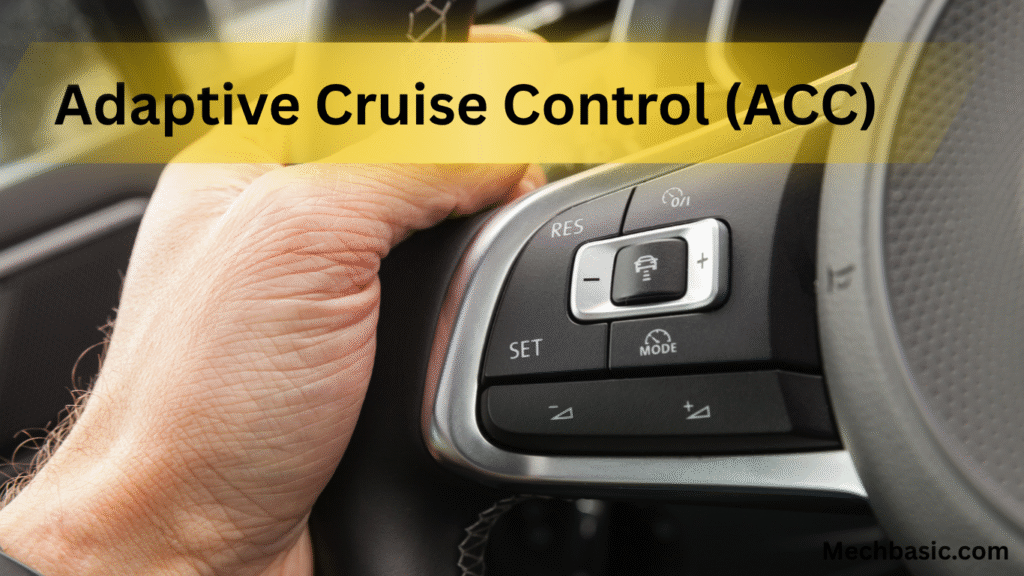
1. Adaptive Cruise Control (ACC)
Definition
- ACC is an advanced driver-assistance system (ADAS) that automatically adjusts the vehicle’s speed to maintain a safe distance from the car ahead while using cruise control.
How It Works
- Sensors / Radar / Cameras detect vehicles ahead.
- Cruise Control maintains the set speed if the road is clear.
- Automatic Adjustment:
- If a slower vehicle appears, ACC reduces speed or applies brakes.
- Once the road is clear, ACC accelerates back to the preset speed.
Key Features
- Maintains safe following distance.
- Works in highways and stop-and-go traffic (some systems).
- Reduces driver fatigue on long trips.
- May include forward-collision warning and automatic braking.
Limitations
- Works only within speed range defined by the system.
- Cannot fully replace driver attention; driver must remain alert.
- Performance affected by bad weather or poor visibility (fog, heavy rain).
2. ACC as Ignition/Accessory Mode
- Definition: ACC can also appear on the ignition switch as Accessory Mode.
- Function:
- Powers electrical components (radio, infotainment, windows) without starting the engine.
- Helps save fuel while using accessories.
- Location: Usually the first or second turn of the ignition key.
Summary Table
| ACC Meaning | Function | Key Points |
|---|---|---|
| Adaptive Cruise Control | Maintains speed & safe distance automatically | Uses radar/cameras, reduces fatigue, safety assist |
| Accessory Mode | Powers electrical systems without engine | First ignition key position, for radio/lights/windows |
✅ In Short
ACC in modern cars usually refers to Adaptive Cruise Control, an advanced cruise system that maintains a safe distance from vehicles ahead.
On older cars or ignition switches, ACC can also mean Accessory Mode, which powers car electronics without starting the engine.
FAQ Section:
1. What is Adaptive Cruise Control?
Adaptive Cruise Control (ACC) is an advanced driver-assistance system that automatically adjusts your car’s speed to maintain a safe following distance from the vehicle ahead, using radar, lidar, or cameras.
2. How does ACC differ from regular cruise control?
Traditional cruise control maintains a constant speed set by the driver. ACC, however, monitors traffic and automatically accelerates or brakes to keep a safe gap from the car in front.
3. How does ACC detect other vehicles?
ACC uses radar sensors, lidar, and forward-facing cameras (usually mounted in the grille or windshield) to track the distance and relative speed of vehicles ahead.
4. Can Adaptive Cruise Control bring the car to a complete stop?
Yes, in most modern systems (called Stop & Go ACC), the car can slow down to a complete stop in traffic and resume driving when the vehicle ahead moves again.
5. Does ACC work in all weather conditions?
ACC performance may be limited in heavy rain, fog, or snow, which can obstruct radar or camera sensors. In such cases, the system might temporarily deactivate and alert the driver.
6. Is ACC the same as Autonomous Driving?
No. ACC is semi-automated — it controls speed and distance, but the driver must remain attentive and ready to take control at any moment.
7. Can the following distance be adjusted?
Yes. Most ACC systems allow the driver to choose different following distance settings (e.g., short, medium, long), measured in seconds rather than meters.
8. Does ACC work at all speeds?
Older systems worked only above certain speeds (like 30 km/h), but newer versions can function from 0 to highway speeds, ideal for stop-and-go traffic.
9. Can ACC detect stationary objects?
Some advanced systems can detect stopped vehicles (especially those with camera + radar fusion), but basic radar-only systems might not respond to stationary obstacles.
10. Is Adaptive Cruise Control safe to rely on?
ACC greatly enhances comfort and reduces fatigue, but it is not foolproof. The driver remains responsible for monitoring the road and intervening when needed.
Other courses:





