
Here’s a detailed explanation of automobile crash and safety, covering the types of crashes, injury mechanisms, and the safety systems designed to protect passengers:
In this article:
1. Definition of Automobile Crash and Safety
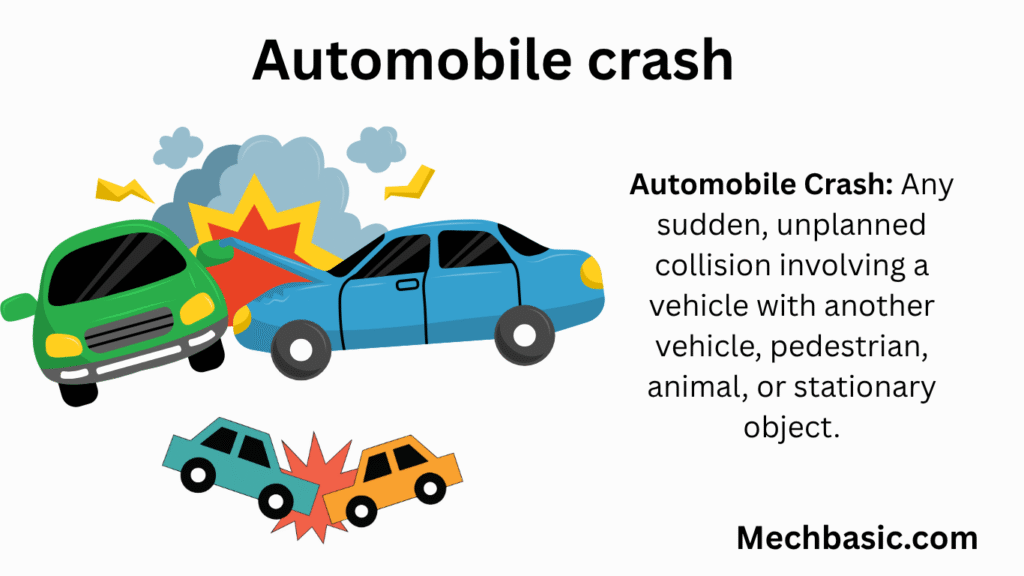
- Automobile Crash: Any sudden, unplanned collision involving a vehicle with another vehicle, pedestrian, animal, or stationary object.
- Automobile Safety: Measures, designs, and technologies aimed at preventing crashes or minimizing injury and damage during a collision.
Vehicle safety is broadly divided into active safety (preventing crashes) and passive safety (minimizing injury during a crash).
2. Types of Automobile Crashes
- Frontal Collision
- Most common type.
- Vehicle crashes head-on into another vehicle or object.
- High risk of chest, head, and leg injuries.
- Side Impact Collision (T-bone)
- Vehicle is hit on the side by another vehicle.
- High risk of rib, pelvic, and head injuries.
- Side airbags help reduce injuries.
- Rear-End Collision
- Vehicle is struck from behind.
- Causes whiplash and neck injuries.
- Crumple zones in the rear minimize damage.
- Rollover Accident
- Vehicle tips over onto its roof or side.
- Common in SUVs with high center of gravity.
- Risk of head and spinal injuries.
- Single Vehicle Crash
- Vehicle hits an object like a tree, wall, or ditch.
- Causes variable injury depending on speed and impact angle.
- Multi-Vehicle Collision
- Involves more than two vehicles.
- Complex crash dynamics increase injury risk.
3. Physics of a Crash
- Energy Transfer:
- Kinetic energy of the moving vehicle is converted into deformation, heat, and sound.
- Formula: KE=12mv2KE = \frac{1}{2} mv^2KE=21mv2, where m = mass, v = velocity.
- Deceleration:
- Rapid deceleration causes internal injuries due to inertia of passengers.
- Impact Force:
- Force experienced depends on speed, mass, and duration of impact:
- Shorter impact time → higher forces → more severe injuries.
4. Types of Injuries in Crashes
| Crash Type | Common Injuries |
|---|---|
| Frontal | Head trauma, chest injuries, leg fractures |
| Side Impact | Rib fractures, pelvic injuries, head injuries |
| Rear-End | Whiplash, neck sprains, back injuries |
| Rollover | Head trauma, spinal injuries, ejection injuries |
| Multi-Vehicle | Combination of above injuries |
5. Automobile Safety Measures
A. Active Safety (Preventing Crashes)
- Anti-lock Braking System (ABS)
- Prevents wheels from locking during sudden braking.
- Improves vehicle control and reduces stopping distance.
- Electronic Stability Control (ESC)
- Helps maintain vehicle stability during skids or sharp turns.
- Traction Control System (TCS)
- Prevents wheel slip during acceleration.
- Adaptive Cruise Control & Collision Avoidance
- Uses radar or cameras to detect obstacles and adjust speed.
- Lane Departure Warning / Assist
- Alerts or corrects steering to prevent unintended lane departure.
- Tire Pressure Monitoring Systems (TPMS)
- Ensures optimal tire pressure to prevent blowouts or loss of control.
B. Passive Safety (Minimizing Injury During Crash)
- Seat Belts
- Restrains passengers to prevent ejection.
- Reduces impact forces on chest and abdomen.
- Airbags
- Deploy on impact to cushion head, chest, and knees.
- Frontal, side, curtain, and knee airbags are common.
- Crumple Zones
- Areas of the vehicle designed to absorb and dissipate kinetic energy.
- Front and rear crumple zones deform to reduce impact on occupants.
- Reinforced Passenger Cabin
- High-strength steel or aluminum frame to protect passengers.
- Forms a survival cell.
- Headrests & Whiplash Protection
- Reduce neck injuries in rear-end collisions.
- Collapsible Steering Columns
- Reduce chest and head injuries during frontal impacts.
6. Modern Safety Innovations
- Autonomous Emergency Braking (AEB): Automatically brakes to prevent collision.
- Advanced Driver Assistance Systems (ADAS): Includes lane-keeping assist, blind-spot monitoring, adaptive headlights.
- Pedestrian Protection: Active hoods, sensor-based braking systems.
- Crash Sensors: Deploy airbags precisely and notify emergency services automatically.
7. Safety Ratings and Standards
- NCAP (New Car Assessment Program) – Euro NCAP, Global NCAP, IIHS in the US.
- Crash Tests Include:
- Frontal impact (offset and full-width)
- Side impact
- Rollover resistance
- Pedestrian impact
- Cars are rated from 1 to 5 stars for occupant and pedestrian safety.
8. Summary
| Aspect | Active Safety | Passive Safety |
|---|---|---|
| Purpose | Prevent crashes | Reduce injury during crash |
| Examples | ABS, ESC, TCS, AEB | Seat belts, airbags, crumple zones |
| Importance | Reduces accident likelihood | Reduces severity of injury |
Automobile crash safety is a combination of vehicle design, safety systems, and crash avoidance technologies. The goal is preventing accidents whenever possible and protecting occupants if a crash occurs.
Other courses:





