
The terms “frame” and “chassis” are often used interchangeably in casual conversation, but in automotive engineering, they have distinct meanings. Here’s a detailed explanation of the difference:
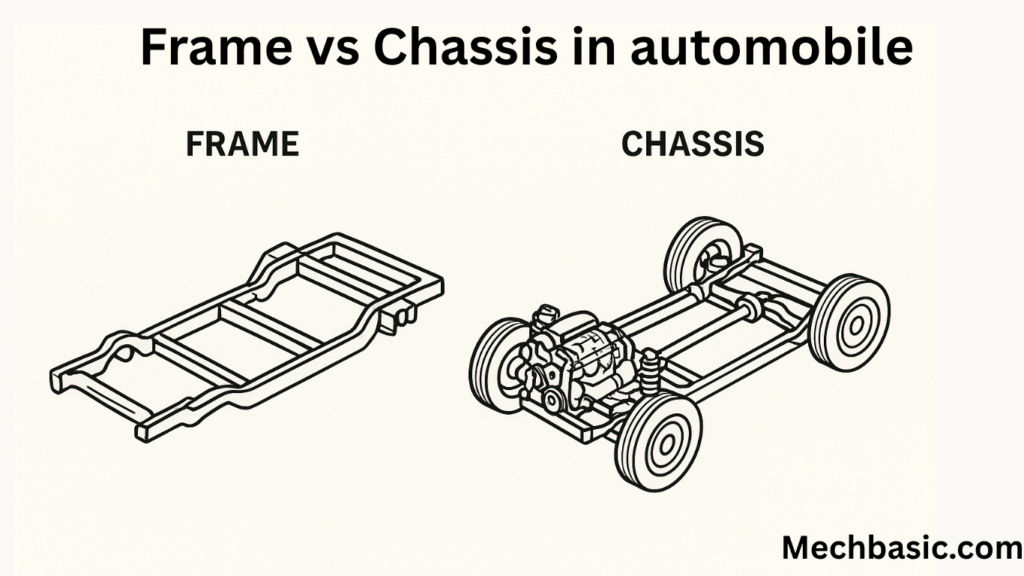
1. Definition
| Term | Definition |
|---|---|
| Chassis | The complete structural framework of a vehicle, including the frame, suspension, wheels, engine, transmission, steering, and other mechanical components, but excluding the body in some contexts. Essentially, it’s the vehicle’s “skeleton” ready to support all systems. |
| Frame | The structural base or backbone of the vehicle, usually made of steel or aluminum, onto which the engine, suspension, and body are mounted. The frame is a component of the chassis, not the whole system. |
In short, the frame is part of the chassis, while the chassis includes the frame plus other critical components.
2. Components
| Component | Frame | Chassis |
|---|---|---|
| Structural beams | Yes | Yes |
| Engine & transmission | No | Yes |
| Suspension system | No (but mounted on frame) | Yes |
| Steering & brakes | No | Yes |
| Wheels & axles | No | Yes |
| Body (optional in chassis) | No | Sometimes included (monocoque designs) |
3. Purpose / Function
| Term | Purpose |
|---|---|
| Frame | Provides primary structural support and maintains rigidity. Transfers vehicle load between suspension and drivetrain. |
| Chassis | Provides overall support for all vehicle systems. Ensures structural integrity, ride stability, safety, and handling. The chassis integrates frame, suspension, steering, brakes, and powertrain. |
4. Types
Frame Types:
- Ladder Frame
- Backbone Frame
- Space Frame
Chassis Types:
- Ladder Frame Chassis (includes frame + suspension + engine mounts)
- Monocoque / Unibody Chassis
- Backbone Chassis
- Space Frame Chassis
Notice that all chassis types have a frame, but some chassis designs like monocoque/unibody do not have a separate frame—they use the body itself as a structural element.
5. Materials
- Frame: Mild steel, high-strength steel, aluminum, carbon fiber (for specialized vehicles).
- Chassis: Typically uses the frame material plus mounts, brackets, suspension arms, and other components—so the chassis material is a combination depending on design.
6. Analogy
- Frame = Skeleton bones (supports the body).
- Chassis = Skeleton + muscles + joints (supports movement, strength, and function of the entire vehicle).
7. Key Differences
| Feature | Frame | Chassis |
|---|---|---|
| Definition | Structural base of the vehicle | Complete structural framework including mechanical components |
| Function | Supports load and provides rigidity | Supports vehicle systems, ensures safety, stability, and performance |
| Components Included | Rails, cross members | Frame + suspension + engine + transmission + steering + brakes + wheels |
| Types | Ladder, Backbone, Space frame | Ladder frame chassis, Monocoque chassis, Space frame chassis |
| Repair | Easier to repair or replace | More complex due to integrated systems |
✅ In Short
The frame is the core structure of a vehicle, while the chassis includes the frame plus all mechanical systems that make the vehicle operational.
Think of it as: Frame = skeleton, Chassis = skeleton with muscles and organs.
Other courses:





