
Let’s go in detail about the types of headlights in a car, both by function and technology.
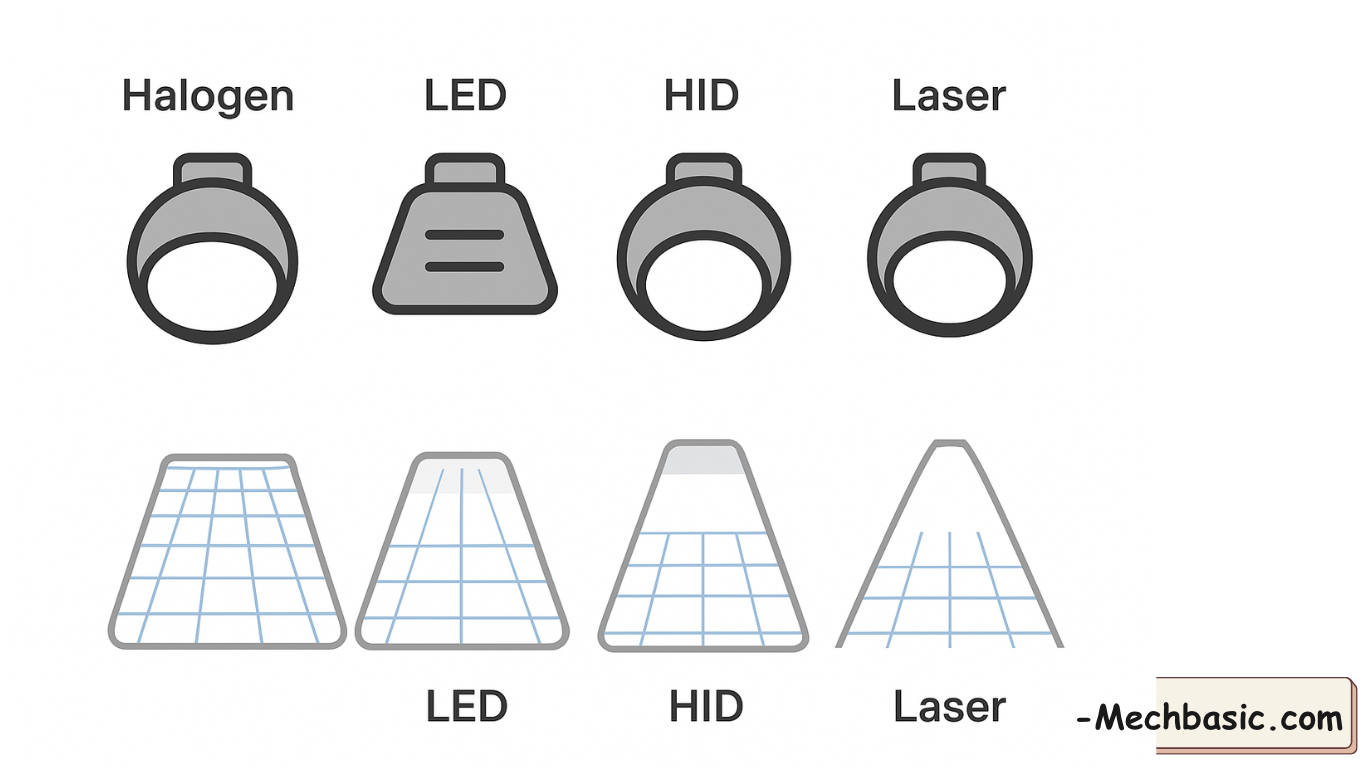
1. Headlights by Beam Pattern (Function)
Headlights can be classified based on how they illuminate the road and interact with other traffic.
| Type | Description | Use / Notes |
|---|---|---|
| Low Beam (Dipped Beam) | Provides short-range, wide, and downward light to illuminate the road ahead without blinding oncoming traffic. | Used for night driving in traffic, urban areas, or rain/fog. Usually on by default at night. |
| High Beam (Main Beam) | Provides long-range, bright, focused light to illuminate the road far ahead. | Used on open roads with no oncoming traffic. Can blind other drivers if used incorrectly. |
| Adaptive / Cornering Lights | Headlights pivot with steering input to illuminate curves in the road. | Improves visibility around corners at night. |
| Daytime Running Lights (DRL) | Lights that stay on during the day to improve vehicle visibility. | Often LED; required in many countries for safety. |
| Fog Lights (Front) | Mounted low; produces wide, short, horizontal beam to cut through fog, rain, or snow. | Helps illuminate road edges without reflecting back in fog. |
| Laser or Matrix Headlights | Advanced adaptive lights; can selectively dim areas to avoid blinding other drivers. | Used in high-end vehicles; combines long-range illumination with safety. |
2. Headlights by Technology (Light Source)
| Type | Description | Pros | Cons |
|---|---|---|---|
| Halogen | Traditional filament bulb with halogen gas for brighter light. | Cheap, easy to replace, widely available | Shorter lifespan, moderate brightness, more energy consumption |
| HID (High-Intensity Discharge / Xenon) | Uses an electrical arc in xenon gas to produce bright white/blue light. | Brighter, long-range, efficient | Expensive, requires ballast, can glare if misaligned |
| LED (Light Emitting Diode) | Uses semiconductor diodes to produce bright, efficient light. | Energy-efficient, long lifespan, instant illumination, flexible design | Higher upfront cost, complex electronics |
| Laser Headlights | Emits laser beams converted to bright LED light; extremely focused. | Extremely bright, energy-efficient, long range | Very expensive, rare, usually in premium cars |
| Projector Headlights | Uses a lens to focus light into a sharp beam pattern; can use halogen, HID, or LED bulbs. | Sharp cutoff reduces glare, focused illumination | Slightly more complex and costly than reflector lights |
| Reflector Headlights | Traditional design; bulb shines onto a parabolic reflector to direct light. | Simple, cost-effective | Beam pattern less precise, more glare risk |
3. Key Features of Modern Headlights
- Automatic Headlights: Turn on/off based on ambient light conditions.
- Adaptive Headlights: Adjust beam direction based on steering angle and vehicle speed.
- Self-Leveling Headlights: Adjust vertical aim when the vehicle is loaded to prevent glare.
- Matrix or Pixel LED: Can selectively dim sections of the beam to avoid blinding other vehicles.
- Daytime Running Lights (DRL): Often integrated with headlight units for energy-efficient visibility.
4. Summary Table
| Classification | Type / Technology | Purpose / Feature |
|---|---|---|
| Beam Pattern | Low Beam | Short-range, safe for traffic |
| High Beam | Long-range illumination | |
| Adaptive / Cornering | Follows steering for curves | |
| Fog Lights | Low-mounted, wide beam in fog | |
| DRL | Daytime visibility | |
| Light Source | Halogen | Affordable, moderate brightness |
| HID / Xenon | Bright, long-range, efficient | |
| LED | Energy-efficient, long lifespan, flexible design | |
| Laser | Extremely bright and focused | |
| Projector | Sharp cutoff, precise beam | |
| Reflector | Simple, traditional design |
💡 Key Point:
Modern cars often combine multiple types: low/high beam, DRL, LED or HID technology, and adaptive features in one headlight assembly for maximum safety and efficiency.
Other courses:





