
Here’s a detailed explanation of how a differential gear works:
In this article:
Differential Gear – Working Principle
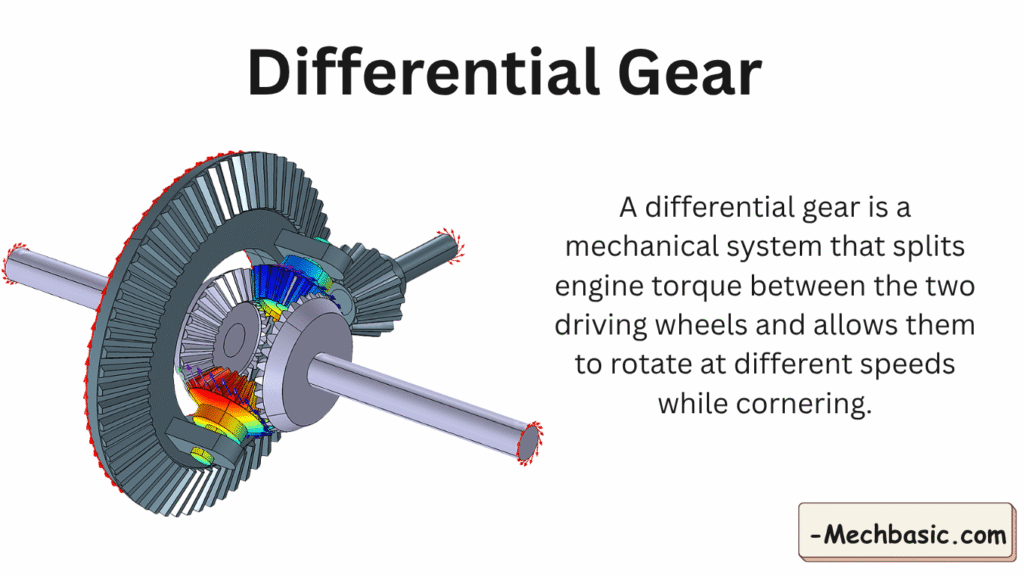
A differential gear is a mechanical system that splits engine torque between the two driving wheels and allows them to rotate at different speeds while cornering.
It is essential for smooth turning and preventing tire and drivetrain stress.
1️⃣ Basic Components of a Differential Gear
- Ring Gear (Crown Wheel):
- Driven by the pinion gear from the drive shaft.
- Rotates the differential case.
- Differential Case / Carrier:
- Houses spider gears and side gears.
- Rotates with the ring gear, carrying torque to the wheels.
- Spider / Planet Gears:
- Small gears mounted on a cross shaft inside the differential case.
- Allow the two side gears (connected to wheels) to rotate at different speeds.
- Side / Sun Gears:
- Connected to the axle shafts.
- Receive torque and drive the wheels.
- Pinion Gear (Drive Pinion):
- Connects the drive shaft to the ring gear.
- Transmits engine torque to the differential.
2️⃣ Working Principle
- Straight Driving:
- When the vehicle moves straight, both wheels rotate at the same speed.
- Spider gears do not rotate on their axis; they act as a rigid connection between the side gears.
- Torque is split equally to both wheels.
- Turning / Cornering:
- The outer wheel must rotate faster than the inner wheel.
- Spider gears rotate on their axis inside the differential case.
- Side gears rotate at different speeds while maintaining torque transfer.
- This allows the outer wheel to cover a longer distance without scrubbing or slipping.
3️⃣ Torque Distribution
- In a basic open differential, torque is equal to both wheels, regardless of traction.
- In limited-slip or torque-vectoring differentials, torque can be biased toward the wheel with better traction using:
- Friction clutches (LSD)
- Helical gears (Torsen)
- Viscous coupling (viscous LSD)
4️⃣ Summary of How Differential Gear Works
- Torque enters the differential via the pinion and ring gear.
- The differential case rotates, carrying the spider gears.
- Spider gears allow the side gears / wheels to rotate at different speeds during a turn.
- Torque is transmitted to the axle shafts and then to the wheels.
In simple terms: the differential gear splits torque and allows speed difference between wheels, enabling smooth turning and preventing tire wear.
FAQ Section:
Here are 10 frequently asked questions (FAQs) about Differential Gears:
- What is a Differential Gear?
It’s a set of gears in a vehicle’s drivetrain that allows wheels on the same axle to rotate at different speeds while transmitting power. - Why do vehicles need a Differential Gear?
To allow smooth cornering, as the outer wheel travels farther than the inner wheel and must rotate faster. - What are the main types of Differential Gears?
Common types include open differential, limited-slip differential (LSD), locking differential, and torque vectoring differential. - How does a Differential Gear work?
It splits engine torque between the wheels and allows speed differences using bevel or planetary gears. - What happens if a vehicle doesn’t have a Differential Gear?
The wheels would be forced to rotate at the same speed, causing tire scrubbing, poor handling, and drivetrain stress during turns. - Can Differential Gears improve traction?
Yes, types like LSD, locking, and torque vectoring differentials enhance traction on slippery or uneven surfaces. - Where is the Differential Gear located?
It is usually mounted on the axle (rear or front) or in the center for all-wheel-drive vehicles. - Do Differential Gears require maintenance?
Yes, periodic checks of gear oil, seals, and bearings are necessary to ensure smooth operation and prevent wear. - What is the difference between an Open Differential and LSD?
An open differential allows full speed difference without torque control, while LSD limits wheel spin to improve traction. - Can I upgrade my Differential Gear for better performance?
Yes, upgrading to LSD, locking, or torque vectoring differentials can improve traction, handling, and off-road capability.
Other courses:





