
Here’s a comprehensive explanation of differential mechanisms in automobiles:
In this article:
Differential Mechanisms
A differential is a critical component in a vehicle’s drivetrain, located between the drive wheels (usually on the rear axle in RWD, front axle in FWD, or both in AWD/4WD). Its primary function is to allow the driving wheels to rotate at different speeds while transmitting torque. This is especially important when a vehicle is turning, as the outer wheel travels a longer distance than the inner wheel.
1️⃣ Purpose of a Differential
- Transmit engine torque from the drive shaft to the wheels.
- Allow different wheel speeds during cornering.
- Reduce tire wear and driveline stress caused by wheel slip.
- Enable smooth and stable turning.
2️⃣ Why Differential is Necessary
When a vehicle turns:
- Outer wheel travels longer distance, inner wheel shorter distance.
- Without a differential, wheels are forced to rotate at the same speed, causing:
- Tire scrubbing
- Steering difficulty
- Excessive stress on drivetrain components
The differential compensates for this difference in rotation.
3️⃣ Types of Differentials
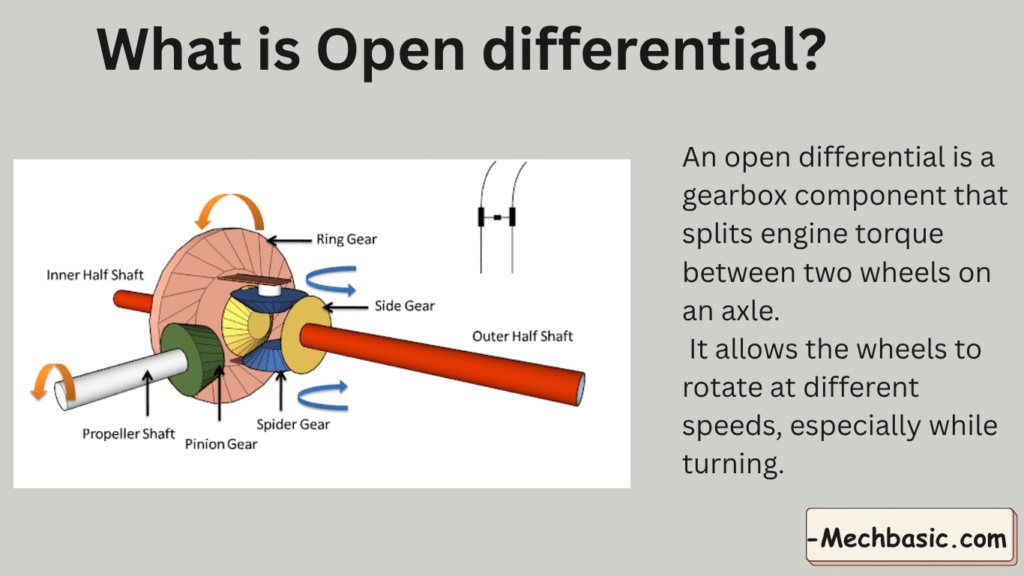
A. Open Differential
- Most common type.
- How it works:
- Torque is split equally to both wheels.
- Uses bevel gears (spider and side gears) to allow wheels to rotate at different speeds.
- Advantages: Simple, inexpensive, reliable.
- Disadvantages: If one wheel loses traction, all torque goes to the slipping wheel (poor off-road performance).
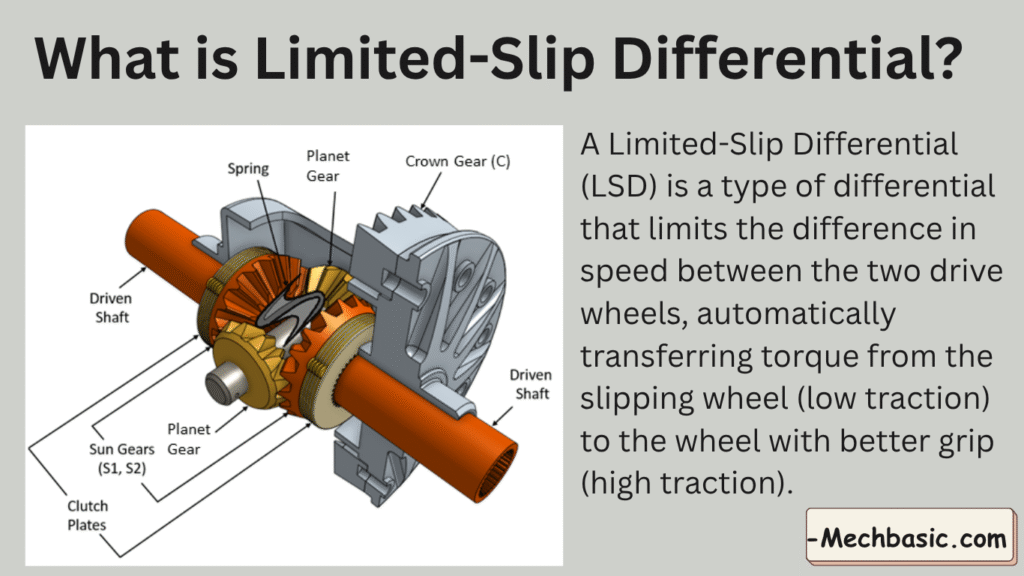
B. Limited Slip Differential (LSD)
- Prevents excessive slip of one wheel by limiting speed difference between wheels.
- Types:
- Clutch-type LSD: Uses friction plates to transfer torque to the wheel with traction.
- Helical / Torsen LSD: Uses gears to automatically bias torque toward the wheel with grip.
- Viscous LSD: Uses viscous fluid to resist speed differences.
- Advantages: Improves traction, especially on slippery roads.
- Disadvantages: More complex, costlier, requires maintenance.
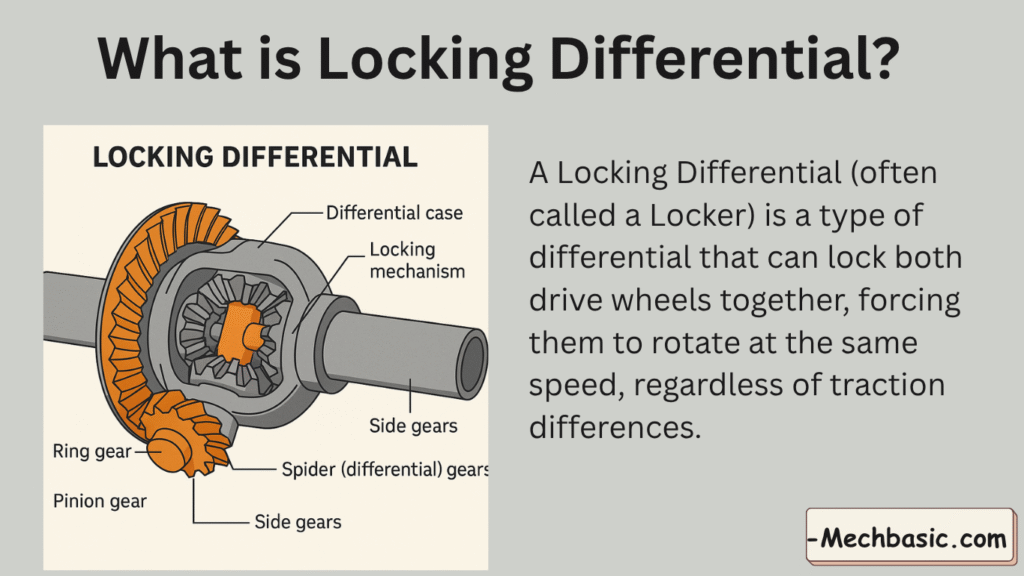
C. Locking Differential
- Can lock both wheels together, forcing them to rotate at the same speed.
- Types:
- Manual locking: Driver engages a lock via lever or switch.
- Automatic locking: Engages automatically when one wheel slips.
- Advantages: Excellent traction in off-road conditions.
- Disadvantages: Difficult to steer when locked, not ideal for normal roads.
D. Torque Vectoring Differential
- Uses electronic or hydraulic controls to distribute torque dynamically.
- Improves cornering stability, traction, and performance.
- Common in modern AWD sports cars and performance vehicles.
4️⃣ Components of a Differential
- Ring Gear (Crown Wheel)
- Driven by the pinion gear from the drive shaft.
- Transfers torque to the differential case.
- Differential Case / Carrier
- Houses side gears and spider gears.
- Rotates with the ring gear, allowing wheel speed differences.
- Pinion Gear (Drive Pinion)
- Engages the ring gear to transmit torque from the drive shaft.
- Side Gears (Sun Gears)
- Connected to axle shafts.
- Allow wheels to rotate at different speeds.
- Spider / Planetary Gears
- Mounted inside the differential case.
- Rotate around side gears to allow differential action.
- Axle Shafts
- Connect differential side gears to wheels.
- Bearings and Housing
- Support gears and ensure smooth operation.
5️⃣ Working Principle of a Simple Open Differential
- Torque from the drive shaft → pinion gear → ring gear → differential case.
- Spider gears rotate on the cross shaft inside the differential case.
- Each side gear connected to a wheel can rotate independently.
- During a turn:
- Outer wheel spins faster, inner wheel spins slower.
- Torque remains split according to wheel resistance.
6️⃣ Advantages of a Differential
- Allows smooth turning without wheel slip.
- Reduces tire wear and driveline stress.
- Provides efficient torque distribution to wheels.
7️⃣ Disadvantages of a Simple Differential
- Open differential: Torque always follows the path of least resistance.
- Traction loss occurs when one wheel is on a slippery surface.
8️⃣ Applications
- RWD cars: Rear axle differential.
- FWD cars: Often integrated into the transaxle.
- 4WD / AWD vehicles: Front, rear, or center differential for torque splitting.
- Trucks and buses: Heavy-duty differential for load handling.
9️⃣ Summary
A differential mechanism:
- Allows wheels to rotate at different speeds while transmitting torque.
- Can be open, limited-slip, locking, or torque vectoring.
- Comprises ring gear, pinion, side gears, spider gears, and housing.
- Critical for vehicle stability, traction, and smooth turning.
Other courses:





