
Here’s a detailed explanation of a center bearing in a propeller shaft:
In this article:
Center Bearing in a Propeller Shaft
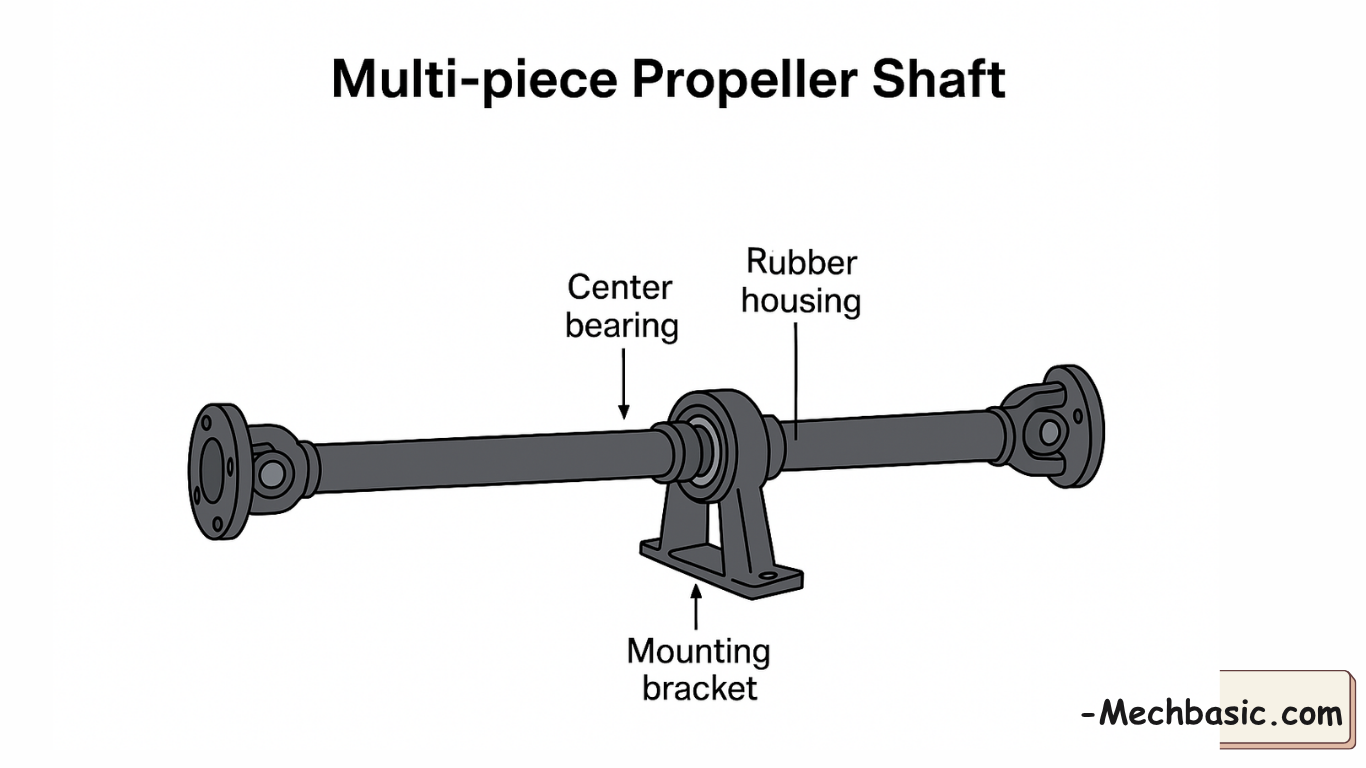
A center bearing (also called a carrier bearing) is a support bearing used in multi-piece propeller shafts. It is mounted along the length of the shaft to support the intermediate section, allowing the shaft to transmit torque smoothly over long distances without excessive vibration or bending.
Center bearings are especially common in trucks, buses, long-wheelbase vehicles, and some AWD cars.
1️⃣ Purpose of a Center Bearing
- Support Long Shafts
- Multi-piece propeller shafts are used in long vehicles where a single shaft would bend or vibrate.
- The center bearing supports the intermediate section, reducing bending stress.
- Reduce Vibration
- Prevents shaft whip and vibration caused by long, unsupported shaft sections.
- Allow Shaft Alignment
- Keeps the shaft aligned with the gearbox and differential.
- Accommodates slight misalignments and suspension movement.
- Support Multi-Piece Shafts
- Multi-piece shafts rotate smoothly even with independent suspension travel or frame flex.
2️⃣ Components of a Center Bearing
- Bearing
- Usually a ball or roller bearing that supports the propeller shaft.
- Provides smooth rotation while carrying axial and radial loads.
- Rubber or Elastomer Housing
- Encases the bearing to absorb vibration and shocks.
- Allows slight flexibility while keeping the shaft aligned.
- Mounting Bracket / Flange
- Bolts to the vehicle chassis or crossmember.
- Secures the center bearing firmly in position.
- Shaft Support Collar
- The propeller shaft passes through the bearing.
- Allows rotation while maintaining center alignment.
3️⃣ Working Principle
- The propeller shaft rotates, transmitting torque from gearbox to differential.
- The center bearing supports the intermediate section of the shaft.
- Rubber housing absorbs minor vibrations and shocks.
- Bearing allows rotation with minimal friction.
- Prevents bending, whip, and vibration, especially in long or multi-piece shafts.
4️⃣ Advantages of a Center Bearing
| Feature | Benefit |
|---|---|
| Supports long shafts | Prevents bending and structural stress. |
| Reduces vibration | Absorbs shocks and minimizes vibrations transmitted to chassis. |
| Improves shaft alignment | Keeps propeller shaft properly aligned with gearbox and differential. |
| Durable under load | Supports torque transmission in heavy vehicles. |
5️⃣ Disadvantages / Issues
- Can wear out over time, causing vibration or noise.
- Rubber housing may deteriorate due to heat or oil contamination.
- Faulty center bearing causes shaft misalignment, vibration, and premature U-joint wear.
- Replacement can be labor-intensive in long-wheelbase vehicles.
6️⃣ Applications
- Trucks, buses, and commercial vehicles with long wheelbases.
- Multi-piece RWD propeller shafts in long cars.
- AWD vehicles with complex shaft layouts.
- Heavy-duty machinery with long torque transmission shafts.
7️⃣ Signs of a Worn or Faulty Center Bearing
- Vibration or shuddering at certain speeds.
- Clunking or squeaking noises from under the vehicle.
- Excessive movement or misalignment of the propeller shaft.
- Premature wear of U-joints or differential mounts.
8️⃣ Summary
A center bearing is a support bearing mounted along a multi-piece propeller shaft that:
- Supports the shaft and prevents bending.
- Reduces vibration transmitted to the chassis.
- Maintains shaft alignment.
- Absorbs shocks via its elastomer housing.
It is essential in long-wheelbase vehicles or heavy-duty applications to ensure smooth and durable torque transmission.
Other courses:





