
Here’s a comprehensive explanation of propeller shaft balancing in automobiles:
In this article:
⚙️ Propeller Shaft Balancing
Propeller shaft balancing is the process of ensuring that the propeller (drive) shaft rotates smoothly without causing vibrations at operating speeds. Proper balancing is crucial for RWD, 4WD, and AWD vehicles with long or high-speed propeller shafts.
1️⃣ Purpose of Propeller Shaft Balancing
- Prevent vibration transmitted to the vehicle cabin.
- Reduce wear and tear on universal joints (U-joints), bearings, and differential.
- Improve driver comfort and vehicle stability.
- Prevent shaft fatigue or failure due to centrifugal forces.
2️⃣ Why Balancing is Needed
A propeller shaft can vibrate if:
- Mass is not evenly distributed along the shaft.
- Misalignment between shaft and differential/gearbox exists.
- U-joints are not at correct angles.
- Damage or wear occurs on the shaft or splines.
- One-piece vs. multi-piece shafts are improperly aligned.
Vibration increases with shaft length and rotation speed, making balancing more critical in long-wheelbase vehicles or high-speed cars.
3️⃣ Types of Balancing
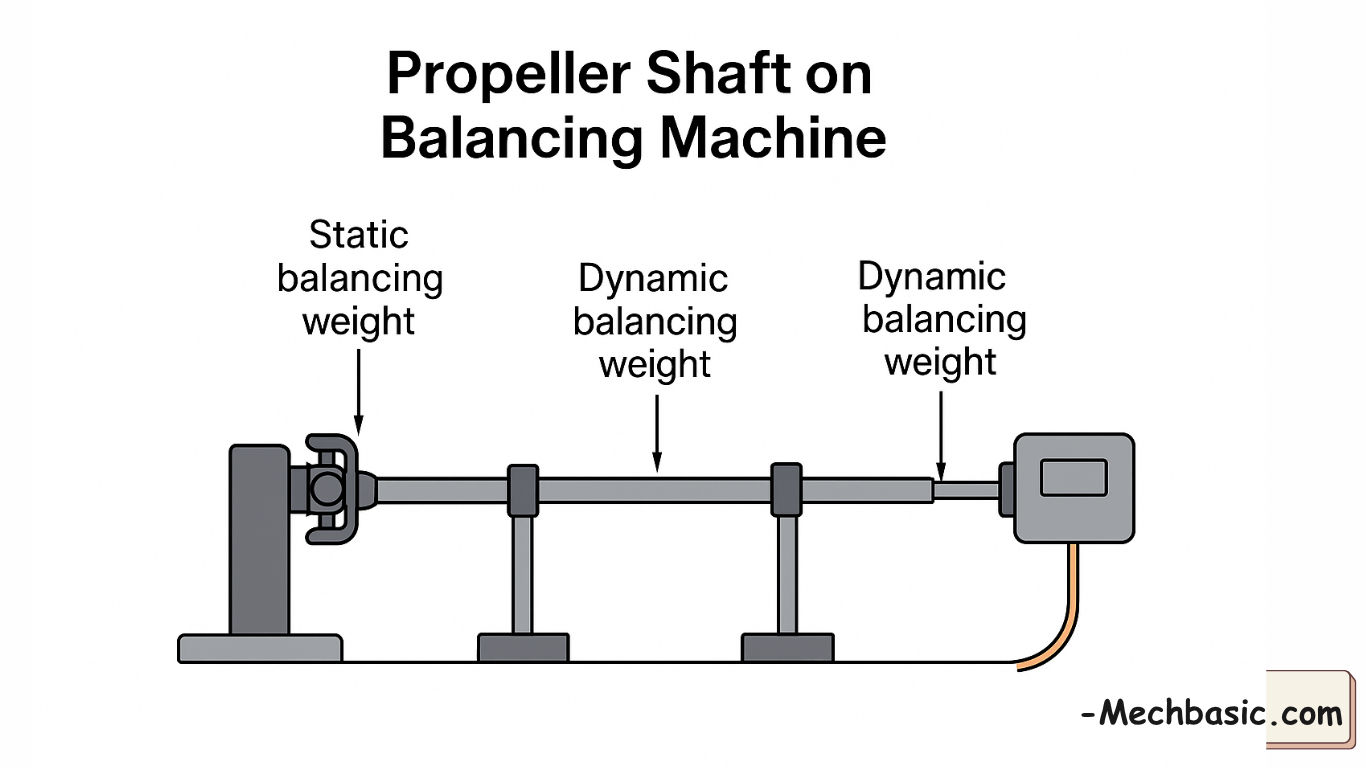
- Static Balancing
- Shaft is balanced without rotation, by adding weights to ensure its center of mass is on the rotational axis.
- Prevents vertical or lateral deflection when the shaft rotates slowly.
- Dynamic Balancing
- Shaft is balanced while rotating at operational speed.
- Corrects vibration caused by mass imbalance along the shaft and at ends.
- Done using balancing machines; small weights are attached to correct high-speed imbalance.
4️⃣ Balancing Procedure
- Inspection: Check shaft straightness, U-joint condition, and spline wear.
- Mounting: Shaft is mounted on a balancing machine.
- Rotation & Measurement: Shaft is spun; vibration sensors detect imbalance.
- Correction: Add balancing weights at specific points along the shaft.
- Verification: Re-spin shaft to ensure vibrations are within permissible limits.
- Installation: Balanced shaft installed back into the vehicle; check for smooth operation.
5️⃣ Balancing of Multi-Piece Shafts
- Long propeller shafts often have two or more pieces with center bearings.
- Both sections must be individually and jointly balanced.
- Correct alignment of U-joints and center bearings is critical to prevent vibration.
6️⃣ Consequences of Improper Balancing
- Excessive vibration at high speeds.
- Premature wear of U-joints, bearings, and differential gears.
- Noise transmitted to cabin (drumming or shuddering).
- Risk of propeller shaft fatigue or fracture.
- Reduced driving comfort and stability.
7️⃣ Summary
Propeller shaft balancing ensures the shaft rotates smoothly without vibration.
- Static balancing: Corrects uneven mass along the shaft.
- Dynamic balancing: Corrects high-speed vibration and mass imbalance at ends.
- Essential for long shafts, heavy-duty vehicles, and high-speed operation.
FAQ Section:
1. What is propeller balancing?
Answer:
Propeller balancing is the process of ensuring that a propeller’s mass is evenly distributed around its axis of rotation. This minimizes vibrations, increases efficiency, and prevents premature wear on the engine and airframe.
2. Why is propeller balancing important?
Answer:
An unbalanced propeller can cause vibrations that lead to:
- Reduced engine life
- Fatigue cracks in mounts and airframes
- Poor fuel efficiency
- Increased noise and discomfort for the pilot
3. What are the types of propeller balancing?
Answer:
There are two main types:
- Static balancing: Ensures the propeller’s weight is evenly distributed when stationary.
- Dynamic balancing: Corrects imbalance that occurs during operation, accounting for aerodynamic and rotational effects.
4. How is static propeller balancing done?
Answer:
The propeller is placed on a low-friction balance stand. If one blade drops, it indicates that side is heavier. Weight is then added to or removed from the appropriate blade or hub until the propeller remains level.
5. What is dynamic propeller balancing?
Answer:
Dynamic balancing is performed with the engine running. Sensors measure vibration levels while the prop spins, and weights are added or adjusted on the spinner or hub until vibration amplitude is minimized.
6. What tools are used for propeller balancing?
Answer:
- Static balancer or mandrel (for static balance)
- Dynamic balancer (electronic system with accelerometers and photo-tach sensors)
- Balance weights and mounting hardware
7. How often should a propeller be balanced?
Answer:
Typically:
- Whenever a new propeller is installed
- After propeller repair or repainting
- If vibration is noticed
- After major engine maintenance or overhaul
8. What are common signs of an unbalanced propeller?
Answer:
- Noticeable vibration in the cockpit
- Loosening of screws or fasteners
- Excessive noise
- Premature wear on engine mounts
- Blurred instrument readings
9. Can I balance my own propeller?
Answer:
Static balancing can be done by experienced mechanics with proper tools.
Dynamic balancing, however, should be performed by certified technicians using specialized equipment for safety and accuracy.
10. What benefits can I expect from proper propeller balancing?
Answer:
- Smoother operation
- Reduced engine and airframe stress
- Improved fuel efficiency and performance
- Longer component life
- Enhanced pilot comfort and reduced fatigue
Other courses:





