
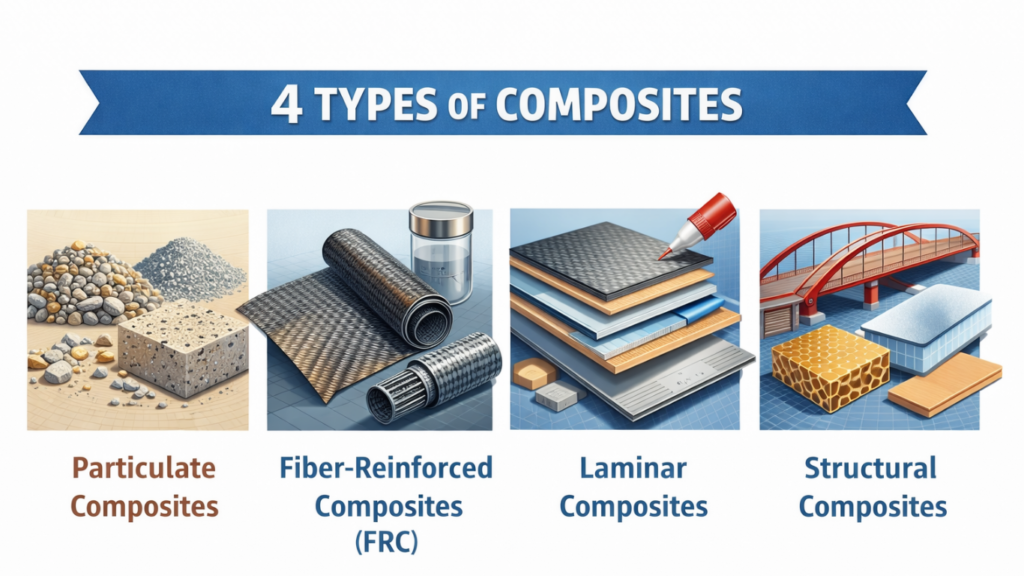
Composites are engineered materials made by combining two or more distinct materials to obtain properties that cannot be achieved by any single material alone. Typically, a composite consists of a matrix (continuous phase) and a reinforcement (discontinuous phase).
In this article:
4 types of composites
Composites are materials made by combining two or more different materials to improve performance.
The four main types of composites are fiber-reinforced, particle-reinforced, structural, and laminar composites.
Each type offers unique advantages such as high strength, light weight, or improved stiffness.
Composites are widely used in aerospace, automotive, construction, and sports industries.
Below are the four main types of composites explained in detail, as commonly taught in manufacturing and materials engineering.
1. Particulate Composites
Definition
In particulate composites, the reinforcement is in the form of small particles dispersed uniformly in the matrix.
Structure
- Matrix: Metal, polymer, or ceramic
- Reinforcement: Hard particles (spherical or irregular)
Characteristics
- Improved strength and hardness
- Better wear resistance
- Isotropic properties (same in all directions)
- Lower cost compared to fiber composites
Examples
- Concrete (cement + sand + gravel)
- Aluminum–silicon carbide (Al–SiC)
- Polymer filled with glass beads
Applications
- Pavements and buildings
- Brake linings
- Wear-resistant machine parts
Advantages
- Easy to manufacture
- Good compressive strength
- Economical
Limitations
- Limited tensile strength improvement
- Not suitable for high load-bearing applications
2. Fiber-Reinforced Composites (FRC)
Definition
These composites use fibers as reinforcement to provide high strength and stiffness.
Types of Fibers
- Glass fibers (GFRP)
- Carbon fibers (CFRP)
- Aramid fibers (Kevlar)
Fiber Arrangement
- Continuous fibers
- Discontinuous (short) fibers
- Aligned or randomly oriented
Characteristics
- Very high strength-to-weight ratio
- Directional properties (anisotropic)
- Excellent fatigue resistance
Examples
- Fiberglass
- Carbon fiber reinforced polymer
- Kevlar composites
Applications
- Aircraft structures
- Automotive body panels
- Sports equipment
- Wind turbine blades
Advantages
- Lightweight
- High tensile strength
- Tailorable properties
Limitations
- Expensive
- Complex manufacturing
- Difficult to recycle
3. Laminar Composites
Definition
Laminar composites consist of layers (laminae) of different materials bonded together to improve overall performance.
Structure
- Layers may be same or different materials
- Each layer contributes specific properties
Characteristics
- Improved strength and stiffness
- Better corrosion and wear resistance
- Good dimensional stability
Examples
- Plywood
- Laminated glass
- Bimetallic strips
Applications
- Furniture and construction
- Safety glass in automobiles
- Thermostats (bimetallic strips)
Advantages
- High surface strength
- Good impact resistance
- Flexible design options
Limitations
- Possibility of delamination
- Weaker interlayer bonding
4. Structural Composites
Definition
Structural composites are designed primarily for load-bearing applications and include sandwich structures and frames.
Types
a) Sandwich Composites
- Two strong outer faces
- Lightweight core (foam, honeycomb)
b) Frame Composites
- Reinforced skeletal structure
Characteristics
- Very high stiffness-to-weight ratio
- Excellent bending resistance
- Lightweight yet strong
Examples
- Aircraft panels
- Spacecraft structures
- Bridge decks
Applications
- Aerospace industry
- Marine structures
- High-performance buildings
Advantages
- Superior structural efficiency
- Weight reduction
- High load-carrying capacity
Limitations
- High manufacturing cost
- Complex repair procedures
Summary Table
| Type of Composite | Reinforcement Form | Key Advantage | Common Applications |
|---|---|---|---|
| Particulate | Particles | Wear resistance | Concrete, brake pads |
| Fiber-reinforced | Fibers | High strength-to-weight | Aircraft, sports |
| Laminar | Layers | Surface strength | Plywood, glass |
| Structural | Sandwich/frame | High stiffness | Aerospace, bridges |
Other courses:





