
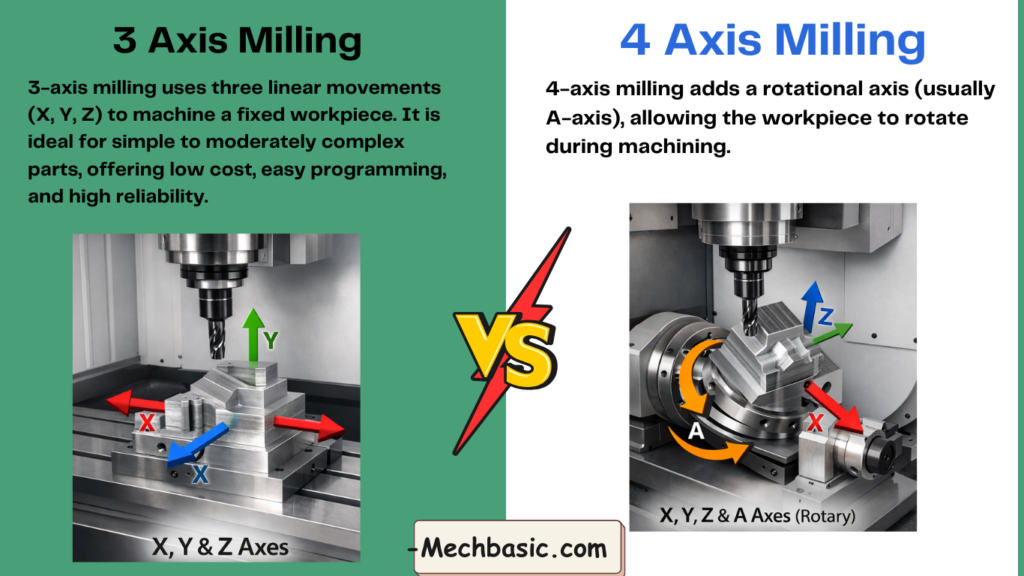
3-axis milling uses three linear movements (X, Y, Z) to machine a fixed workpiece. It is ideal for simple to moderately complex parts, offering low cost, easy programming, and high reliability.
4-axis milling adds a rotational axis (usually A-axis), allowing the workpiece to rotate during machining. This enables machining on multiple sides in a single setup, improving accuracy, reducing setup time, and allowing more complex geometries.
3-axis machining is best for straightforward parts and cost efficiency, while 4-axis machining provides greater flexibility, precision, and productivity for more complex components.
In this article:
- 3-Axis vs 4-Axis Milling – Differences
- 1. Basic Definition
- 2. Axis Motion Comparison
- 3. Rotary Axis (Key Difference)
- 4. Machining Capability
- 5. Types of 4-Axis Machining
- 6. Accuracy & Repeatability
- 7. Setup Time
- 8. Programming Complexity
- 9. Production Efficiency
- 10. Cost Comparison
- 11. Typical Applications
- 12. Advantages & Limitations Summary
- 13. Quick Selection Guide
- 14. Simple Visual Concept (Text)
- 1. Basic Definition
3-Axis vs 4-Axis Milling – Differences
Below is a clear, detailed, engineering-level comparison of 3-axis vs 4-axis milling, covering motion, capability, accuracy, setup, programming, cost, and applications.
1. Basic Definition
3-Axis Milling
- Machine moves along X, Y, and Z linear axes.
- Workpiece remains fixed.
- Cutting tool approaches the part from one direction only (top).
4-Axis Milling
- Includes X, Y, Z linear axes plus one rotary axis (A).
- The workpiece rotates around the X-axis (usually).
- Allows machining on multiple sides in one setup.
2. Axis Motion Comparison
| Feature | 3-Axis Milling | 4-Axis Milling |
|---|---|---|
| Linear axes | X, Y, Z | X, Y, Z |
| Rotary axis | ❌ None | ✅ A-axis (rotation) |
| Tool tilt | ❌ No | ❌ No |
| Workpiece rotation | ❌ No | ✅ Yes |
Note: 4-axis does not tilt the tool—it only rotates the workpiece.
3. Rotary Axis (Key Difference)
In 3-Axis Milling
- To machine another side:
- Stop machine
- Unclamp part
- Re-orient manually
- Re-set datum
In 4-Axis Milling
- Rotary table rotates the part automatically.
- Multiple faces machined in one setup.
- Eliminates repositioning errors.
4. Machining Capability
3-Axis Capabilities
✔ Flat surfaces
✔ Pockets and slots
✔ Vertical holes
✔ Simple contours
4-Axis Capabilities (Additional)
✔ Multi-side machining
✔ Indexing operations
✔ Circular features
✔ Complex profiles around a cylinder
✔ Engraving on curved surfaces
5. Types of 4-Axis Machining
a) Indexing (Positional 4-Axis)
- Rotary axis moves to a position
- Locks
- Milling occurs
- Most common use
b) Continuous 4-Axis
- Rotary axis moves simultaneously with X, Y, Z
- Used for:
- Helical milling
- Turbine blades
- Complex cylindrical shapes
6. Accuracy & Repeatability
| Aspect | 3-Axis | 4-Axis |
|---|---|---|
| Single-face accuracy | High | High |
| Multi-face accuracy | Lower (multiple setups) | Higher (single setup) |
| Alignment errors | More | Minimal |
7. Setup Time
3-Axis
- Multiple setups required
- Higher chance of human error
- Longer production time
4-Axis
- Single setup for most parts
- Automated rotation
- Faster production
8. Programming Complexity
| Aspect | 3-Axis | 4-Axis |
|---|---|---|
| CAM complexity | Low | Medium |
| G-code difficulty | Simple | More complex |
| Skill required | Basic CNC knowledge | Advanced CNC knowledge |
9. Production Efficiency
3-Axis
- Best for:
- Low-volume production
- Simple parts
- Prototyping
4-Axis
- Best for:
- Medium to high-volume production
- Complex parts
- Reduced cycle time
10. Cost Comparison
| Cost Factor | 3-Axis | 4-Axis |
|---|---|---|
| Machine cost | Low | Higher |
| Maintenance | Low | Medium |
| Tooling cost | Low | Medium |
| Programming cost | Low | Higher |
11. Typical Applications
3-Axis Applications
- Flat plates
- Brackets
- Simple molds
- Machine bases
- Training and education
4-Axis Applications
- Shafts
- Cam profiles
- Turbine components
- Medical implants
- Automotive parts
- Engraved cylindrical parts
12. Advantages & Limitations Summary
3-Axis Milling
Advantages
✔ Simple
✔ Affordable
✔ Easy maintenance
Limitations
✘ Multiple setups
✘ Limited geometry
✘ Longer production time
4-Axis Milling
Advantages
✔ Multi-side machining
✔ Higher accuracy
✔ Faster cycle times
Limitations
✘ Higher cost
✘ Complex programming
✘ Skilled operator required
13. Quick Selection Guide
Choose 3-Axis Milling if:
- Part is simple
- Budget is limited
- Low production volume
Choose 4-Axis Milling if:
- Part has features on multiple sides
- Cylindrical or rotational geometry is required
- High precision and productivity are needed
14. Simple Visual Concept (Text)
3-Axis:
Tool ↑↓
      ←→
      ↔
Workpiece fixed

4-Axis:
Tool ↑↓ ←→ ↔
Workpiece rotates ⟳
Other courses:





