
Road safety refers to measures taken to prevent accidents and protect all road users.
It involves following traffic rules, using safety gear, and staying alert while traveling.
Good road safety practices help reduce injuries, save lives, and ensure smooth transportation.
In this article:
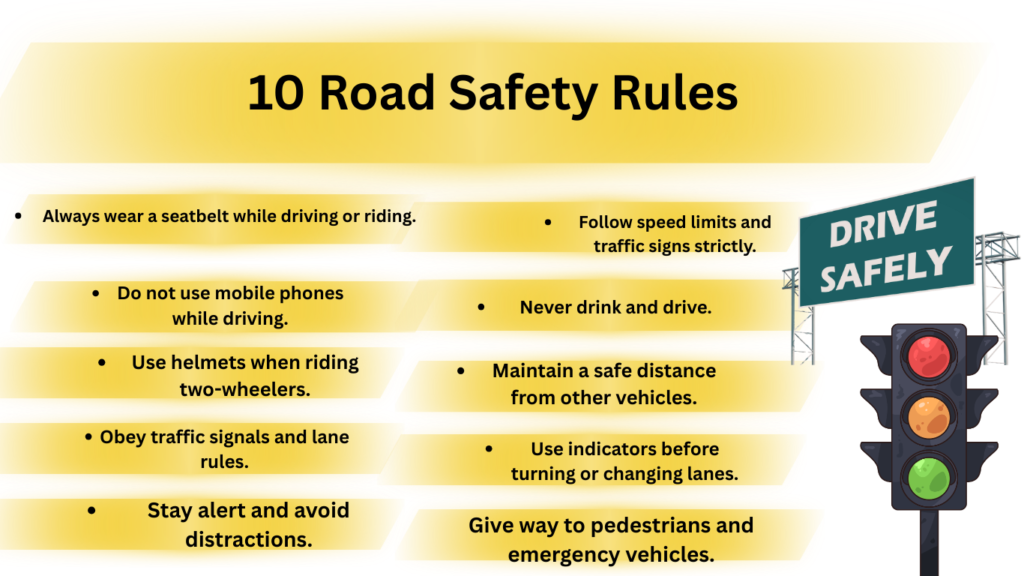
- 10 Important Road safety rules:
- 1. Always wear a seatbelt while driving or riding
- 2. Follow speed limits and traffic signs strictly
- 3. Do not use mobile phones while driving
- 4. Never drink and drive
- 5. Use helmets when riding two-wheelers
- 6. Maintain a safe distance from other vehicles
- 7. Obey traffic signals and lane rules
- 8. Use indicators before turning or changing lanes
- 9. Stay alert and avoid distractions
- 10. Give way to pedestrians and emergency vehicles
- Legal importance
- Summary:
10 Important Road safety rules:
Here’s your list of 10 road safety rules explained in detail, with practical insights on why each rule matters and what can go wrong if ignored.
1. Always wear a seatbelt while driving or riding
Seatbelts are your first line of defense in a crash. They:
- Prevent you from being thrown forward or out of the vehicle
- Work with airbags to reduce injuries
- Distribute impact force across stronger body parts
👉 Without a seatbelt, your body keeps moving due to inertia, which can cause severe or fatal injuries.
2. Follow speed limits and traffic signs strictly
Speed limits are designed based on:
- Road conditions
- Traffic density
- Accident risk zones
Driving too fast:
- Reduces reaction time
- Increases crash severity
👉 Higher speed = more kinetic energy → more damage in accidents.
3. Do not use mobile phones while driving
Using a phone causes:
- Visual distraction (eyes off road)
- Manual distraction (hands off wheel)
- Mental distraction (mind off driving)
Even 2–3 seconds of distraction can lead to serious accidents.
4. Never drink and drive
Alcohol affects:
- Reaction time
- Judgment
- Coordination
👉 Even small amounts can impair driving ability.
This is one of the leading causes of fatal accidents worldwide.
5. Use helmets when riding two-wheelers
Helmets protect:
- Head (most vulnerable part)
- Brain from traumatic injury
👉 A good helmet can reduce the risk of death by ~40–50% in accidents.
6. Maintain a safe distance from other vehicles
Also called the following distance rule.
Why it matters:
- Gives time to react if the vehicle ahead brakes suddenly
- Prevents rear-end collisions
👉 Use the 2–3 second rule (more in rain or at night).
7. Obey traffic signals and lane rules
Traffic signals ensure:
- Smooth flow of vehicles
- Reduced collision points
Ignoring signals can cause:
- Side-impact crashes (very dangerous)
- Traffic chaos
8. Use indicators before turning or changing lanes
Indicators communicate your intention to others.
Without signaling:
- Other drivers cannot predict your move
- Leads to sudden collisions
👉 Always signal a few seconds before turning or changing lanes.
9. Stay alert and avoid distractions
Common distractions:
- Eating while driving
- Talking to passengers
- Adjusting music/navigation
Being alert helps:
- Spot hazards early
- React quickly
10. Give way to pedestrians and emergency vehicles
Pedestrians are the most vulnerable road users.
Always:
- Stop at zebra crossings
- Slow down in crowded areas
For emergency vehicles:
- Move aside immediately
- Do not block ambulances, fire trucks, or police vehicles
Legal importance
In countries like India, these rules are enforced under the
Motor Vehicles Act, with fines and penalties for violations.
All these rules are based on simple principles:
- Reduce risk
- Increase reaction time
- Protect human life
Summary:
Road safety is not just about following rules, it’s about:
- Protecting yourself
- Protecting others
- Preventing avoidable accidents
Other courses:





