
A bad ignition coil can cause a wide range of problems, from hard starting and engine misfires to loss of power and poor fuel economy — and because its symptoms often overlap with spark plug or fuel injector issues, it’s important to understand exactly how to identify it.
Let’s go through this in full detail, step by step — including how ignition coils work, what happens when they fail, and the specific signs you can look for.
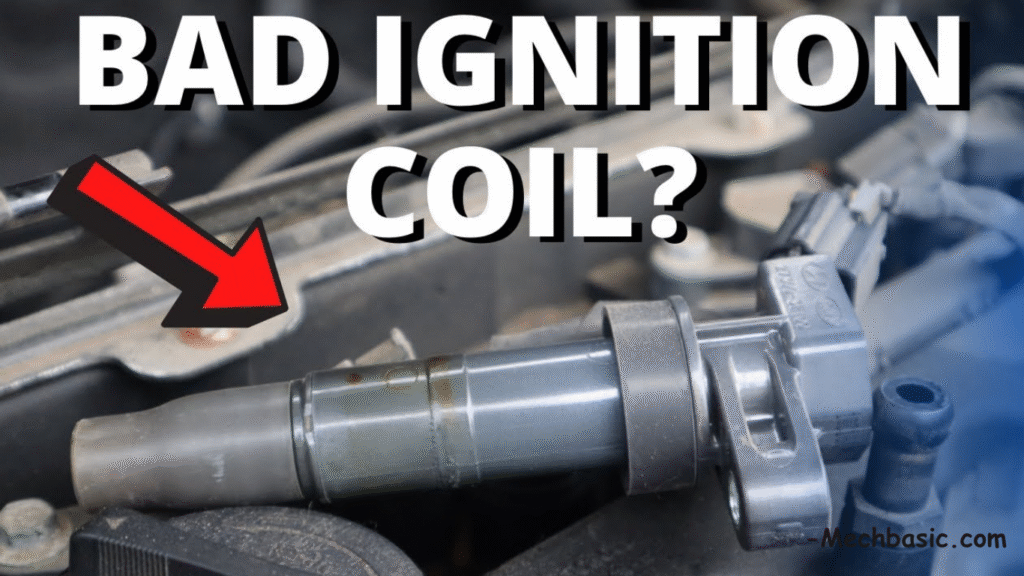
1. What the Ignition Coil Does
The ignition coil is basically a miniature transformer that converts the car’s 12 volts from the battery into 20,000–50,000 volts (or more) — enough to jump the air gap at the spark plug and ignite the air–fuel mixture.
Modern cars may have:
- One coil for all cylinders (older distributor systems),
- One coil per pair of cylinders (waste-spark system), or
- One coil per spark plug (coil-on-plug / COP system).
If any coil fails, that cylinder will not receive spark, and combustion will be incomplete or absent.
2. Common Signs of a Bad Ignition Coil
1. Engine Misfires or Rough Idle
Description:
- Engine shakes, vibrates, or runs unevenly at idle or while driving.
- You may feel jerking or hesitation on acceleration.
Why It Happens:
- The bad coil fails to produce enough voltage for the spark plug → no combustion in one or more cylinders.
- That cylinder contributes no power → engine runs roughly.
Confirming:
- Scan tool shows misfire codes such as P0301–P0306 (indicating cylinder number).
- If misfire moves when you swap coils between cylinders → the coil is the problem.
2. Difficulty Starting or No Start
Description:
- Engine cranks but takes long to start, or doesn’t start at all.
- May start and immediately stall.
Why It Happens:
- Weak or no spark prevents ignition of air–fuel mixture.
- If multiple coils (or the single coil in a distributor system) fail → engine cannot start at all.
Tip:
- A car with one bad coil in a multi-coil setup might still start but run rough.
- A car with one central coil (old system) won’t start if that coil fails.
3. Loss of Power / Poor Acceleration
Description:
- Engine feels sluggish, struggles to climb hills, or hesitates when accelerating.
- Throttle response is delayed or jerky.
Why It Happens:
- Missing or weak spark reduces engine power output.
- ECU may enter “limp” mode to protect the catalytic converter.
4. Decreased Fuel Economy
Description:
- You notice you’re refueling more often, or fuel consumption increases noticeably.
Why It Happens:
- Unburned fuel from misfiring cylinder exits into exhaust.
- ECU adds more fuel trying to stabilize idle, wasting fuel.
5. Check Engine Light (CEL) / Engine Warning Light
Description:
- CEL flashes or stays illuminated.
Why It Happens:
- ECU detects misfire or ignition circuit malfunction.
- Common Diagnostic Trouble Codes (DTCs):
- P0300 – Random/Multiple Misfire
- P0301–P0308 – Misfire in specific cylinder
- P0351–P0358 – Ignition Coil “A–H” Primary/Secondary Circuit Fault
Tip:
- A flashing CEL = severe misfire (raw fuel entering catalytic converter → risk of damage).
6. Backfiring or Popping Noise from Exhaust
Description:
- Loud popping or “bang” from exhaust while accelerating or decelerating.
Why It Happens:
- Unburned fuel from a misfiring cylinder ignites in the exhaust system instead of in the combustion chamber.
- Often accompanied by strong fuel smell.
⚠️ Warning: This can damage the catalytic converter or muffler if left untreated.
7. Strong Fuel Smell from Exhaust
Description:
- Noticeable gasoline odor especially at idle or during misfire.
Why It Happens:
- Faulty coil → incomplete combustion → raw fuel passes into exhaust.
- O₂ sensors detect rich mixture → ECU may reduce injector pulse width → unstable idle.
8. Engine Stalling or Shutting Off Unexpectedly
Description:
- Engine dies suddenly while driving, then restarts after a few minutes.
- May cut out intermittently.
Why It Happens:
- Coil overheats internally and temporarily stops working.
- When cooled, connection reestablishes → engine restarts.
Note:
This is typical of an intermittent open circuit inside the coil windings.
9. Hard Starting in Damp or Rainy Conditions
Description:
- Car struggles to start or runs rough when humidity is high or after rain.
Why It Happens:
- Moisture causes arcing or shorting inside or around the coil.
- Cracked coil housing allows current to leak to ground instead of spark plug.
Tip:
- Inspect coil body at night — you may see tiny sparks (arcing) in the dark.
10. Exhaust Smell of Sulfur (“Rotten Eggs”)
Description:
- A pungent sulfur smell from the exhaust after extended misfiring.
Why It Happens:
- Unburned fuel overheats the catalytic converter → sulfur compounds form.
⚠️ Indicates long-term misfire — replace coil and check catalytic converter condition.
3. Technical Causes of Ignition Coil Failure
| Cause | Description |
|---|---|
| Age & Heat | Continuous exposure to high engine temperatures causes insulation breakdown. |
| Moisture / Oil Leaks | Oil or water entering spark plug wells short-circuits coil. |
| Worn Spark Plugs | Excessive resistance forces coil to work harder → premature failure. |
| Vibration / Poor Mounting | Can damage internal windings. |
| Corroded Connectors | Poor contact leads to intermittent operation. |
| Overvoltage or ECU faults | Voltage spikes damage coil circuitry. |
4. How to Diagnose a Bad Ignition Coil
Basic Methods:
| Method | What to Check | Result |
|---|---|---|
| OBD-II Scan | Misfire or coil circuit codes (P030x / P035x) | Identifies faulty cylinder |
| Swap Test | Swap suspect coil to another cylinder | If misfire moves → bad coil |
| Spark Test | Use spark tester tool on suspect coil | Weak/no spark = bad coil |
| Multimeter Test | Measure coil primary (0.3–1.0Ω) & secondary resistance (5k–15kΩ) | Open or shorted = failed |
| Oscilloscope | Observe coil waveform (if available) | Missing or irregular pattern = bad coil |
5. Difference Between Bad Coil and Bad Spark Plug
| Symptom | Bad Ignition Coil | Bad Spark Plug |
|---|---|---|
| CEL Code | P035x | P030x |
| Swapping Coil Moves Misfire | ✅ Yes | ❌ No |
| Visible Damage | Cracked housing, arcing | Worn electrode, carbon fouling |
| Fuel Smell | Stronger (raw fuel) | Sometimes |
| Rough Idle | Severe, immediate | Gradual, minor |
6. Summary Table — Signs of a Bad Ignition Coil
| Category | Symptom | Why It Happens |
|---|---|---|
| Performance | Rough idle, hesitation, misfire | Weak/no spark on one cylinder |
| Starting | Hard start or no start | Coil not firing spark plugs |
| Power / Fuel | Loss of power, poor mileage | Incomplete combustion |
| Warning Light | Check Engine Light (P030x, P035x) | ECU detects ignition fault |
| Sound / Smell | Backfire, fuel odor, sulfur smell | Unburned fuel in exhaust |
| Intermittent Behavior | Engine dies, restarts later | Coil overheating internally |
| Environmental | Worse in rain/damp | Arcing from cracked coil housing |
7. What to Do if You Suspect a Bad Ignition Coil
- Scan for codes (OBD-II).
- Note the misfiring cylinder (P030x).
- Swap coils to confirm the fault moves.
- Inspect spark plug and wiring (ensure not the real cause).
- Replace coil(s) with high-quality OEM or equivalent units.
- Check for oil leaks (especially valve cover gaskets on coil-on-plug engines).
- Clear codes and test drive.
Other courses:





